
UIT University Eyes Growth and Global Relevance, Says VC Dr. Vali uddin
PAKISTAN
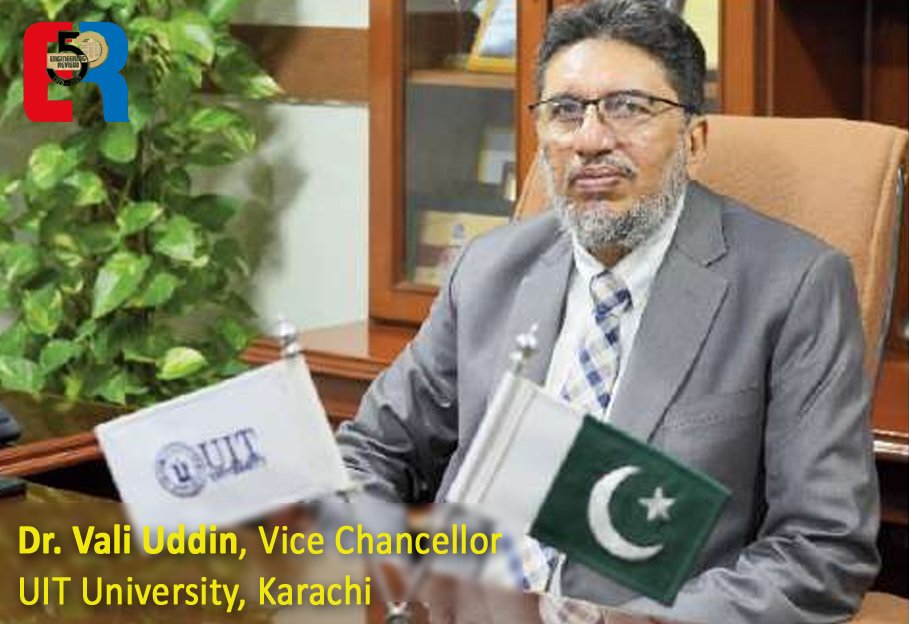
In an exclusive interview with Engineering Review, Dr. Vali Uddin, Vice Chancellor of UIT University, Karachi, shares insights drawn from his rich academic leadership experience across leading institutions including NUST, Iqra University, Hamdard University, and Sir Syed University. Reflecting on UIT’s transformation from a young institute into an emerging university, he discusses how the institution is redefining its academic direction with a strong emphasis on practical learning, industry–academia collaboration, research culture, and emerging technologies. Dr. Vali Din also outlines UIT’s vision for expansion, innovation-driven education, and its evolving role in preparing industry-ready engineers for Pakistan and beyond.
Different shades of universities
I have had the opportunity to work at several institutions—NUST, Iqra, Hamdard, Sir Syed, and now UIT. Every institution has its own culture and environment, along with its strengths and challenges. One thing common to all is their commitment to quality education. If we look at how UIT is different, Hamdard was a large university with many programs, while Sir Syed evolved from an engineering university into a multi-program institution. Everywhere, IT and computing departments are growing rapidly. UIT is different in that it began as a small institute; its first classes started in Spring 2022, and now its first batch is about to graduate. It is transitioning from an institute to a university. With this new direction, our focus is also changing—strengthening research culture, building national and international collaborations, policy-making, and product development—because as a new institution, we must take it forward.
Exploring UIT’s Distinction
UIT’s key advantage has been its strong practical orientation. From the start, students here have been very strong practically alongside theoretical knowledge, and they adapted quickly. Even now, our graduates’ employment ratio is very good. We want to maintain this edge and extend it to new programs we plan to launch, so our graduates meet market requirements fully.
Industry–Academia Collaboration
As you may have seen, participation in industrial events is essential. We want to bring industry closer at multiple levels. We are working at an advanced level with industry on internships and practical exposure. We have also designed the curriculum to engage students with industry, and the third level is engaging faculty. We aim to implement all these within one year.
The Next Level of Industry–Academia Collaboration
We have many industry collaborations and benefit from being located in Karachi. However, much of the local industry consists of production units—except for software houses—where students do not always get deep learning opportunities. There is a lack of homegrown industry. Graduates and faculty are not engaged at the level they should be, which affects growth.
What to Do?
That is why we focused on our core strength. Pakistan’s IC design tape-out was done by UIT students. We identified this area, focused on it, and trained students. To date, nine tape-outs have been completed, and our students are present on all major global IC design platforms. There is strong demand, and real design work is happening. Currently, our students are working on a new quantum computing project acquired from abroad, which has been very successful. We have also formed partnerships for human resource training and will conduct training in Sindh and Balochistan, with roles as designers.
Emerging Technologies and Traditional Engineering Disciplines
Globally, job opportunities for engineers are increasing. IT has developed software, but it must be implemented—whether in robotics, alternative energy, or electric vehicles. A new EV market is emerging, with large projects underway. Engineers are needed everywhere. While we have updated curricula according to requirements, we have not moved fast enough.
Significance of Labs
Another major requirement is laboratories, which are expensive. Labs are needed across disciplines, but when student numbers are low, institutions are reluctant to invest heavily, limiting output. In this area, the government and PEC should consider how they can help.
University Consortium for Joint Use of Labs
I have raised the issue of labs at PEC as well. High-end labs are capital-intensive; therefore, the government or large institutions should invest in them and allow all universities to use them. We need to work according to our local environment and develop policies, rather than only citing international examples.
UIT Expansion
We urgently need more space. Pakistan has a large youth population, and to introduce new programs and variations, work has been done and final approvals obtained. We are constructing a new building of similar size to the existing one, with a target of completion within three years. Currently, we have around 1,600–1,700 students, which will increase to about 3,500.
By Manzoor Shaikh
READ MORE

Govt Moves to Reform Power Sector Regulatory Framework
Federal Minister for Finance and Revenue Senator Muhammad Aurangzeb chaired the first meeting of the…

Apple Appoints Salman Dar as First Head of Government Affairs in Pakistan
Apple has appointed Salman Dar as its first Head of Government Affairs for Pakistan, marking…
From Slide Rules to Artificial Intelligence — An Engineer’s 60-Year Journey
Engr. Farooq Mehboob reflects on six decades of engineering, from manual calculations and slide rules…
Engineering, Public Service and Nation Building: The Journey of Engr. Mukhtiar A. Shaikh
From the classrooms of Dawood Engineering College to leadership roles in public service, industry, and…
Building a Stronger Nation: Tahir Sultan on Engineering, Governance, and Economic Revival
Engineering Review: In the aftermath of the Middle East war, Pakistan’s fault lines and weaknesses…
Anthropic Researcher Resigns Over AI Safety Concerns
An Anthropic researcher has resigned from the artificial intelligence (AI) company, warning that leading AI…