
PAKISTAN – Academia
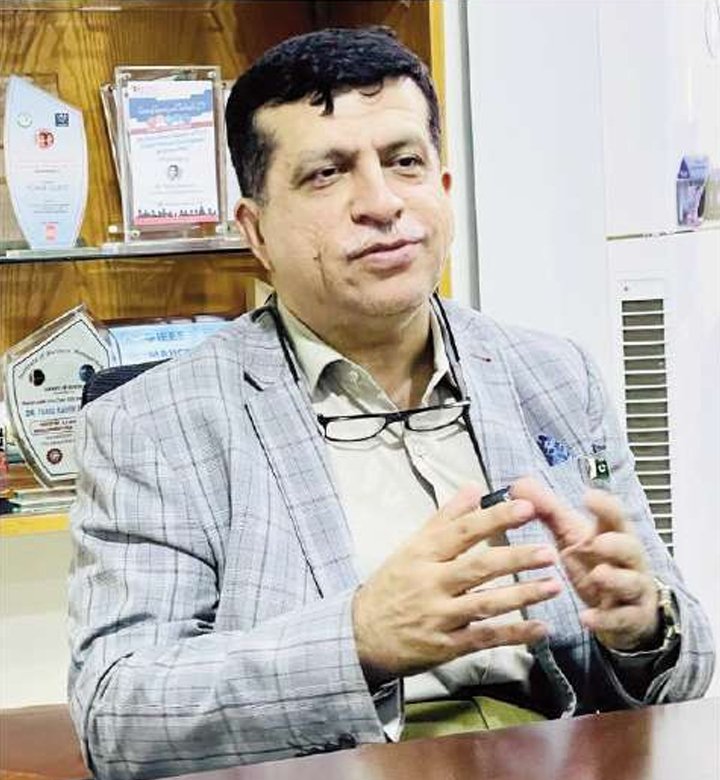
From Rankings to Recognition: Dr. Tariq Soomro on IoBM’s Global Ambitions
By Manzoor Shaikh
In an in-depth conversation with Engineering Review, Dr. Tariq R. Soomro, Rector of the Institute of Business Management (IoBM), Karachi, shares his perspective on university rankings, research impact, international accreditation, and the fast-changing landscape of emerging technologies. Drawing on IoBM’s experience in regional and global ranking frameworks, Dr. Soomro explains how strategic faculty structuring, research focus, and perception management have strengthened the university’s visibility and performance. He also reflects on the challenges of sustaining progress, the importance of impact-driven research over sheer numbers, and the need for thoughtful policies on the use of artificial intelligence in academia, outlining his priorities for IoBM’s next phase of growth.
Ranking of Universities
There are two views on this issue. Some say there is no need for ranking, as alumni and employers would determine where universities stand. Others support the standards on which university standings are ranked.
QS is one of the top rankings and is believed to be prestigious. It impacts universities in terms of admissions, as it determines their standing. Pakistan has a very low number of universities that appear in world rankings. Now, the Asia ranking was introduced in this exercise in 2024. In this ranking, 82 universities from Pakistan appeared. After the Asia ranking, we are more visible than ever. We qualified from the start of this category. We understood the mechanism and fulfilled the parameters. One of the significant parameters is research. Another basis is perception—how other people perceive IoBM. They seek employer lists and talk to them about the university. On the research side, they assess the quantitative aspect of research by looking at numbers. The target is 1,000 publications in three years. This is not possible for every university, given the size of student and faculty populations engaged in research.
QS Ranking Qualification and Our Success
The number of universities appearing in the ranking is not satisfying; more universities should have appeared. Ranking does not happen automatically; universities must submit their evidence. HEC is, in a way, compelling universities to participate in rankings, as it asks about ranking in one of its rubrics.
This is serious work for universities. What we have done is distribute our faculty into four parts, as everybody cannot do everything. We have two kinds of faculty: PhD and non-PhD. We divided PhD faculty into two categories—scholarly academicians and professional academicians. The former focus more on research, while the latter teach more. Earlier, everyone was doing everything, which was difficult. Likewise, we categorized non-PhD faculty as scholarly practitioners and instructional practitioners. Instructional practitioners focus on teaching, while scholarly practitioners engage in some research and funding. We have prepared an excellent framework, appreciated by HEC as well. Since we are moving toward international accreditation, we need to change ourselves. This benefited us as our visibility improved by default.
Research vs Numbers
In Pakistan, one may write 15 papers and become a professor. However, what is important is the impact of the research. Recently, THE discussed impact research based on the SDGs. Each university must cover at least three SDGs, while the fourth must be SDG 17. Another ranking, the Shanghai Ranking, asks at the outset whether any faculty member or student has ever won a Nobel Prize. No Pakistani university qualifies for that ranking. The university from which I earned my PhD had three Nobel laureates.
Next Target as Rector
Sustaining any achievement is a major challenge. In recent Asian rankings, many universities fell in the list and scored lower than before. We have improved and moved upward continuously. First, we aim to move further up the list and enter world rankings. Second, we are now pursuing international accreditation. Some public-sector universities have already done so, and we are also capable. We are going for CCSP accreditation, as we are a business university. Then there are the “three crowns,” a distinction earned by a very small number of universities. Additionally, BGA is another crown, and we are its first member in Pakistan.
Impact of Fast Changes in Emerging Technologies
These technologies are widely used today. Our students use them, including AI tools, for assignments, and we are experienced enough to understand this. Using these tools is not wrong; not acknowledging them is. We need to change the perspective that failing to mention the use of AI tools is inappropriate. These tools should be used positively, but we may have stopped thinking independently. Young people have started relying heavily on these tools, which is a real concern. We need to formulate a policy.
Publised in ER Jan 16-31, 2026
READ MORE

Govt Moves to Reform Power Sector Regulatory Framework
Federal Minister for Finance and Revenue Senator Muhammad Aurangzeb chaired the first meeting of the…

Apple Appoints Salman Dar as First Head of Government Affairs in Pakistan
Apple has appointed Salman Dar as its first Head of Government Affairs for Pakistan, marking…
From Slide Rules to Artificial Intelligence — An Engineer’s 60-Year Journey
Engr. Farooq Mehboob reflects on six decades of engineering, from manual calculations and slide rules…
Engineering, Public Service and Nation Building: The Journey of Engr. Mukhtiar A. Shaikh
From the classrooms of Dawood Engineering College to leadership roles in public service, industry, and…
Building a Stronger Nation: Tahir Sultan on Engineering, Governance, and Economic Revival
Engineering Review: In the aftermath of the Middle East war, Pakistan’s fault lines and weaknesses…
Anthropic Researcher Resigns Over AI Safety Concerns
An Anthropic researcher has resigned from the artificial intelligence (AI) company, warning that leading AI…