
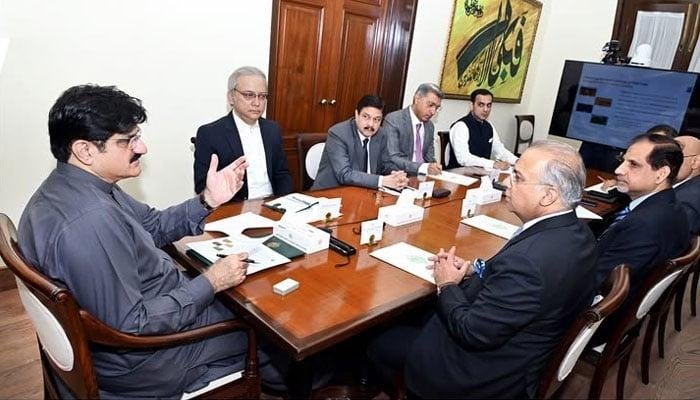
Sindh Chief Minister Syed Murad Ali Shah has reaffirmed his government’s commitment to attracting domestic and international investment in the province’s extensive mineral resources, describing the sector as a major opportunity to accelerate industrialization, strengthen energy security, create employment and generate sustainable economic growth.
Presiding over a high-level meeting at the CM House, the Chief Minister reviewed the province’s coal and non-coal mineral potential, ongoing mining operations, infrastructure requirements and opportunities for future investment. Minister for Mines and Minerals Syed Sardar Shah briefed the meeting on the province’s geological resources, existing projects, investment prospects and the government’s plans for sustainable mineral development.
Murad Ali Shah said Sindh possessed considerable mineral wealth that could play a transformative role in the provincial and national economy if explored and utilized through scientific methods, modern technologies and responsible mining practices.
He emphasized that the government’s objective was not limited to extracting raw minerals but also included establishing processing and manufacturing industries to increase the value of natural resources, generate skilled employment and expand export opportunities.
Thar coal: A major energy and industrial opportunity
Thar coal remains the most significant component of Sindh’s mineral wealth. According to the briefing, the Thar coalfield contains estimated reserves of 175 billion tones, offering substantial potential for indigenous energy production and industrial development.
The presentation also highlighted an estimated energy equivalent of 50 billion tones of oil equivalent (TOE) and coal-related gas-equivalent resources of approximately 2,000 trillion cubic feet (TCF).
The Chief Minister reviewed the progress and operational capacity of two major coal mining and power generation projects established under the China-Pakistan Economic Corridor (CPEC) early harvest program.
The first is the Sindh Engro Coal Mining Company (SECMC), established under a public-private partnership arrangement. The company has an annual coal mining capacity of 11.2 million tones and supports power generation of 1,980 megawatts.
The Sindh government holds a 54.7 per cent stake in the company, while Engro and its associates own the remaining 45.3 per cent. The provincial government has invested Rs12.9 billion in equity. The second major project is Sino-Sindh Resources Limited (SSRL), established with Chinese investment. It has an annual mining capacity of 7.8 million tones and power generation capacity of 1,320 megawatts.
The project represents private investment exceeding $2.6 billion. These projects are also contributing to reducing dependence on imported coal, helping save foreign exchange and strengthening the country’s capacity to utilize indigenous energy resources. Opportunities beyond coal While Thar coal dominates the province’s mineral development landscape, Sindh has considerable investment potential in several other minerals that could support construction, manufacturing, steel production and export-oriented industries.
According to the Mines and Minerals Department, important mineral deposits include granite, iron ore, marble, limestone, Celestine, China clay, silica sand and lake salt. Granite deposits in Nagarparkar, district Tharparkar, offer opportunities for the development of dimension stone industries, decorative products and modern cutting and polishing facilities.
Establishing processing units near mining locations could help increase the commercial value of these deposits. Iron ore deposits in Thatta, Jamshoro and Tharparkar present opportunities for further exploration, mineral beneficiation and the development of steel-related industries.
Similarly, marble deposits in Thatta and Jamshoro could support the production of finished stone products, while limestone reserves across Khairpur, Dadu, Jamshoro, Sukkur, Hyderabad, Thatta and Karachi could provide raw material for cement manufacturing and construction industries. Other identified opportunities include celestite in Jamshoro, China clay in Tharparkar, silica sand in Jamshoro and Thatta, and lake salt deposits in Dadu, Sanghar and Tharparkar.
These resources offer potential for investment in processing, refining, manufacturing and the production of value-added goods. The Chief Minister directed the relevant authorities to facilitate investors interested in developing these sectors, stressing that local processing and manufacturing would generate greater economic benefits than exporting unprocessed minerals. Responsible mining and community development The meeting also examined the social and environmental responsibilities associated with mineral development, particularly in areas where mining activities directly affect local communities.
The Mines and Minerals Department highlighted the social development initiatives undertaken alongside the Thar coal projects, including employment generation, healthcare, education, clean drinking water and community infrastructure. Under Thar Coal Block-I, approximately 5,000 jobs have been generated, with nearly 97 per cent of the workforce belonging to Sindh. The briefing also reported more than 20,000 direct local employment opportunities cumulatively during project development and implementation. Community initiatives include a 250-bed hospital in Islamkot, healthcare facilities, reverse osmosis (RO) plants and technical training programs designed to equip local youth with skills required by the mining and energy industries.
Under Block-II, approximately 2,350 local people are employed through SECMC-related operations. Around 94 per cent of the workforce comes from Sindh, including 60 per cent from Thar. The project also supports seven medical facilities providing free healthcare services and operates 33 reverse osmosis plants to supply clean drinking water to surrounding communities. Environmental initiatives were another important component of the briefing. These include the plantation of more than 1.3 million trees under the Thar Million Tree Program, water treatment and reuse, biodiversity conservation, bio-saline agriculture and progressive land rehabilitation.
Murad Ali Shah stressed that mineral development must not come at the expense of environmental protection or community interests. He called for strict compliance with environmental standards, occupational health and safety regulations and appropriate arrangements for communities affected by mining activities, including resettlement where necessary. Infrastructure and new investment avenues The meeting also reviewed infrastructure requirements for expanding mining operations, particularly road connectivity, water supply and transportation facilities. The proposed Thar Rail Connectivity Project, a joint venture between the federal and Sindh governments, was discussed as an important initiative to improve the transportation of coal from Thar to industrial centres across the country.
The railway link is expected to provide more efficient access to national markets and facilitate the wider utilization of indigenous coal by power plants and other industries. The briefing also identified opportunities for alternative utilization of Thar coal, including coal briquetting and coal-to-urea production.
These initiatives could open new avenues for industrial investment while supporting agricultural inputs, food security and foreign exchange savings. To facilitate prospective investors, geological and exploration data are available, while 12 blocks have been developed following detailed drilling activities.
Government promises investor-friendly environment Concluding the meeting, the Chief Minister reiterated that Sindh was open to domestic and international investment in its mineral sector. He encouraged strategic partnerships, joint ventures, technology transfer and the adoption of modern mining practices.
He directed the relevant departments to ensure transparent regulations, competitive investment opportunities, efficient administrative procedures and strong institutional support for investors. The government, he said, wanted to transform Sindh’s mineral resources into a foundation for long-term economic development, industrial expansion, employment generation and improved living standards. He maintained that the success of the province’s mineral development strategy would ultimately depend on balancing investment and commercial activity with environmental sustainability and the protection of communities living in resource-rich areas. – ER
Appeared in ER Nov, 2026, Issue II
READ MORE
Engr. Abbas Sajid Appointed ASHRAE RAL Regional Lecturer
Pakistani HVACR professional to contribute to technical knowledge-sharing and professional development across ASHRAE’s Region-at-Large Engr….
Pakistan, Spain Agree to Strengthen Cooperation in Agriculture and Water Management
Pakistan and Spain have agreed to expand cooperation in agriculture, with a particular focus on…

Padel Super League 2026 on 18, 19 and 20 December 2026
Karachi is set to witness an exciting blend of sports and business networking as Padel…
Pakistan’s Textile Export Competitiveness Hinges on Green Supply Chains and Digital Transformation
Pakistan’s textile and apparel industry must accelerate its transition towards environmentally responsible supply chains, digital…
NED Career Fair 2026: Leading Orgs. under One Roof to Strengthen IA Linkages
The Directorate of Industrial Liaison (DIL), of NED University of Engineering & Technology, successfully organized…
Sindh Seeks Investment in Vast Mineral Wealth to Drive Industrialisation and Economic Growth
Sindh Chief Minister Syed Murad Ali Shah has reaffirmed his government’s commitment to attracting domestic…