
CLIMATE CHANGE
BELEM, Brazil: Pakistan has told the UN climate leadership that its ability to deliver on its enhanced emissions-reduction pledge—cutting 50% of national emissions by 2035—depends squarely on the availability of US$565 billion in international climate finance, a requirement the country says remains largely unmet.
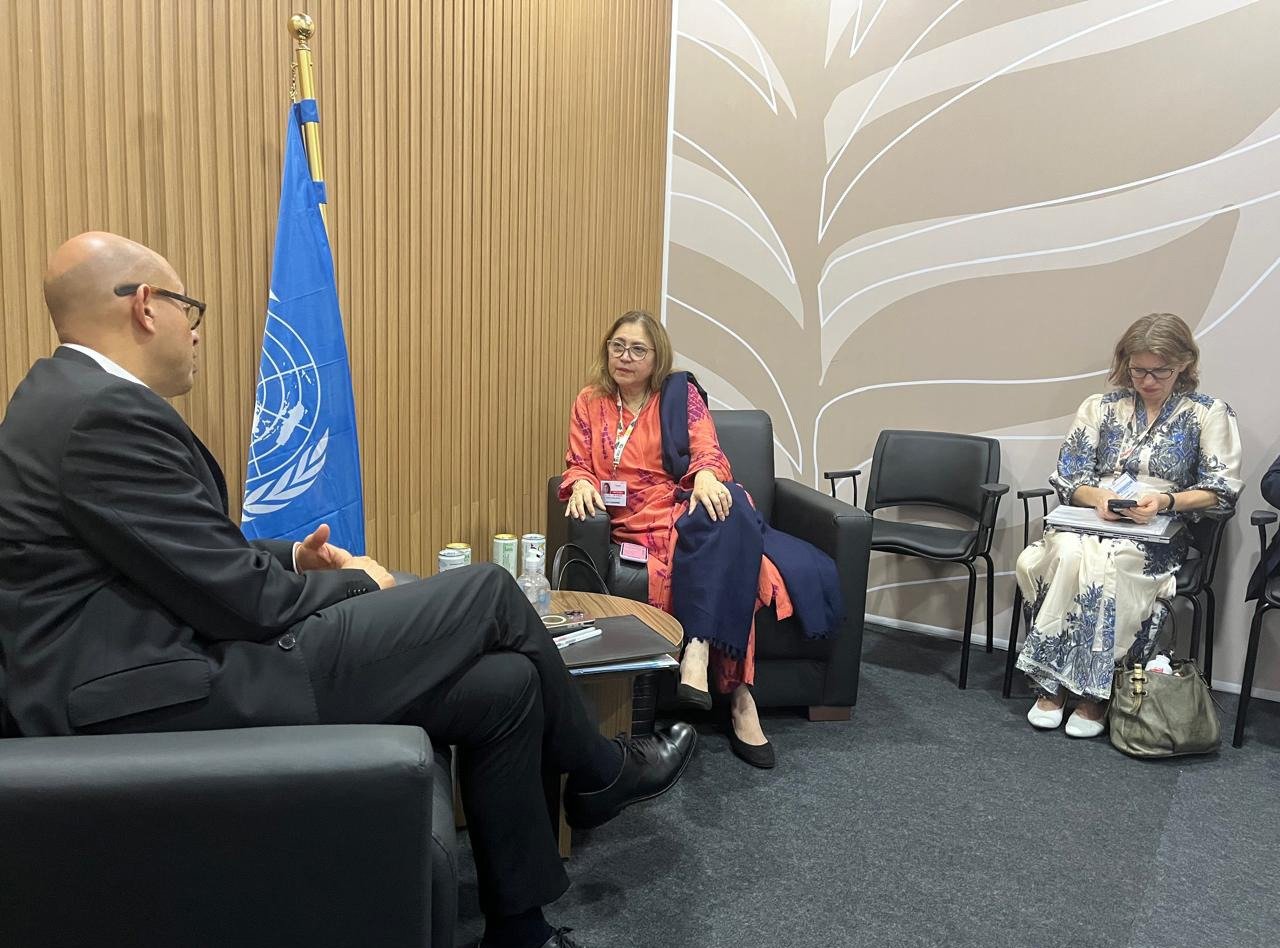
This was the key message shared by Ms. Aisha Humera Chaudhry, Pakistan’s Head of Delegation to COP30 and Secretary, Ministry of Climate Change & Environmental Coordination (MoCC&EC), during a high-level bilateral meeting with Mr. Simon Stiell, Executive Secretary of the UNFCCC.
Held on the sidelines of the UN Climate Summit (COP30) in the Amazonian city of Belem, the meeting reviewed Pakistan’s climate commitments and the broader COP30 negotiation agenda, according to an official statement.
Ms Chaudhry informed the UNFCCC chief that Pakistan submitted its updated Nationally Determined Contribution (NDC 3.0) in September 2025, laying out an enhanced mitigation pathway to 2035. She said Pakistan has already increased its domestically financed mitigation contribution from 15% to 17%, demonstrating its commitment to global climate goals.
However, she stressed that Pakistan cannot meet the remaining 33% of its mitigation ambition without large-scale international support. “Pakistan’s full 50% emissions-reduction target is contingent on climate finance of US$565 billion by 2035,” she said. “While Pakistan continues to submit NDCs and Biennial Transparency Reports on time, the promised international support has not materialised at the scale required.”
She added that the financing gap is undermining collective progress toward limiting global temperature rise to 1.5°C, and called for urgent delivery of climate finance, technology transfer, and deeper international cooperation.
Mr Stiell appreciated Pakistan’s timely NDC submission and sought clarity on its expectations from COP30. Ms Chaudhry emphasized that Adaptation must be elevated to the same level of priority as Mitigation, particularly for climate-vulnerable countries. Even a tripling of global adaptation finance, she said, would still fall short given the extremely low baseline.
Highlighting Pakistan’s fragile Hindukush–Karakoram–Himalaya ecosystem—home to more than 13,000 glaciers—she briefed the UNFCCC chief on Pakistan’s efforts to draw global attention to rapidly accelerating glacier melt, repeated GLOF incidents, and the devastating 2025 floods. She also invited UNFCCC leadership to next year’s Cross-Regional Glacier Resilience Summit in Pakistan.
The meeting concluded with Pakistan reiterating the need for grant-based, accessible climate finance, including fulfilment of commitments under the Loss and Damage Fund, and urging more responsive UNFCCC financial mechanisms to support NAPs, NDC implementation, and resilience-building programmes. – PID/ER
MORE NEWS
Pakistan, Netherlands Explore Expanded Energy Cooperation
PAKISTAN Federal Minister for Petroleum Ali Pervaiz Malik held a meeting with H.E. Robert Jan…
Proposal to Establish Blue Economy Sectoral Council to Boost Exports
PAKISTAN Rana Ihsaan Afzal Khan, Coordinator to the Prime Minister on Commerce, held a meeting…

Pakistan raises climate concerns at Arctic Circle Rome Forum
WORLD Federal Minister for Climate Change Musadik Masood Malik represented Pakistan at the Arctic Circle…

OGDCL, PPL Announce Oil and Gas Discovery at Baragzai X-01 Well
PAKISTAN Oil and Gas Development Company Limited (OGDCL) and Pakistan Petroleum Limited (PPL) have announced…

Supernet Announces CEO Change, Jamal Nasir Khan Appointed as New Chief Executive
PAKISTAN Supernet Limited has announced a change in its top management, informing the Pakistan Stock…

Building Future with Tech-Skilled Youth
By Ramesh Raja Sindh, with its rich cultural heritage and industrious population, is home to…
Leave a Reply