
PAKISTAN
By Ramesh Raja
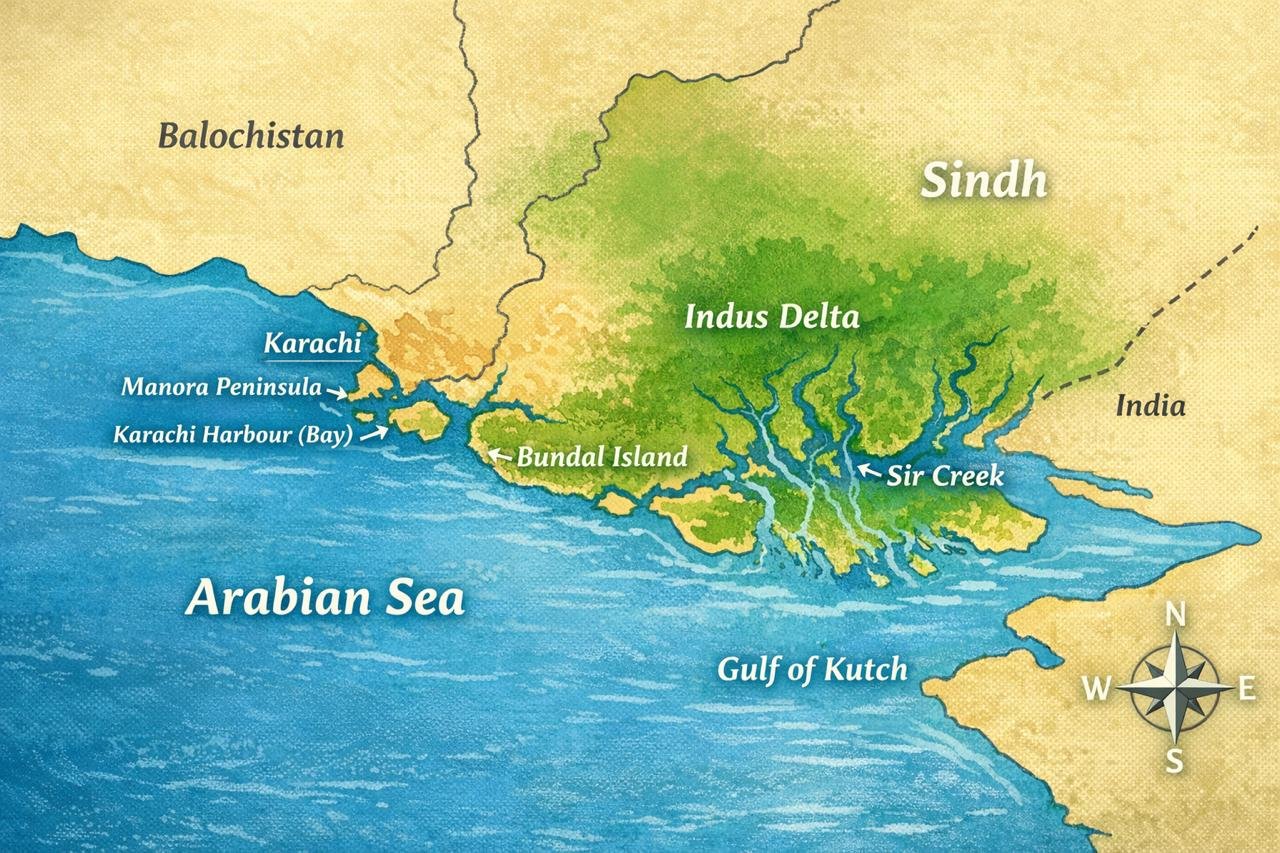
Sindh, with its strategic location along the Arabian Sea, has historically been a hub of maritime trade, cultural exchange, and economic activity. Its coastline stretches from Karachi to the Indus Delta, encompassing important geographical features such as Manora Peninsula, Bundal Island, Kharo Creek, Sir Creek, and Keti Bandar. These natural formations have not only shaped the region’s ecology but have also provided opportunities for ports, fisheries, and trade that continue to fuel Sindh’s economy.
1. Oceans, Seas, and Regional Connections
Globally, there are five major oceans; Pacific, Atlantic, Indian, Southern, and Arctic; covering 71% of Earth’s surface. Sindh lies along the Arabian Sea, part of the Indian Ocean, linking it to critical international maritime routes. Other regional seas in the Indian Ocean include the Red Sea, Bay of Bengal, Andaman Sea, Laccadive Sea, and Java Sea. These waters have historically enabled Sindhi merchants to trade with Arabia, East Africa, and South-East Asia.
2. Legal Framework and Maritime Rights
Under UNCLOS (1982):
• Territorial Sea (0–12 nm): Full sovereignty; foreign ships may pass under “innocent passage” rules.
• Contiguous Zone (12–24 nm): Limited coastal control over customs, immigration, and pollution.
• Exclusive Economic Zone (EEZ, 12–200 nm): Coastal states control resource exploitation; foreign ships can navigate freely but need licenses for fishing, drilling, or mining.
• High Seas (>200 nm): Open to all, governed by international law.
Ships passing through Sindh’s waters do not pay passage fees, except for port services or resource usage.
3. Geography and Water-Land Ratio
The Earth’s total surface is approximately 510 million km², with 71% covered by water and 29% by land. This underscores the dominance of oceans and seas in shaping global climate, trade, and human settlement. Sindh’s coastal belt, though modest compared to the global oceans, holds significant strategic and economic importance. The region’s creeks, bays, lagoons, and deltaic channels serve as natural harbors, fishing grounds, and ecological buffers. Sindh’s major coastal features include:
• Manora Peninsula: Protects Karachi Harbour and serves as a natural breakwater.
• Karachi Harbour: A natural bay, forming the economic lifeline of Pakistan.
• Bundal Island: Part of the Indus Delta, with strategic potential for maritime development.
• Kharo and Sir Creeks: Tidal waterways separating Sindh from India, rich in mangroves and fishery resources.
• Indus Delta: A complex network of tidal channels, lagoons, and wetlands supporting biodiversity and fisheries.
4. Historical Maritime Trade
Sindh has a rich maritime heritage:
• Ancient ports such as Debal, Lahari Bandar, and Barbarikon were central to trade with Mesopotamia, Persia, and the Roman world.
• Greek and Arab travelers recorded Sindh’s navigable delta and vibrant commerce.
• Riverine trade via the Indus River connected inland cities like Sukkur, Rohri, and Kotri to the sea, enabling export of cotton, grains, and textiles.
• Sindhi Hindus before partition operated private shipping companies, contributing to regional trade across the Indian Ocean.
• Poetry by Shah Abdul Latif Bhittai reflects Sindh’s seafaring culture, highlighting the historical significance of maritime activity.
5. Economic Importance of Sindh’s Seas
Seas and oceans are the lifelines of Sindh’s economy:
a) Trade & Ports:
– Karachi Port and Port Qasim handle the majority of Pakistan’s imports and exports.
– Approximately 90% of Pakistan’s international trade moves by sea.
b) Fisheries & Aquaculture:
– Coastal communities depend on the Indus Delta and Arabian Sea for protein-rich seafood.
– Fisheries contribute hundreds of millions of dollars annually in revenue.
c) Energy Resources:
– Offshore oil and gas exploration is ongoing along Sindh’s coastline.
– Potential for renewable energy through offshore wind and tidal projects.
d) Marine Industries:
– Shipbuilding, repairs, and shipbreaking at Gadani, Balochistan, provide employment and industrial growth.
6. Strategic and Security Significance
Sindh’s coastal waters are vital for national defense and sovereignty:
• Naval bases in Karachi safeguard maritime borders.
• Access to the Arabian Sea gives Pakistan geopolitical leverage along global trade routes.
• Creeks like Sir Creek are strategically important for border control and resource management.
7. Environmental and Social Importance
• Ecological Services: Mangroves, lagoons, and tidal wetlands support biodiversity and mitigate floods and storms.
• Climate Regulation: Coastal waters influence rainfall and temperature patterns.
• Society & Culture: Millions rely on the sea for employment, tourism, and cultural practices. Beaches like Hawksbay and Sandspit attract local and international visitors.
8. Global Maritime Transportation
• Maritime transport dominates global cargo movement (80–90% by tonnage).
• Road (7–10%) and rail (5–7%) handle regional trade.
• Air (<1%) is mainly for high-value goods.
• Sindh’s ports are thus central to national and regional connectivity.
9. The Blue Economy: Global Trends and Sindh’s Opportunity
The blue economy refers to the sustainable use of ocean resources for economic growth, improved livelihoods, and ocean ecosystem health. Globally, countries are focusing on:
• Sustainable fisheries and aquaculture to prevent overfishing.
• Renewable offshore energy such as wind, wave, and tidal power.
• Marine biotechnology for pharmaceuticals and industrial products.
• Maritime tourism and eco-tourism.
• Pollution control and marine conservation to protect ecosystems.
Sindh can leverage these global trends by:
i. Expanding sustainable fisheries in the Indus Delta and offshore areas.
ii. Developing renewable energy projects along the coast (wind, tidal, and solar-maritime hybrid systems).
iii. Promoting maritime tourism at Karachi beaches, islands, and historical ports.
iv. Enhancing port infrastructure and shipbuilding industries at Karachi and Keti Bandar.
v. Strengthening environmental laws and marine monitoring to ensure clean and productive seas.
vi. Encouraging research and innovation in marine biotechnology and aquaculture.
By aligning with the global blue economy, Sindh can transform its maritime resources into sustainable economic growth, ecological stability, and strategic influence.
Engr. Ramesh Raja is a civil engineer and managerial/ planning professional who also contributes as a freelance writer on technical matters. He may be reached at engineer.raja@gmail.com
READ MORE
Sindh’s Seashore: Opportunity to Modernise Blue Economy
PAKISTAN By Ramesh Raja Sindh, with its strategic location along the Arabian Sea, has historically…

Sukkur Barrage Modernisation: CM Reviews Year-3 Progress, Orders Swift Completion
PAKISTAN – Sindh Sindh Chief Minister Syed Murad Ali Shah on Thursday reviewed the third-year…

Larry Summers Steps Down from Harvard Teaching Role Amid Epstein Links
PAKISTAN Former US Treasury secretary Larry Summers resigned from his teaching post at Harvard University…

Pakistan’s Citi Pharma Enters Real Estate Investment Sector with New Subsidiary
PAKISTAN Citi Pharma Limited has announced that the Securities and Exchange Commission of Pakistan (SECP)…
Agriauto Industries Limited Posts Strong Turnaround as Auto Sector Gains Momentum
PAKISTAN Agriauto Industries Limited (AGIL) has reported a strong financial turnaround for the six months…

Sindh High Court Sanctions Merger of Supernet Limited into Supernet Technologies
PAKISTAN Telecard Limited has informed the Pakistan Stock Exchange (PSX) that the Honourable High Court…