


Engr. Al Kazim Mansoor, Head of Soilmat Engineers, shares the reasons why Pakistani engineering companies are unable to benefit from the construction industry boom in countries around Pakistan. These views were expressed in an interview with Engineering Review.
Talk of Improving Pakistan’s Economy & the Ground Reality
The question is: from which point in time are we making the comparison? If we compare today with the situation two to two-and-a-half years ago, there is some improvement. There is relative stability: the dollar has stabilized, and the interest rate has come down from 22 percent to 12 percent. However, the real question is whether this improvement is sufficient. If we continue to move forward at this pace, we will not reach a desirable level.
Our GDP growth is around 3 percent; even if it increases to 3.5 percent, it is still inadequate. In the past, Pakistan did experience higher GDP growth at times, but that growth was import-led, which later resulted in foreign exchange crises. Currently, over the last two to two-and-a-half years, foreign borrowing has not increased, which has suppressed GDP growth.
India’s GDP growth is around 8 percent, while Pakistan’s is about 3 percent. Pakistan’s population growth is 2.3 percent compared to India’s 1.9 percent. Bangladesh’s growth stands at 5–6 percent. This means that if our GDP grows by 3 percent while population grows by 2 percent, real GDP growth is only 1 percent. At this rate, it is unclear when we will reach an acceptable level. At present, there is stability, but growth remains stagnant—not only in the construction industry but in other sectors as well.
Some people point to the stock exchange as a positive sign. For example, when Nawaz Sharif’s government ended, the stock index was around 55,000 points and the dollar was at Rs100. Now the dollar is around Rs300, so in real value terms the index is effectively the same. Over the past 7–8 years, nothing substantial has changed. If we look at market capitalization in dollar terms, there has been no significant increase.
Construction Industry as a Barometer
This sector must be closely examined by looking at the number of projects and their value. It can also be judged through cement and steel consumption. There has been some improvement, but there is no marked difference. In other words, there is no significant growth in this sector.
How to Create a Boom in the Construction Industry: Constraints
First of all, the government must take the initiative. In the past, our economy leaned heavily toward speculation. For instance, investing in plots yielded higher returns than investing in industry, where profits were around 15–20 percent annually. That situation has now slowed, largely due to taxation, and plots are mostly being purchased only by those with real need. Investment in real estate has declined.
During a major depression in the United States, when growth had fallen to zero, the government took the initiative to build interstate highways. Government spending revived industry, with both direct and indirect impacts across the economy. At the time, a British journalist wrote that while Britain built roads from one city to another, Americans “built roads from nowhere to nowhere.” As a result, roads were constructed, transportation expanded, and economic activity took off.
Will Punjab’s New Housing Projects Help? What About Similar Projects?
Unfortunately, the situation in Sindh is far worse than in Punjab. The output here is extremely poor. If Punjab invests Rs100 billion, the results are visible; investing the same amount in Sindh yields very different outcomes. Corruption is higher in Sindh. Look at projects in Karachi—for example, the University Road project. It is a bus corridor project, yet only about 30 percent has been completed in five years. In Punjab, similar projects are completed within 18 months.
There is clearly a driving force there that is missing here. I have full confidence in Chief Minister Murad Ali Shah—he is educated and capable—but implementation is not visible. Contractors are the same everywhere. In Lahore, underpasses are built in a matter of weeks—18, 24, or 30 weeks. Here, projects simply drag on.
New Technologies, Faster Communication, and Our Engineering Firms
In my view, the quality of engineering companies is deteriorating. Twenty years ago, and even earlier during the Bhutto or Zia-ul-Haq eras, Pakistani companies used to secure projects in Saudi Arabia, Iran, and the UAE. Pakistanis built airports and executed many major projects. Today, companies from those countries come here to take work. This means we have not kept pace with global developments.
We no longer have the capacity to go abroad and secure construction projects. One major reason is that government-owned companies such as FWO and NLC have been given a free hand. For example, when a private contractor bids for a Rs1 billion project, they must provide a 2 percent bid bond and a 10 percent performance bond, amounting to Rs100 million. Banks provide guarantees with great difficulty. Additionally, for a 10–15 percent mobilization advance, another bank guarantee is required. In total, around Rs270 million is needed before work even begins.
In contrast, organizations like FWO can arrange everything with a single letter. These entities do not operate on the same financial footing as private companies. As a result, only well-established private firms survive, while smaller ones fall behind.
During discussions on CPEC projects, joint ventures were often mentioned. A Chinese company once explained that the Multan–Sukkur Motorway was worth Rs400 billion. If a Pakistani company were involved, it would need to contribute Rs120 billion, along with a performance bond of Rs12 billion. No Pakistani company can provide such a bond. Consequently, large projects go either to foreign companies or to government-owned companies. These government entities then subcontract work to local firms, which prevents local private companies from growing.
Is There Any Way Out?
These issues have been discussed at various forums. However, nothing will change unless the government takes firm decisions. FWO was originally established to work in frontier areas, yet now it operates across all sectors. NLC was created for transportation purposes, but its role has expanded far beyond that.
There is also deterioration in the consulting sector, largely due to brain drain. When I graduated in the 1980s, out of a batch of 180 students, only 18–20 went abroad for master’s degrees. Of those, 6–7 stayed abroad and 10–12 returned. Today, if 20–25 graduates go abroad, 24 stay there, and perhaps one returns due to personal constraints.
The young workforce is leaving Pakistan, and the boom in the Middle East further attracts talented individuals abroad. As a result, the consulting sector is also being affected, and I do not see any meaningful improvement. – By Manzoor Shaikh
WATCH THE INTERVIEW
READ MORE

Industry 5.0 and Green Engineering: Human-Centric Sustainable Production
INDUSTRY 5.O Industry 5.0 redesigns the production architecture in order to place human beings at…

Navigating the Future of Careers in Pakistan in the AI Era
AI ERA By Prof. Dr. Tariq Rahim Soomro, SMIEEE We rode the wave of freelancing…

US–Israel–Iran War: Where Does Pakistan’s Food Security Stand?
FOOD SECURITY By Manzoor Shaikh For now, doomsday scenario such as a full-scale escalation involving…

A Milestone Achievement in 5G Railway Communication Research
INTERBATIONAL COLLABORATION Mehran University of Engineering & Technology (MUET) proudly announces the successful completion of…

Where does Pakistan stand in unprecedented surge of AI, emerging technologies?
TECHNOLOGY CEO Rastek Technologies, Engr. Rafik Ahmed Lakhani, in a conversation with ER, explained how…
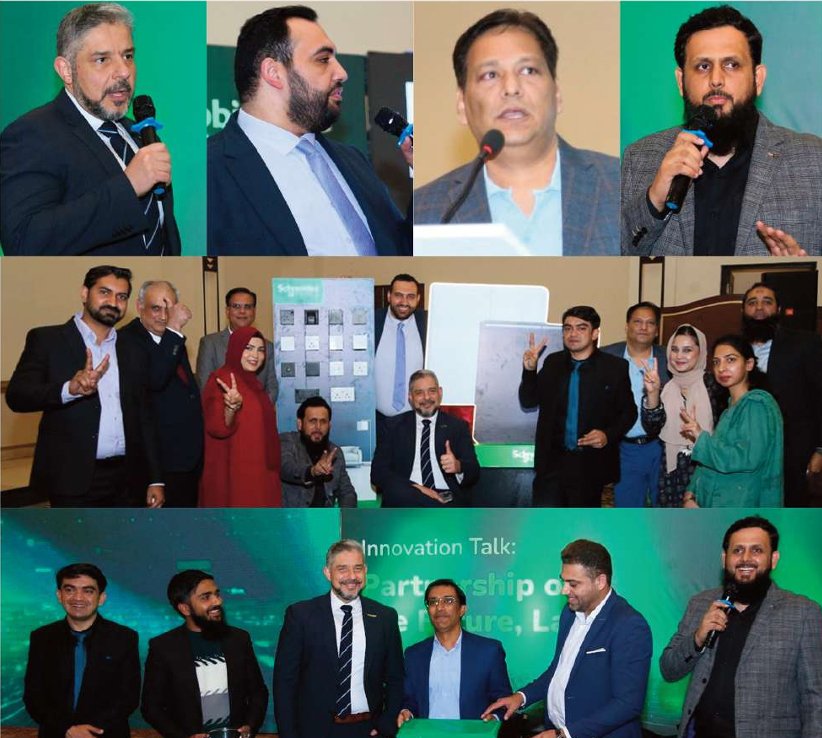
Advancing Energy, Digital Transformation: Schneider Electric Hosts Future Partnership
ENERGY Schneider Electric Pakistan hosted Partnership of the Future – Lahore, bringing together contractors, consultants,…
Leave a Reply