
Engr. Fahim I. Siddiqui reflects on five decades of engineering, lifelong learning, technological transformation, and the values that define a successful engineer.
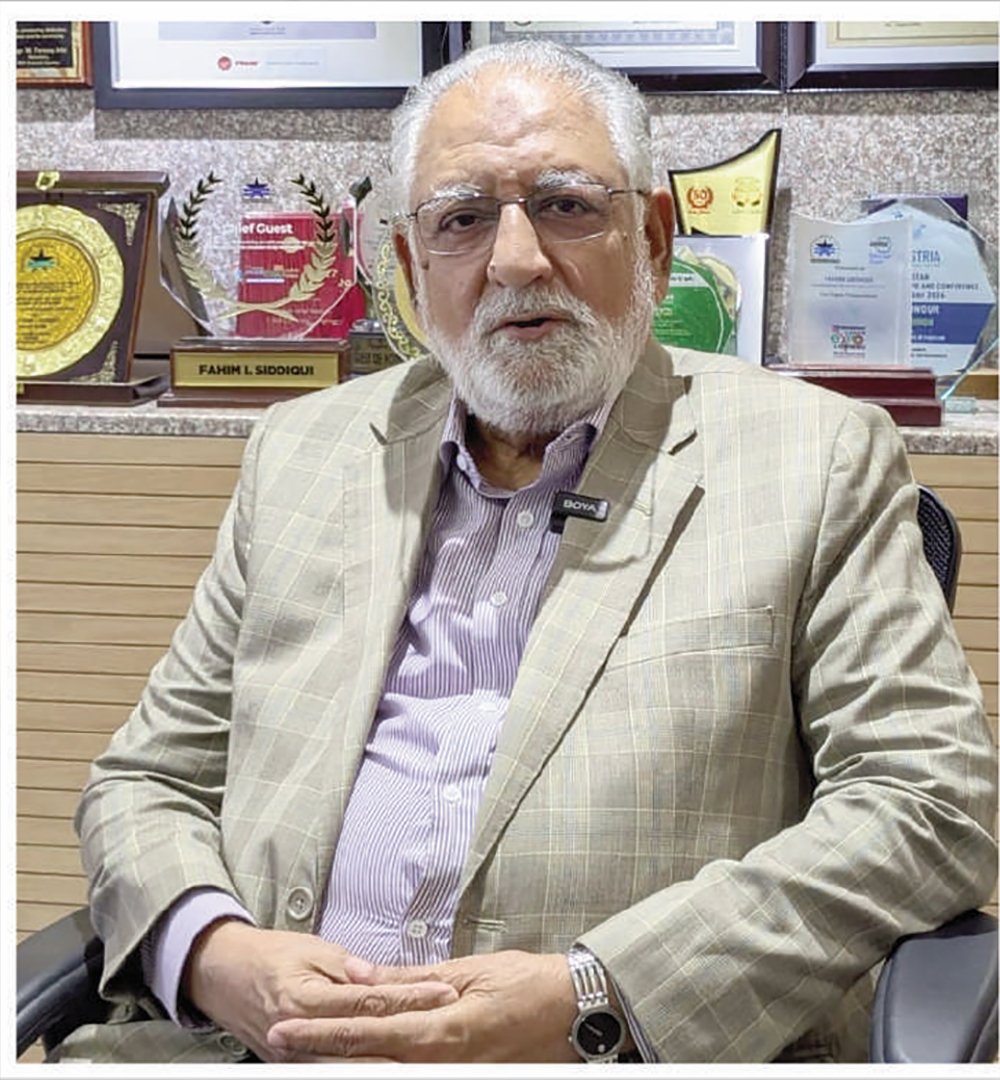
THE INTERVIEW
ER: You graduated in engineering and entered the profession during a very different era. People of your generation often say they were fortunate to witness remarkable changes over their lifetime. What was the engineering profession like when you started your career? Tell us about your journey into engineering and your early professional life.
Engr. Fahim Siddiqi:
My journey has been quite long and extraordinary because I have witnessed tremendous changes—not only in engineering but in life itself. I often say that I belong to a generation that has seen everything from oil lamps and trams to artificial intelligence and virtual reality. However, when I look ahead to the next ten years, if life gives me the opportunity, I believe that journey will be even more exciting.
My family lived in East Pakistan because my father was associated with the jute industry. We were six brothers and one sister, all living in Dhaka. I completed my schooling there, but after the 1971 war, our family became prisoners of war for nearly 22 months. We were repatriated to Pakistan towards the end of 1973, and we had to rebuild our lives from scratch.
As soon as I arrived in Karachi, I joined NED University. I had already completed most of my engineering studies in East Pakistan and was in my final year in 1971, but because of the war, I had not touched a textbook for almost three years. I immersed myself in my studies, often studying for 18 hours a day. When the results were announced, I secured third position in theory and fifth position overall.
That achievement reflected both the strong engineering education I had received in East Pakistan and my determination to rebuild my future.
Beginning of My Professional Career
Immediately after my examinations, I was offered a job by Syed Murtaza Kazmi, who had established International Consultants after completing his master’s degree in the United States.
He had been one of our external professors, teaching Refrigeration & Air-conditioning, and he was also my final-year project supervisor. He simply asked me, “Would you like to work?” I accepted immediately and joined the company at a monthly salary of Rs500.
I remained there from 1974 until 1987—a period of almost fourteen years. Those were the days when Anwar Saadat was at the top of the consulting profession. Kazmi Sahib had developed a healthy professional rivalry with him because everyone admired Anwar Saadat’s work. International Consultants competed with Anwar Saadat’s firm and was regarded as the second-leading consultancy company in Pakistan by the time I left.
Although Kazmi Sahib made me a 30 percent partner in the company in 1979, our temperaments were quite different. One of the reasons for granting me the partnership was my work on the Pakistan Atomic Energy Commission’s Nuclear Reprocessing Plant at Kahuta, where I designed the air-conditioning and process cooling systems. I spent almost two years in Islamabad with a team of four engineers, and I drove daily to Kahuta to ensure the successful execution of the project.
I never thought like an employee because I was highly motivated. From the very first day, I considered the office to be my own. That mindset changed everything. I cared about every detail—from designing the company logo and letterhead to improving office systems and project delivery.
Since I had graduated with distinction and had gained considerable experience, I began receiving offers from Pakistan Steel Mills, ICI, and several other prestigious organizations with much better salary packages. At one stage, I could have almost doubled my income.
However, I had a different philosophy. I did not want to become just another anonymous engineer in a large organization. Instead, I wanted to prove myself in a smaller company where my contributions would make a visible difference. Therefore, I declined all those offers.
Working with Kazmi Sahib proved to be one of the greatest learning experiences of my career. After office hours, when everyone else had left, I would spend another three to four hours every evening reading technical books and manufacturers’ catalogues from our firm’s extensive library. Most of the literature was American, and those years gave me an exceptionally strong technical foundation. Looking back, I believe that period strengthened my engineering fundamentals more than anything else.
Establishing FND Engineering Consultants
In 1987, I bid farewell to Kazmi Sahib and decided it was time to establish my own consultancy.
That same year, together with Roland de’Souza and Abbas Nanji, I founded Fahim, Nanji & de’Souza (FND) Engineering Consultants. Roland specialized in electrical engineering, Abbas was a structural engineer, while I represented the mechanical engineering discipline.
We belonged to the same generation, shared similar values, and believed that quality should never be compromised. We had complete confidence in one another’s professional abilities.
During that period, Arshad Abdullah also encouraged us to establish an MEP consultancy under his organization. While we appreciated his support and encouragement, we believed that if we were to build something lasting, it should be an independent company with its own identity and professional culture. Consequently, we decided to establish FND as an independent consulting firm.
Initially, FND Engineering Consultants provided structural, electrical, and mechanical engineering consultancy services. Later, when Abbas Nanji migrated to Canada, we made a conscious decision to discontinue the structural engineering division rather than appoint someone who did not share our professional standards and vision.
Since then, FND Engineering Consultants has continued as a specialized mechanical and electrical engineering consultancy.
Our philosophy has always been straightforward: quality, integrity, and professionalism must never be compromised. We never believed in becoming the biggest consultancy; instead, we always aimed to be among the most respected. I firmly believe that if you consistently deliver quality work, maintain ethical standards, and earn the confidence of your clients, success naturally follows. – By Manzoor Shaikh
WATCH THE INTERVIEW – Click this Linkedin link