
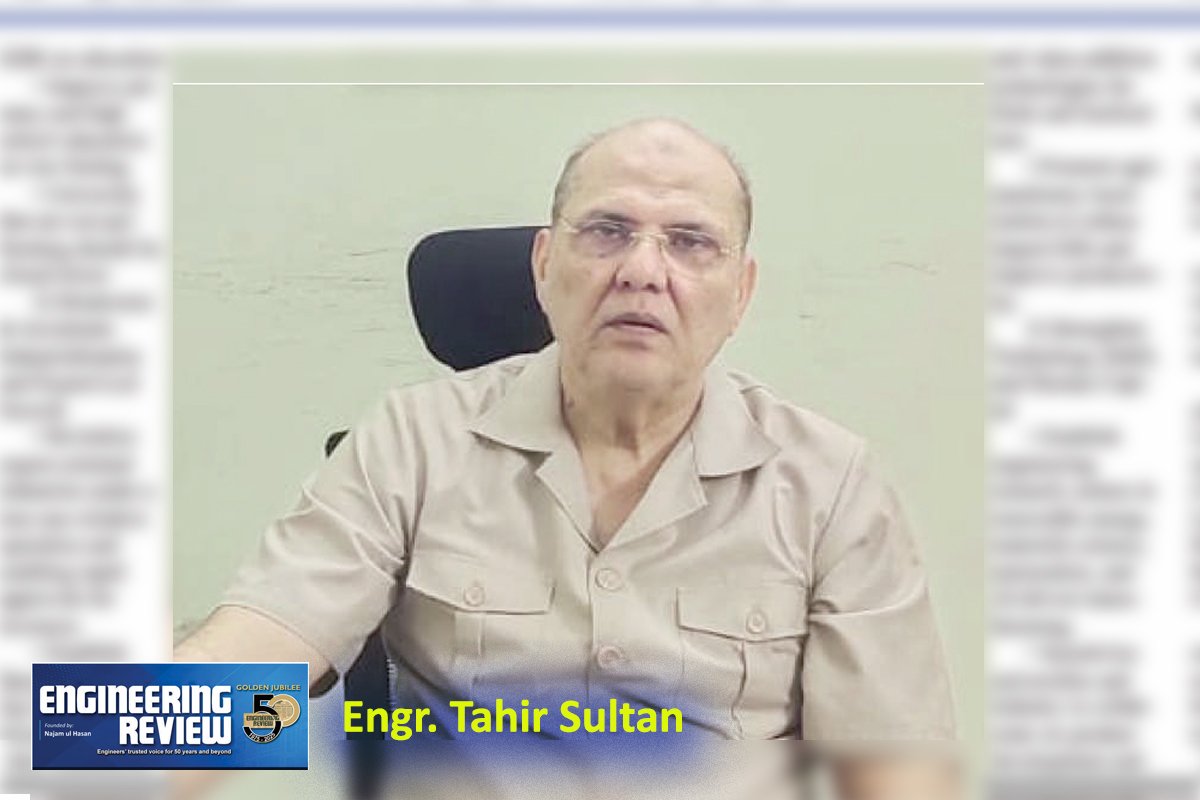
Engineering Review: In the aftermath of the Middle East war, Pakistan’s fault lines and weaknesses regarding self-sufficiency have become evident. What would you suggest to policymakers about which sectors of the economy especially engineering sectors should be revitalized?
Engr. Tahir Sultan: Pakistan’s vulnerabilities exposed by the Middle East crisis are not temporary—they reflect long-standing structural weaknesses. Addressing them requires a shift toward self-reliance, industrial depth, and engineering-driven economic modernization. With decisive reforms, Pakistan can transform this moment of uncertainty into an opportunity for long-term resilience and growth. The following priority actions are recommended for policymakers:
1) Strengthen Internal Governance and Security
- Ensure fool-proof internal security to protect supply chains, industrial zones, and critical infrastructure.
- Eliminate corruption at all tiers, through digital governance, transparent procurement, and strict accountability mechanisms.
2) Education: - Invest at-least 5% of the GDB on education
- Improve primary and high school education on war footing
- University that are not performing should be closed down
3) Modernize & Accelerate Industrialization and Export-Led Growth - Revitalize export-oriented industries under a true one-window operation and enabling rapid approvals for investors.
- Establish Special Engineering Zones (SEZs) focused on high-value manufacturing such as electrical equipment, machinery, automotive parts, and renewable-energy components.
4) Modernize Agriculture and Food-Export Systems - Introduce modern aquaculture and seafood-processing technologies to expand export volumes.
- Adopt post-harvest engineering, cold-chain logistics, and value-addition technologies for fruits and horticulture.
- Promote agri-machinery localization to reduce import bills and improve productivity.
5) Strengthen Technology, R&D, and Human Capital - Establish engineering research centers in renewable energy, materials science, automation, and AI-driven manufacturing.
- Incentivize universities and industry to collaborate on product development and commercialization.
- Launch national programs for technical skills, vocational training, and engineering apprenticeships.
6) Iran – Pakistan Gas Pipe-Line
This project should be completed on war footing, as basic survey and engineering is ready for this project.
ER: Where did you receive your education, and what is the best memory you would like to share with our readers
TS: Most of my formal education took place in Lahore, where I completed my undergraduate degree in Civil Engineering from UET Lahore. I later pursued my Master’s degree at Wayne State University in Detroit, USA.
Although I value every stage of my academic journey, my time in Detroit remains the most memorable and transformative. If one truly wants to understand what education means, how the art of learning shapes a person, and how knowledge should be applied in real life, then studying in the United States provides that clarity. The academic environment, the exposure, and the learning culture in the USA are unmatched.
ER: What kind of engineering and industrial environment did you encounter after completing your education, and what changes do you observe in modern engineering and industrial practices in Pakistan today?
TS: I have been fortunate to work in organizations where the systems were largely managed by competent professionals. When I began my career, the construction industry still maintained a relatively ethical, educative, and professional environment—despite the presence of corruption. There were norms, standards, and a culture of learning that shaped young engineers.
Unfortunately, the situation today has deteriorated significantly. In the construction sector in particular, the environment is no longer ethical, professional, or conducive to learning. The culture of mentorship and knowledge-sharing that existed when I began my career has almost disappeared. Corruption has overshadowed the values, discipline, and professional pride that once guided the industry.
What concerns me most is that the urge to learn has been replaced by the urge to make money quickly. The passion for work, craftsmanship, and continuous improvement has diminished among many young professionals. When financial gain becomes the only motivation, the long-term health of the industry suffers. In my view, meaningful correction cannot be achieved through regulations alone. Real change must begin at the foundational level—within our schools and our homes. By grooming the next generation in an honest, disciplined, and ethical culture, we can rebuild the moral framework that our professional sectors desperately need.
ER: What would you suggest to bring industry and academia closer together, and do you think the present model of collaboration is producing meaningful results?
TS: I am not fully updated on the latest formal frameworks of industry–academia collaboration, but based on my interactions with fresh engineering graduates, it is evident that the present model is far from effective. Most young engineers today are uncertain about their career paths, lack exposure to real-world engineering environments, and have limited understanding of industry expectations. This clearly indicates a disconnect between what universities teach and what the industry actually needs.
Bridging this gap is not a simple task, even when sincere efforts are made. However, meaningful progress can be achieved if engineering universities redesign their approach. The most practical and impactful step would be to integrate field-based learning and applied research into undergraduate curricula. Students and faculty should jointly work on industry-oriented projects, site-based studies, and problem-solving assignments drawn from real engineering challenges. In my view, only through structured field engagement, project-based learning, and genuine partnership between faculty and industry professionals can we expect meaningful results from academia–industry collaboration.
ER: What is your opinion about the role of Engineering Review in highlighting and disseminating issues related to Pakistan’s engineering sector?
TS: In my view, Engineering Review is already playing an important role by documenting and publishing the insights of experienced engineers across various disciplines. These interviews and articles help highlight the real issues, gaps, and opportunities within Pakistan’s engineering sector.
However, for this effort to create meaningful impact, it is equally important that your work reaches the people who shape national policy. The perspectives and recommendations published in your journal should be systematically communicated to those at the helm of government, regulatory bodies, planning institutions, and public-sector organizations. If the journal continues to strengthen this bridge between professional insight and policy formulation, its role in Pakistan’s engineering landscape will become even more influential and transformative.
READ MORE
Building a Stronger Nation: Tahir Sultan onEngineering, Governance, and Economic Revival
Engineering Review: In the aftermath of the Middle East war, Pakistan’s fault lines and weaknesses…

Anthropic Researcher Resigns Over AI Safety Concerns
An Anthropic researcher has resigned from the artificial intelligence (AI) company, warning that leading AI…
Qaiser Ahmed Sheikh Calls for Turning Economic Knowledge into Practical Solutions
Federal Minister for Board of Investment Qaiser Ahmed Sheikh has called for greater efforts to…

Apple Unveils $1,999 Folding iPhone Duo in Major Flagship Redesign
Apple has unveiled the iPhone Duo, a $1,999 foldable smartphone that marks the company’s biggest…

Meta Launches Muse AI Agent to Handle Everyday Tasks
Meta has launched Muse, a personal artificial intelligence (AI) agent designed to help users aged…

Petition Seeks Under-16 Social Media Restrictions in Pakistan
A petition has been filed before the Federal Constitutional Court (FCC), seeking restrictions on social…