
PAKISTAN – Karachi
By Manzoor Shaikh
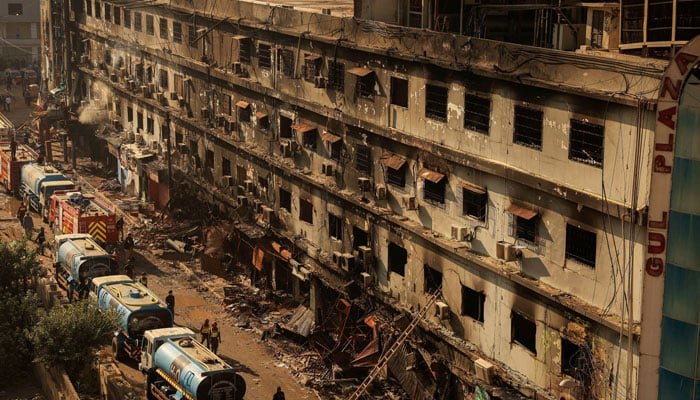
The fire operation at Gul Plaza in Karachi’s South District has been declared complete, with official figures confirming that 79 people lost their lives, either due to burns or suffocation. Yet another deadly incident has added to the long list of urban tragedies in Pakistan’s largest city—one marked by poor governance, weak regulatory enforcement, and chronic neglect of safety standards.
While the forensic report is still awaited, unofficial accounts circulating suggest that the fire may have been triggered by children playing with burnt matchsticks inside the building. Authorities, however, have not yet confirmed the cause of ignition.
What is beyond dispute, according to fire safety and engineering experts, is that the scale of damage and loss of life could have been drastically reduced—or entirely prevented—had basic fire safety measures been implemented and followed.
A Building Without Safety
Gul Plaza is one among thousands of buildings in Karachi that fail to meet even the minimum fire safety requirements. Experts point out that both commercial and residential occupants often remain indifferent to emergency preparedness, evacuation planning, and fire prevention—until disaster strikes.
“This incident has once again exposed the real state of our governance and regulatory systems,” said one expert, noting that similar questions have arisen after every major fire tragedy in Karachi over the past 15 years: Why do so many people die in relatively small buildings?
Codes Exist, Compliance Does Not
Pakistan is not short of laws or technical guidance. The Pakistan Engineering Council (PEC) developed a comprehensive Building Code of Pakistan several years ago, which clearly outlines requirements for emergency exits, fire-resistant design, evacuation routes, and firefighting systems. The code applies across the federation.
In Sindh, additional provisions exist under the Occupational Safety and Health Act, which also incorporates building safety standards. However, experts say the problem lies in implementation and enforcement, not legislation.
Design engineers, they argue, must also ensure that approved drawings strictly follow these codes and that building control authorities enforce compliance without exception.
The First Three Minutes Matter
Fire safety specialists emphasize that the first three minutes of a fire are critical. If a fire is controlled during this window, a major catastrophe can often be avoided.
“There is a severe lack of awareness among the general public,” said Jawed Akhtar, a fire safety expert. “In Gul Plaza, we saw panic, lack of coordination, no understanding of how to operate firefighting equipment, and no emergency response plan. Smoke disorients people—without training, they don’t know where to go.”
According to him, a functional emergency response plan alone could have saved every life. “There should have been immediate announcements, organized evacuation, and trained personnel guiding occupants towards emergency exits.”
Awareness, Training, and Attitude Change
Ali Ashraf, another expert, stressed that engineering solutions already exist, but they are useless without awareness and training.
“Even if firefighting equipment is installed, it cannot be used effectively unless people are trained,” he said. “Residents and workers in multi-storey buildings must understand fire types, extinguisher usage, and evacuation protocols. Missing the initial three minutes often means losing control entirely.”
He added that people must also understand the five classes of fire and the fire triangle—oxygen, fuel, and heat—to respond appropriately.
Start Early, Educate Deeply
Aijaz ul Haq, Secretary, the Institution of Engineers Pakistan, Karachi emphasized the need for long-term sensitization, suggesting that fire safety concepts should be included in school curricula.
“If people learn about fire behavior, risks, and response from childhood, they become safer adults,” he said. “We already have laws and regulations. Building associations should deploy trained volunteers at entry and exit points to guide occupants during emergencies.”
Role of Engineering Bodies and Media
Engr. Ayaz Mirza, the organizer of OHSE Conference of the Institution of Engineers Pakistan highlighted the role of professional institutions such as the Institution of Engineers Pakistan (IEP), which regularly submits safety recommendations to government departments and conducts awareness activities.
“Not all recommendations are implemented, but some have been incorporated into law,” he said, adding that pressure on authorities has continued for over a decade.
Experts unanimously stressed that the media must play a proactive role in spreading fire safety awareness. Collaboration between engineering bodies and media platforms could significantly improve public preparedness.
Survey of Unsafe Buildings Urgently Needed
Experts called on the Pakistan Engineering Council, in collaboration with builders’ associations such as ABAD, to conduct an urgent survey of buildings in old and semi-old areas of Karachi.
They also pointed out that, according to existing laws, there should be at least one fire station for every 100,000 people—a requirement that is far from being met in many parts of the city.
A Preventable Loss
The Gul Plaza fire is not an isolated incident but a systemic failure of planning, enforcement, awareness, and accountability. Experts agree that unless building safety codes are enforced, emergency preparedness is institutionalized, and public awareness is taken seriously, such tragedies will continue to repeat themselves.
And each time, the question will remain the same: Why were lives lost when the solutions were already known?
READ MORE

Gul Ahmed Textile Mills Limited Appoints Mohammed Zaki Bashir as CEO
PAKISTAN Gul Ahmed Textile Mills Limited (GATM) has appointed Mohammed Zaki Bashir as its Chief…

Lucky Cement Limited Subsidiary Enters Partnership with GAC Group
PAKISTAN Lucky Cement Limited has announced that its subsidiary, Lucky Motor Corporation Limited (LMC), has…
OGDCL Announces Start of Production from Spinwam-1 Discovery
PAKISTAN Oil and Gas Development Company Limited (OGDCL) has announced the commencement of gas and…
Pakistan, Netherlands Explore Expanded Energy Cooperation
PAKISTAN Federal Minister for Petroleum Ali Pervaiz Malik held a meeting with H.E. Robert Jan…
Proposal to Establish Blue Economy Sectoral Council to Boost Exports
PAKISTAN Rana Ihsaan Afzal Khan, Coordinator to the Prime Minister on Commerce, held a meeting…

Pakistan raises climate concerns at Arctic Circle Rome Forum
WORLD Federal Minister for Climate Change Musadik Masood Malik represented Pakistan at the Arctic Circle…
Leave a Reply