
By: Ramesh Raja
Pakistan today does not suffer from a shortage of construction; it suffers from a collapse of maintenance culture. From highways to hospitals, sports complexes to water supply schemes, and even multi-billion-rupee mega projects, our infrastructure begins to decay alarmingly soon after inauguration. This failure is not accidental, nor is it purely technical. It is the direct outcome of a national mindset and governance model that treats maintenance as optional, expendable, and politically unattractive.
The tragedy is that Pakistan has done much of the hard work correctly, on paper and during construction. What we consistently fail to do is protect, operate, and maintain what we build.
Maintenance: Accepted in Theory, Abandoned in Practice
In modern infrastructure planning, maintenance is not a side issue; it is a core concept. Feasibility studies, PC-I documents, and financial models in Pakistan routinely include operation and maintenance (O&M) provisions. Taxes, tolls, and user charges are justified to the public on the explicit premise that they will ensure safe and continuous operations over the asset’s life.
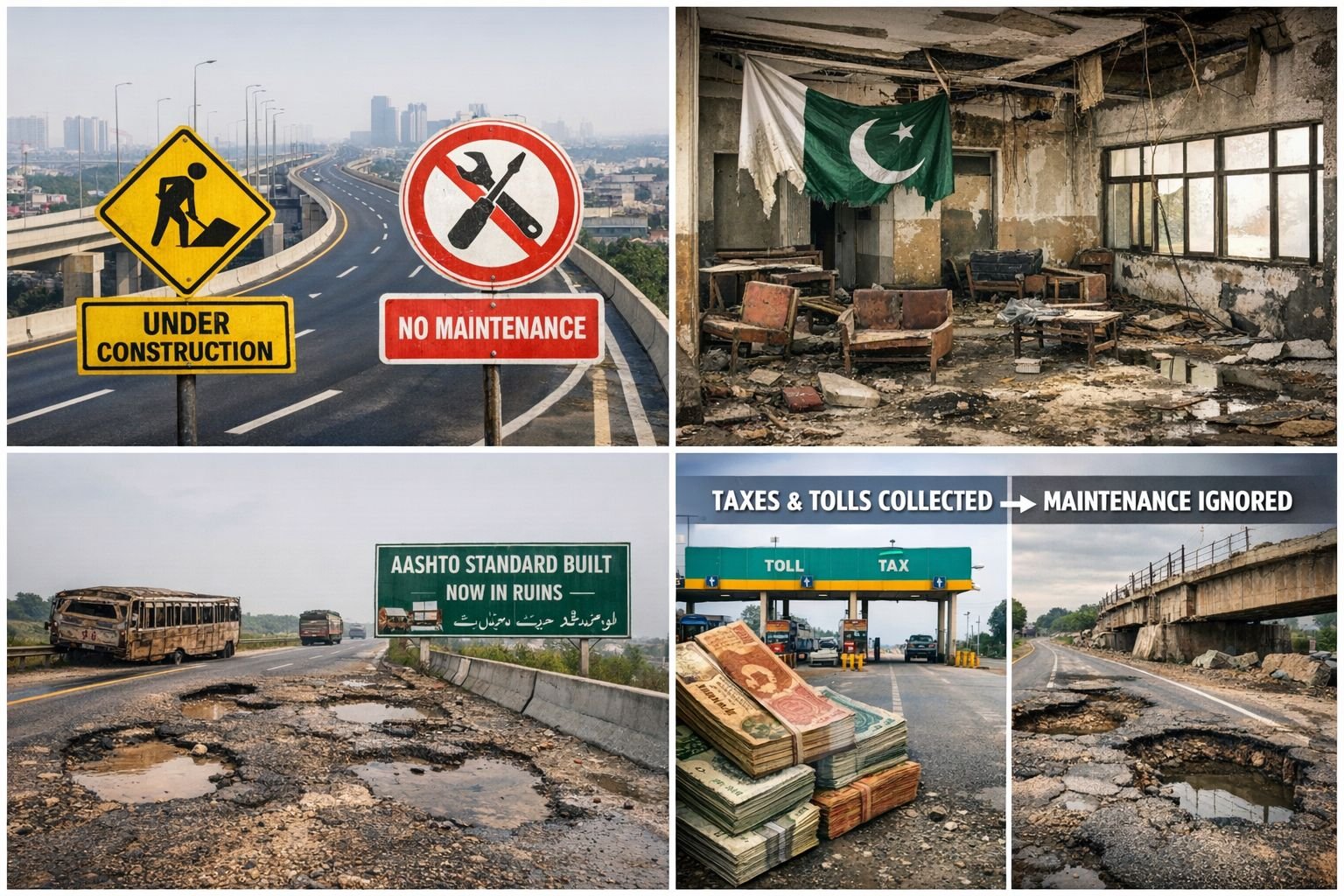
Yet once construction is complete and the ribbon is cut, maintenance quietly disappears from priorities. Taxes and tolls continue to be collected efficiently, but the funds meant for upkeep are diverted, delayed, or diluted. Maintenance allocations are the first to be cut and the last to be released. As a result, what was designed to last decades begins to fail within years.
This disconnect between planning and execution is the single biggest reason Pakistan’s infrastructure underperforms.
World-Class Construction, Third-World Maintenance
There is an uncomfortable irony in our current situation. Pakistan has largely adopted international construction codes and practices. We use modern machinery, advanced plants, and qualified engineers. Our highways and motorways are built on AASHTO standards, comparable in design to those in developed countries.
But infrastructure built to international standards requires international-level maintenance. A highway designed for a 20–30 year life will not survive without routine inspections, timely resurfacing, drainage upkeep, and preventive interventions. In Pakistan, despite proper toll collection, such maintenance is rarely carried out. The result is predictable: premature pavement distress, safety hazards, rising vehicle operating costs, and eventual structural failure.
In simple terms, we build like developed countries but maintain like none.
A National Culture of Neglect
This failure is not limited to government institutions; it reflects a broader societal attitude. We neglect maintenance in our homes, public spaces, and workplaces. Temporary fixes replace preventive care. Problems are addressed only after a breakdown. This mindset, when scaled to national infrastructure, produces catastrophic outcomes.
Preventive maintenance—which globally costs a fraction of reconstruction—is culturally undervalued. Breakdown maintenance becomes the norm, even though it is the most expensive, disruptive, and unsafe option.
Evidence of Failure All Around Us
The consequences are visible everywhere:
Public buildings and sports complexes become unusable within years due to broken utilities and lack of routine care.
Water supply schemes fail when pumps, pipelines, and filtration plants stop working over minor, unattended faults.
Drainage systems clog, leading to urban flooding and public health emergencies every monsoon.
Roads and highways develop potholes and structural damage shortly after completion.
Mega projects, built at enormous public expense, deteriorate prematurely despite sound design and construction.
These are not isolated failures. They are symptoms of a systemic elimination of maintenance.
The Economic Cost of Neglect
Ignoring maintenance has a heavy price: premature asset failure, repeated reconstruction, safety risks, service disruptions, and loss of public trust. The state ends up rebuilding what could have been preserved at a fraction of the cost.
Globally, maintenance is treated as an investment, not an expense. In Pakistan, it is treated as a burden, postponed until failure makes it unavoidable.
What Must Change
If Pakistan is serious about sustainable development, it must shift from a “construction-only” mindset to a maintenance-driven state.
Key reforms are unavoidable:
- A National Maintenance Policy, legally binding and applicable to all public assets.
- Ring-fenced use of taxes and tolls, ensuring revenues collected for infrastructure are spent exclusively on O&M.
- Performance-based maintenance contracts, linking payments to measurable service standards.
- Mandatory life-cycle costing in all project approvals.
- Independent asset management systems with transparent condition reporting.
- Audit and parliamentary oversight of maintenance spending, equal in rigor to development expenditure.
- Cultural change, promoted through education and professional training, to normalize care and upkeep.
Pakistan’s infrastructure crisis is not caused by the lack of expertise, machinery, or international standards; it is caused by a deliberate neglect of maintenance despite continuous tax and toll collection. Until revenues collected in the name of safe operations are actually used for upkeep, even the best-designed projects will continue to fail prematurely.
True development is not measured by how many projects we inaugurate, but by how long and how safely they serve the people. Without enforceable maintenance laws, protected funding, and a national culture of care, Pakistan will remain trapped in a costly cycle of construction, collapse, and reconstruction—a cycle we can no longer afford.
Engr. Ramesh Raja is a civil engineer and managerial/ planning professional who also contributes as a freelance writer on technical matters. He may be reached at engineer.raja@gmail.com
READ MORE
PM Special Initiative: Industrial, Agricultural Sectors Consume 2,164 GWh of Additional Electricity in Just Three Months
ENERGY The government’s Surplus Power Package has triggered a considerable surge in electricity demand from…
NHA Senior Engineers Begin Feasibility Studies for Karachi Port–Hyderabad M-10 Motorway
MOTORWAYS Federal Minister for Communications Abdul Aleem Khan chaired a high-level meeting of the National…

Amalgamation of Telenor into Pak Telecom: PTCL Receives PTA NOC for Telenor Pakistan Merger
TELECOM Pakistan Telecommunication Company Limited has received a No Objection Certificate (NOC) from the Pakistan…

Microsoft to invest $10 billion in Japan for AI and cyber defence expansion
TECHNOLOGY Microsoft on Friday said it will invest 1.6 trillion yen ($10 billion) in Japan…

SG Power Limited Appoints Umer Ali Malik as CEO, Charts Strategic Transformation Plan
PAKISTAN SG Power Limited has appointed Umer Ali Malik as its Chief Executive Officer with…

ARCHION Corporation Listed on Tokyo Stock Exchange, Begins Operations
WORLD ARCHION Corporation, a newly formed holding company created through the business integration of Hino…
Leave a Reply