
PAKISTAN
The initiative is among the world’s largest post-disaster housing reconstruction programs, aimed at building more than 2.1 million climate-resilient homes for flood-affected families, says Murad Shah.
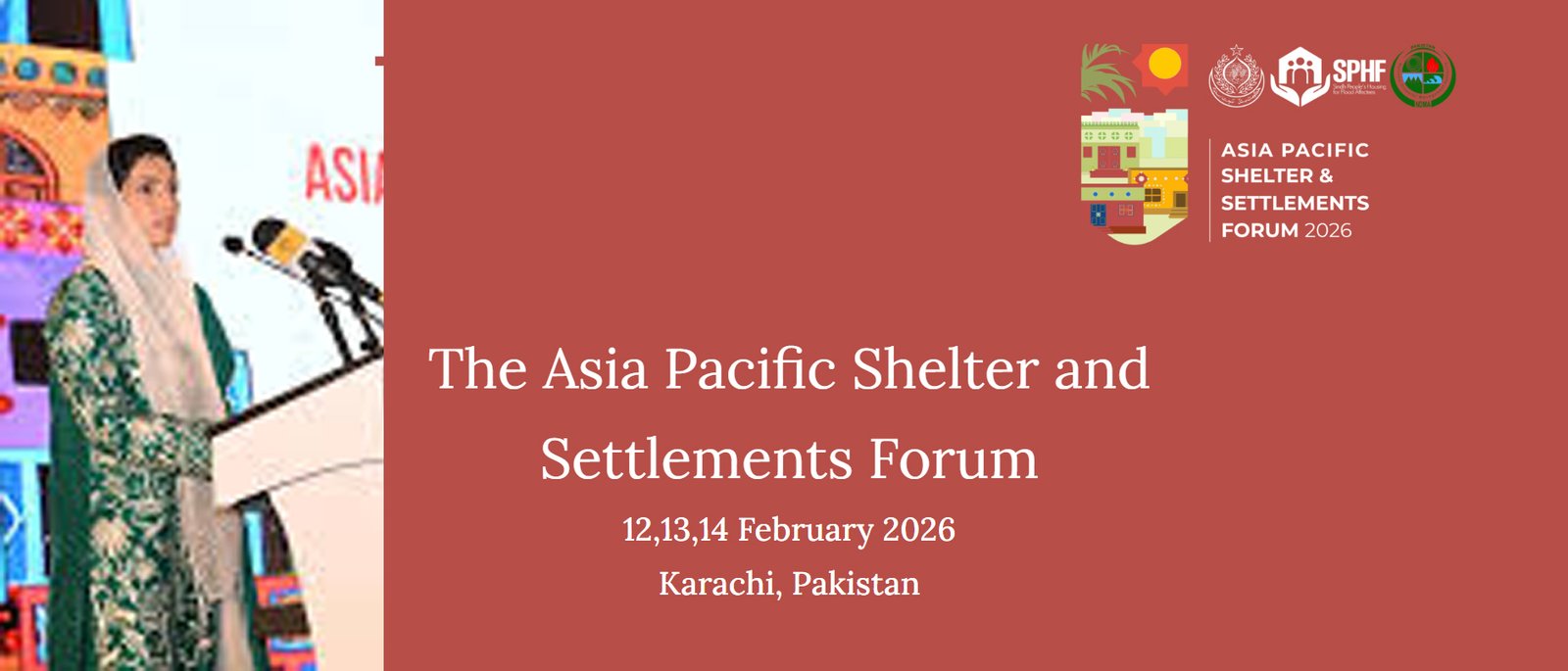
Sindh’s post-flood housing recovery program was showcased as a global model for climate-resilient and people-centred reconstruction as the provincial government hosted the three-day Asia-Pacific Shelter and Settlements Forum (APSSF) 2026, bringing together regional and international policymakers, humanitarian leaders, development partners, and experts.
The forum, held at a local hotel, was attended by Sindh cabinet members, Chief Secretary Sindh Syed Asif Hyder Shah, senior officials, diplomats, representatives of international financial institutions, donor agencies, academia, civil society, and the private sector, making it the region’s largest gathering focused on housing and human settlements.
In her presidential address, First Lady of Pakistan, Bibi Aseefa Bhutto Zardari, said safe shelter is not merely a structure but the foundation of dignity, security, and opportunity. Chief Minister Syed Murad Ali Shah said Sindh has demonstrated that large-scale recovery, social inclusion, and climate resilience can go hand in hand, citing the province’s housing initiative as a global benchmark.
“Resilience is built with people, not for people. When communities are trusted and empowered, recovery becomes faster, stronger, and more sustainable,” the Chief Minister said.
“Shelter is far more than a roof over one’s head. It is where families recover from loss, children feel secure enough to dream, and communities regain the strength to move forward,” the First Lady added, stressing that climate-resilient housing must be treated as a basic human right, especially in climate-vulnerable regions.
Highlighting the widening impact of climate change, rapid urbanization, and inequality across the Asia-Pacific region, Bibi Aseefa noted that insecure housing disproportionately affects women and children. She emphasized that placing women at the center of housing ownership creates long-term social and economic stability for entire communities.
World’s Largest Post-Disaster Housing Effort
The Chief Minister detailed the Sindh People’s Housing for Flood Affectees (SPHF) program, launched after the devastating 2022 floods that submerged nearly 70 percent of the province and damaged over 2.1 million homes. He described it as one of the largest post-disaster housing reconstruction programs in the world, aimed at building over 2.1 million climate-resilient houses.
He underscored that homes and land titles are being issued in women’s names, promoting ownership, dignity, and financial inclusion. The program has drawn global recognition, including a recent visit by World Bank President Ajay Banga to SPHF sites in Larkana.
“Everywhere we went, affected families made only one demand: give us our homes back,” he recalled.
Murad Ali Shah said the initiative was made possible through the vision of Chairman Bilawal Bhutto Zardari, who pushed for rebuilding homes despite severe financial constraints. Within a week of initial planning, the World Bank pledged support, followed by commitments from multiple partners at a global donors’ conference.
He informed participants that over 700,000 houses have been completed, while construction continues at scale.
Administrative and Technical Engagement
Welcoming delegates, Chief Secretary Syed Asif Hyder Shah said the forum aimed to develop a practical roadmap to address climate-driven housing challenges. Field visits have also been planned to provide firsthand insight into recovery efforts.
SPHF CEO Khalid Shaikh shared that around 750,000 houses have been completed, over 1.5 million are under construction, and 1.5 million bank accounts have been opened for beneficiaries, most of them women.
International Endorsements
World Bank Country Director Bolormaa Amgaabazar praised Sindh’s efforts, calling the forum a vital platform for global dialogue on shelter and resilience. She noted that millions opened bank accounts and secured land ownership for the first time under the program.
ADB Deputy Country Director Asad Aleem emphasized the need to integrate housing with water, sanitation, and hygiene (WASH) facilities and reaffirmed ADB’s continued support over the next three years.
IsDB Regional Director Saleh Jlassi joined via video link, while EU representative Jeroen Willems termed Sindh’s program well-planned and effective, announcing that the European Investment Bank would also support the initiative.
Representatives from IOM, Habitat for Humanity, and Catholic Relief Services (CRS) highlighted Sindh’s recovery model as a beacon of hope for disaster-affected regions worldwide.
A documentary featuring stories of flood survivors and the reconstruction journey was screened during the forum, underscoring the scale of devastation and the unprecedented recovery effort underway.
The conference will continue with technical sessions and policy dialogues focused on translating commitments into actionable strategies to ensure safe, resilient, and dignified housing across the Asia-Pacific region. KARACHI: ER News Desk
READ MORE
Pakistan, Netherlands Explore Expanded Energy Cooperation
PAKISTAN Federal Minister for Petroleum Ali Pervaiz Malik held a meeting with H.E. Robert Jan…
Proposal to Establish Blue Economy Sectoral Council to Boost Exports
PAKISTAN Rana Ihsaan Afzal Khan, Coordinator to the Prime Minister on Commerce, held a meeting…

Pakistan raises climate concerns at Arctic Circle Rome Forum
WORLD Federal Minister for Climate Change Musadik Masood Malik represented Pakistan at the Arctic Circle…
OGDCL, PPL Announce Oil and Gas Discovery at Baragzai X-01 Well
PAKISTAN Oil and Gas Development Company Limited (OGDCL) and Pakistan Petroleum Limited (PPL) have announced…
Supernet Announces CEO Change, Jamal Nasir Khan Appointed as New Chief Executive
PAKISTAN Supernet Limited has announced a change in its top management, informing the Pakistan Stock…
Building Future with Tech-Skilled Youth
By Ramesh Raja Sindh, with its rich cultural heritage and industrious population, is home to…
Leave a Reply