


Engr. Asghar Siddiqui, CEO of SEP (SEM-ElekEn Partnership), on Pakistan’s Economic Reality, Real World of Consultants & Economic boom outside Pakistan
Is Pakistan’s economy improving?
The short answer is no. As the saying goes, “the mouth is moving, but nothing is reaching the stomach.” That is how our economy is functioning, and this is how I see it. In our office, we have an excessive workload—we are overloaded with work—but the outcomes that should follow are not there.
If we speak from our own profession as an example, the situation is clear. What is happening in other industries is well known and hardly needs explanation—industries are shutting down. If the country’s economy were improving, why would people be leaving? Educated young people are frustrated and migrating because they see no future here. That alone is enough to show that the economy is not improving.
In the past, by completing 10 projects we earned what we needed; today, even after doing 50 projects, we do not earn the same. Clients who get work done from us are themselves distressed afterward. The message is very clear.
Better than the recent economic downturn?
You talk about money circulating, but that circulation is also increasing hardship. The people you mention—who say money is being spent and markets are active—who are they, and how many are they? If you divide society into three classes, the largest segment is the lower class. Look at their condition: survival has become difficult for them. Crime is rising—is that an indicator of a healthy economy?
Look at poor areas of all kinds—people are suffering. Even our lower-level staff cannot make ends meet. People used to go abroad before as well, but the difference now is stark. In my class of 150 students, perhaps 50 could afford to go abroad; the rest stayed and worked here after completing engineering. Today, almost 100 percent are ready to leave, trying to gather money from anywhere to get out. That change says everything.
Aren’t global opportunities increasing compared to the past?
Many countries are eager to invite technical professionals. Opportunities are there globally.
What about consultants? How are they doing?
Now I will speak frankly. I told you earlier that when the economy is not healthy and cash flow is poor, corruption increases. This corruption existed earlier to some extent, but now it has spread widely. The number of dishonest people has surpassed the number of honest ones.
I say this responsibly: outside Karachi, it is difficult to find a truly clean consultant. Go to Balochistan, Peshawar, or Punjab—you will struggle to find consultants with real integrity, whose loyalty is to the client alone. Straightforward consultants can now be counted on one hand. Why does this happen? Because when the economy deteriorates, ethical standards also collapse.
Our income either comes directly from the end user or through architects. Earlier, architects used to give consultants their rightful share. Now everyone wants to keep all the money. Instead of engaging a proper company, they hire two individuals from one firm and two the other one, pay them a small amount, and get the work done.
Engineers working with us—despite what we consider good salaries—receive offers of double or triple pay from Saudi Arabia or Dubai. Naturally, they leave so their families can live a comfortable life. If people could live a decent life here and saw hope for a better future, they would not leave. But there is no hope, so they go.
Many so-called consultants exist today, but they are neither capable nor eligible to provide proper consultancy services.
What is ACEP doing? Have you spoken to them?
Yes, I have. Their response is, “What can we do? We cannot do anything.” But we have PEC—the highest authority. It is their responsibility to take action against unqualified entities practicing consultancy. There must be a way.
I have raised this issue within ACEP. Our seniors who run ACEP and IEEEP must act. In IEEEP, people from our batch have become active, and over the last two years you have seen some programs. But if consultants are not working honestly, what can be achieved?
In Punjab, the situation has reached a point where clients know that consultants take money from vendors and others. The client says they take from vendors. When mindsets become like this, corruption becomes normalized. Except for one or two, it is hard to find clean consultants in Punjab.
Economic boom outside Pakistan and our consultants
Our consultants are working abroad—many of them are. The work we get is mostly by default; we do not even have time for marketing because we are too busy with existing work. Why do people look abroad? To earn foreign exchange.
Consultancy services are being exported by many, but largely without deliberate effort. We remain busy with work here—money or no money, the workload is heavy.
People go abroad to compensate for the deficiencies in their local business. Many companies have come here having their head offices overseas, keeping only liaison offices here. They hire local staff at good salaries and send the work abroad.
Our consultants often do not secure projects directly; instead, they associate with foreign firms. The major share of profit goes to those firms, and a smaller portion comes to us—but even that is often double what we earn locally. This should be done. We have worked abroad—in Dubai, Saudi Arabia, Qatar, and the USA—and we know all the norms. Whenever work comes, we will certainly do it. We should do it. The intention should be to bring money from outside. The problem is: once the money comes in, what happens to it?
Engineering universities and the engineers they produce
Some change has occurred. Computers, electronics, and AI have advanced significantly. In certain fields, universities are producing very good graduates. Many of our electrical engineering graduates are working in computers, electronics, and AI, but they are not as strong in core electrical engineering as earlier generations.
Previously, universities produced graduates with very strong analytical abilities. When I conducted interviews earlier, I never even took technical interviews—I could judge candidates by their conversation and vision. Now, after forming a partnership, we have introduced a proper interview process.
Engineering has lost its core somewhere along the way due to emerging technologies and AI. Many universities have emerged besides NED. Earlier, we could easily distinguish an NED graduate through conversation. Now, we can no longer tell the difference. By Manzoor Shaikh
WACH THE INTERVIEW
READ MORE

Industry 5.0 and Green Engineering: Human-Centric Sustainable Production
INDUSTRY 5.O Industry 5.0 redesigns the production architecture in order to place human beings at…

Navigating the Future of Careers in Pakistan in the AI Era
AI ERA By Prof. Dr. Tariq Rahim Soomro, SMIEEE We rode the wave of freelancing…

US–Israel–Iran War: Where Does Pakistan’s Food Security Stand?
FOOD SECURITY By Manzoor Shaikh For now, doomsday scenario such as a full-scale escalation involving…

A Milestone Achievement in 5G Railway Communication Research
INTERBATIONAL COLLABORATION Mehran University of Engineering & Technology (MUET) proudly announces the successful completion of…

Where does Pakistan stand in unprecedented surge of AI, emerging technologies?
TECHNOLOGY CEO Rastek Technologies, Engr. Rafik Ahmed Lakhani, in a conversation with ER, explained how…
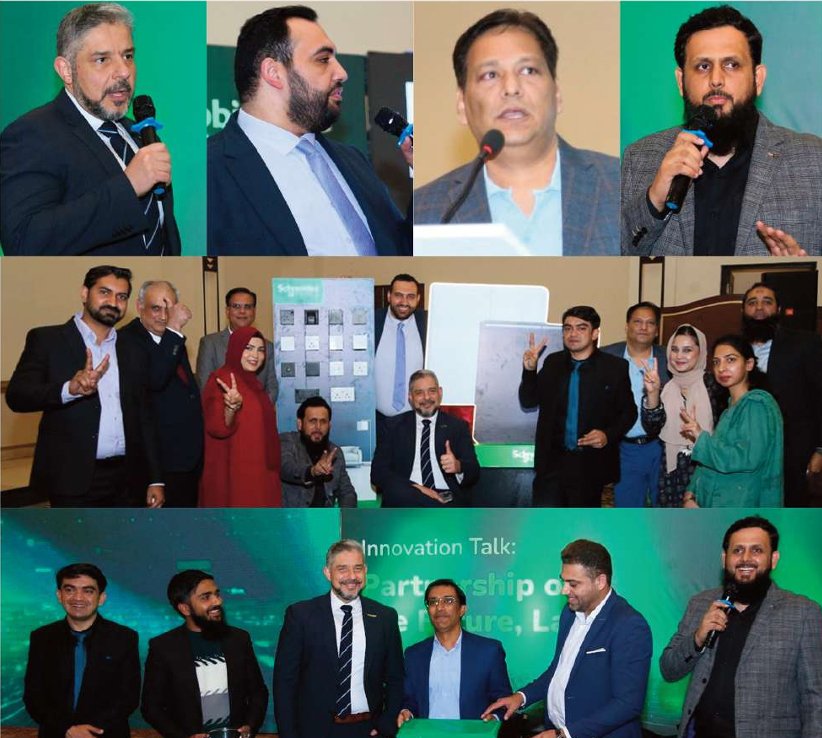
Advancing Energy, Digital Transformation: Schneider Electric Hosts Future Partnership
ENERGY Schneider Electric Pakistan hosted Partnership of the Future – Lahore, bringing together contractors, consultants,…
Leave a Reply