
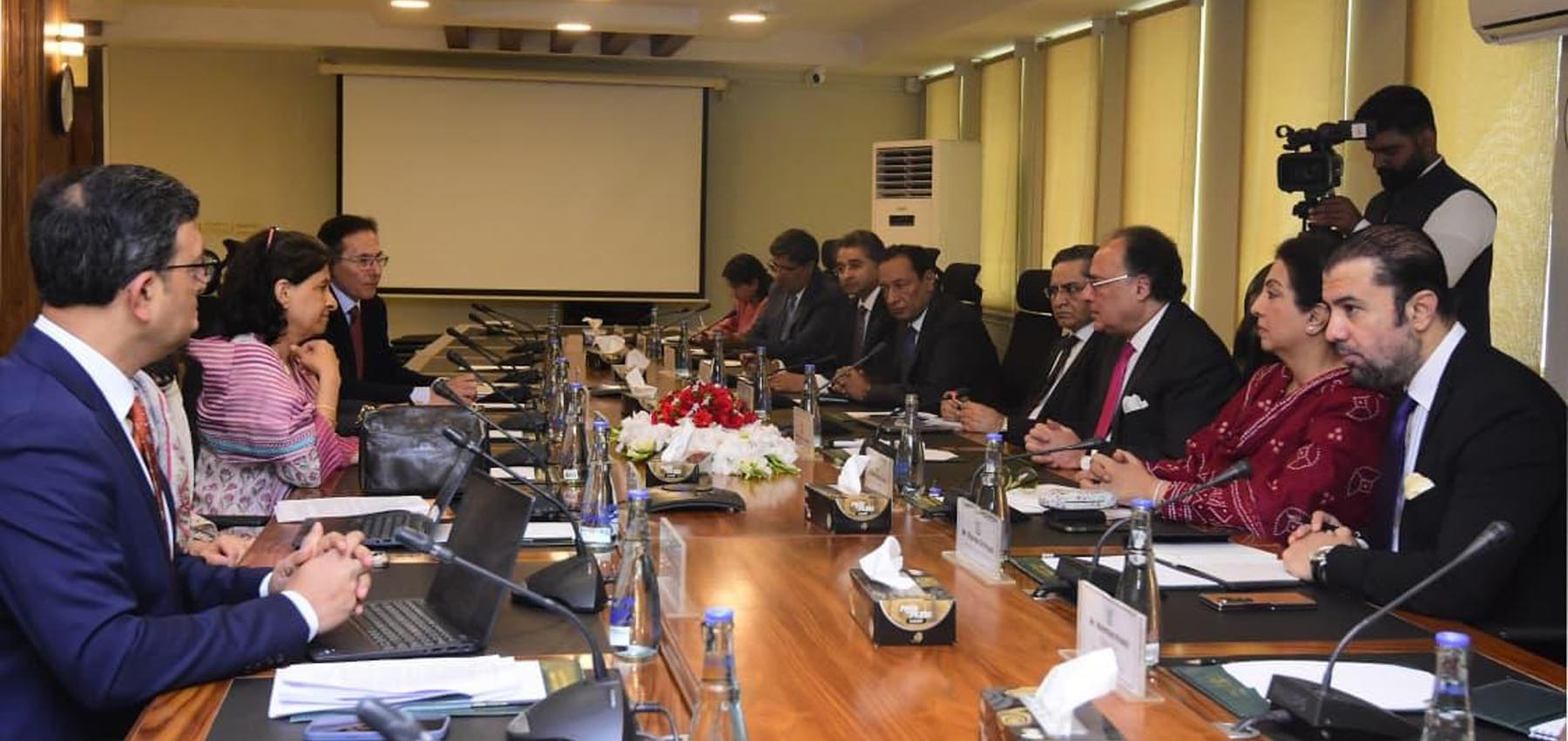
Federal Minister for Finance and Revenue, Muhammad Aurangzeb, held a meeting with a high-level delegation of the World Bank Group led by Vice President for Human Development, Mamta Murthi, to discuss Pakistan’s human development agenda, healthcare reforms, education, skills development, and social protection initiatives.
The delegation included World Bank Country Director for Pakistan Bolormaa Amgaabazar, Regional Director for Human Development Keiko Inoue, Health Practice Manager Sherin Varkey, and IFC Director Simon Andrews.
Welcoming the delegation, Senator Aurangzeb appreciated the World Bank Group’s continued support for Pakistan’s development priorities and noted that after making progress in restoring macroeconomic stability, the government is now placing greater emphasis on improving social and human development indicators through investments in health, education, skills development, and social protection.
The finance minister highlighted that Pakistan’s large youth population presents a major opportunity for economic growth, provided adequate investments are made in human capital development. He stressed the need to enhance workforce participation, improve educational outcomes, and equip young people with skills that match the changing demands of the labour market.
The discussions focused on key human development challenges, including maternal and child health, nutrition, immunization, early childhood development, education quality, and population-related issues. Mamta Murthi emphasized that long-term development progress depends on improvements in child nutrition, reduction in stunting, foundational learning, and access to quality healthcare and education services.
Both sides also explored ways to strengthen primary healthcare systems and expand access to essential services for mothers and children. The meeting reviewed the growing role of artificial intelligence and digital technologies in healthcare, education, and workforce development, with participants exchanging international experiences on technology-driven service delivery and healthcare financing.
A significant portion of the meeting was devoted to workforce readiness, skills development, and job creation. Senator Aurangzeb underlined the importance of upskilling and reskilling Pakistan’s workforce to meet emerging economic needs and create better employment opportunities, particularly for the country’s youth.
The World Bank delegation shared global experiences in technical and vocational training and highlighted the importance of stronger industry linkages, greater private-sector involvement, and skills programmes aligned with labour market requirements.
The meeting also discussed opportunities for enhanced collaboration among the Government of Pakistan, the World Bank Group, and the private sector to advance the country’s human capital objectives. During the discussion, Mamta Murthi invited Pakistan to participate in a global forum on Universal Health Coverage to be held in Japan later this year, jointly supported by the Government of Japan, the World Bank Group, and the World Health Organization.
Concluding the meeting, the finance minister reaffirmed the government’s commitment to reforms aimed at strengthening human capital, improving social outcomes, expanding employment opportunities, and promoting inclusive and sustainable economic growth. Both sides agreed to continue close cooperation in the fields of health, education, social protection, workforce development, and technology-enabled public service delivery.
Islamabad: ER
READ MORE

Govt Moves to Reform Power Sector Regulatory Framework
Federal Minister for Finance and Revenue Senator Muhammad Aurangzeb chaired the first meeting of the…

Apple Appoints Salman Dar as First Head of Government Affairs in Pakistan
Apple has appointed Salman Dar as its first Head of Government Affairs for Pakistan, marking…
From Slide Rules to Artificial Intelligence — An Engineer’s 60-Year Journey
Engr. Farooq Mehboob reflects on six decades of engineering, from manual calculations and slide rules…
Engineering, Public Service and Nation Building: The Journey of Engr. Mukhtiar A. Shaikh
From the classrooms of Dawood Engineering College to leadership roles in public service, industry, and…
Building a Stronger Nation: Tahir Sultan on Engineering, Governance, and Economic Revival
Engineering Review: In the aftermath of the Middle East war, Pakistan’s fault lines and weaknesses…

Anthropic Researcher Resigns Over AI Safety Concerns
An Anthropic researcher has resigned from the artificial intelligence (AI) company, warning that leading AI…