
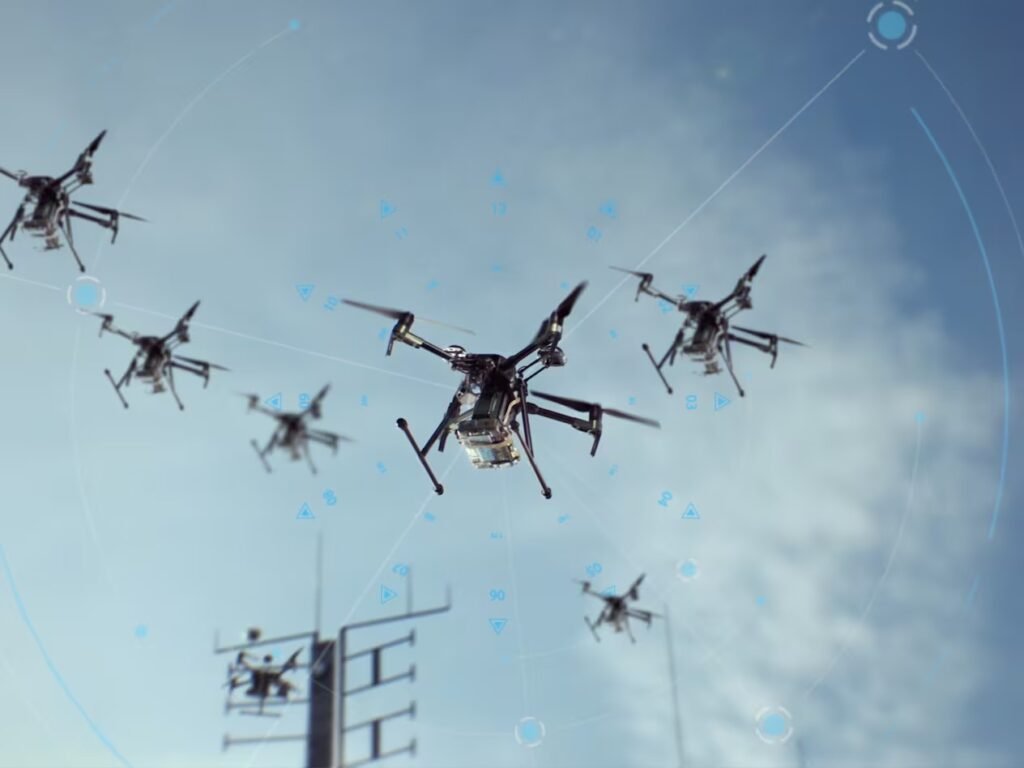
A South Korean university researcher has developed a low-power artificial intelligence system that can identify drones in real time while significantly reducing the energy required for detection.
Doyeon Kim, an undergraduate researcher in the Department of Electronic and Electrical Engineering at Sungkyunkwan University, developed the system as part of research published in IEEE Transactions on Industrial Informatics.
The research addresses a growing challenge in drone surveillance. As unmanned aerial vehicles become more widespread, military and industrial facilities increasingly need systems capable of detecting and identifying unauthorised drones. However, conventional AI-based detection systems often require powerful processors and consume substantial amounts of electricity, making them difficult to deploy on small, battery-powered devices.
Kim and his research team developed an AI system called UAV-NAS, which uses an automated process to identify an efficient neural-network architecture for analysing drone signals. Rather than relying entirely on engineers to manually design the AI structure, the system searches for an architecture that can deliver the required performance with fewer computing resources.
The researchers then implemented the AI system on a field-programmable gate array (FPGA), a type of semiconductor that can be customised for specific computing tasks while using relatively little power.
Tests showed that the system could accurately identify different types of drones and determine their flight status while reducing power consumption by 88.7% compared with running the AI on a conventional CPU.
The researchers said the technology could support continuous drone monitoring in outdoor, military and industrial environments where battery life and energy efficiency are critical.
Kim has conducted semiconductor and FPGA research since his undergraduate years and also gained industry experience through an internship at South Korean AI semiconductor startup Rebellions.
He is scheduled to graduate with a bachelor’s degree this month and will begin a fully funded PhD programme at Purdue University in the United States in September, where he plans to continue research in semiconductors and artificial intelligence. – TX/ERMD
READ MORE

Fauji Cement Approves 50 MWh Battery Energy Storage and 10 MW Solar Project
The Board of Directors of Fauji Cement Company Limited (FCCL) has approved the installation of…
First-Year QUEST Nawab Shah Student Found Dead; Students Allege Brutal Torture
The body of a first-year student of the Quaid-e-Awam University of Engineering, Science and Technology…

AI Voices May Increase Scam Risks for Some Dialect Speakers
The growing use of artificial intelligence (AI)-generated voices is raising concerns that increasingly realistic synthetic…

China Reassesses AI Risks as Cybersecurity Threats Grow
China is reassessing the risks posed by artificial intelligence as increasingly capable AI models demonstrate…

Pakistan Moves Towards Competitive Electricity Market with First Wheeling Auction
Pakistan has taken a major step towards shifting its power sector from the traditional single-buyer…

Sindh CM Orders Enrolment Drive to Fill New Schools
Sindh Chief Minister Syed Murad Ali Shah has directed the School Education Department, district administrations…