
By Ramesh Raja
Introduction: Civil engineering has always evolved by adopting innovative materials and technologies to construct stronger, safer, and more durable infrastructure. From reinforced concrete and prestressed structures to high-performance concrete and smart monitoring systems, each advancement has enhanced the resilience of the built environment. Today, the world is witnessing another revolutionary development; the self-healing concrete, a material capable of repairing its own cracks with minimal or no human intervention. This innovation has the potential to redefine the future of infrastructure by reducing maintenance costs, increasing structural durability, and promoting environmental sustainability.
The Problem of Cracking in Concrete
Concrete is the most widely used construction material due to its high compressive strength, versatility, and affordability. However, it possesses one inherent limitation: it is susceptible to cracking. Cracks may develop due to drying shrinkage, thermal expansion and contraction, excessive loading, settlement, earthquakes, or environmental exposure.
Although many of these cracks initially appear insignificant, they gradually become pathways for water, chlorides, sulphates, and carbon dioxide. These harmful substances reach the embedded steel reinforcement, initiating corrosion, reducing structural capacity, and ultimately shortening the service life of bridges, buildings, highways, dams, and tunnels. Worldwide, governments spend billions of dollars annually on repairing such deterioration.
What is Self-Healing Concrete?
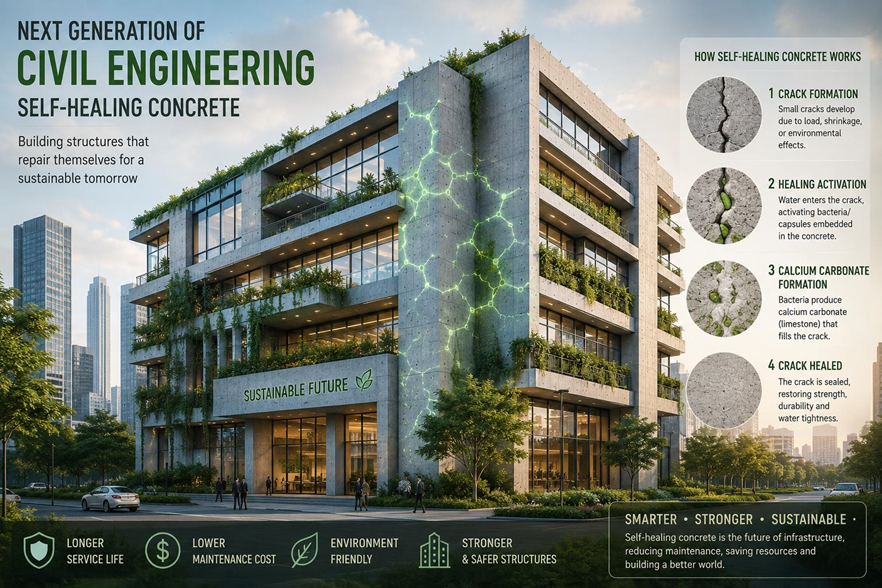
Self-healing concrete is an advanced construction material designed to automatically repair small cracks without requiring conventional maintenance. Inspired by biological systems, where living organisms naturally heal wounds, self-healing concrete restores its integrity when cracks develop. Instead of allowing damage to progress, the material activates internal healing mechanisms that seal the cracks before they can cause serious structural deterioration.
This emerging technology represents a shift from reactive maintenance to proactive durability, allowing infrastructure to preserve its strength and functionality over extended periods.
Mechanisms of Self-Healing
Several technologies have been developed to enable self-healing in concrete.
One of the most promising approaches uses dormant bacteria mixed within the concrete along with suitable nutrients. When water enters a crack, the bacteria become active and produce calcium carbonate (limestone), naturally filling and sealing the crack.
Another method incorporates microscopic capsules filled with epoxy resin or other healing agents. As a crack propagates, these capsules rupture and release the healing material, which hardens and bonds the cracked surfaces together.
Researchers are also developing vascular network systems containing interconnected micro-channels that transport healing agents throughout the concrete. Similar to blood vessels in the human body, these channels can repeatedly deliver repair materials whenever damage occurs.
Advanced shape memory materials are another innovation. Shape Memory Alloys (SMAs) and Shape Memory Polymers (SMPs) can return to their original shape after deformation, helping close cracks and restore structural performance, particularly after seismic events.
Advantages of Self-Healing Concrete
The adoption of self-healing concrete offers numerous engineering, economic and environmental benefits.
It significantly extends the service life of structures by preventing crack propagation and reinforcement corrosion. Maintenance requirements are substantially reduced, resulting in lower lifecycle costs and fewer traffic disruptions during repair works. The technology also enhances water tightness, making it highly suitable for tunnels, reservoirs, marine structures, and hydraulic works.
From an environmental perspective, reduced repair activities decrease the consumption of construction materials, energy, and carbon emissions, contributing to more sustainable infrastructure development. Improved durability also enhances public safety by reducing the likelihood of structural failures.
Practical Applications
Self-healing concrete is particularly valuable for critical infrastructure where repairs are difficult, expensive, or disruptive. It has promising applications in highways, motorways, bridges, flyovers, tunnels, airport pavements, metro systems, retaining walls, dams, offshore structures, ports, water reservoirs, and high-rise buildings.
For transportation agencies such as the National Highway Authority (NHA), the technology offers the possibility of reducing maintenance expenditures while improving the long-term performance of roads and bridges subjected to heavy traffic and harsh environmental conditions.
Challenges and Future Research
Despite its considerable promise, self-healing concrete still faces several challenges. The initial construction cost remains higher than conventional concrete, and long-term field performance data are still being accumulated. Researchers continue to improve the efficiency of healing mechanisms, increase the size of cracks that can be repaired, and reduce production costs.
The development of international design standards, quality control procedures, and engineering specifications will also be essential before the technology becomes widely adopted in mainstream construction projects.
The Future of Civil Engineering
The future of civil engineering lies in intelligent, resilient, and sustainable infrastructure. Self-healing concrete represents one component of a broader transformation that includes smart sensors, artificial intelligence, digital twins, robotics, drone inspections, and advanced materials. Together, these technologies will enable structures to detect damage, monitor their condition in real time, and automatically respond to deterioration before it becomes critical.
As urbanization continues and infrastructure demands increase, the integration of self-healing materials will become increasingly important for building cities that are safer, more economical, and environmentally responsible.
Conclusion
Self-healing concrete is more than an innovative construction material; it represents a fundamental change in the philosophy of infrastructure management. Rather than waiting for damage to occur and then undertaking costly repairs, future structures will possess the ability to repair themselves, extending their operational life while reducing maintenance costs and environmental impacts. Although further research and practical implementation are required, self-healing concrete is poised to become one of the defining technologies of next-generation civil engineering, paving the way for smarter, stronger, and more sustainable infrastructure worldwide.
READ MORE

Zong Launches 5G Home Broadband Service in Pakistan
Zong has launched Z HomeFi, a 5G fixed wireless access (FWA) home broadband service, aiming…

BYD Eyes Ultra-Fast EV Charging Technology for Pakistan
Chinese electric vehicle (EV) manufacturer BYD is in discussions with its Pakistani partner, Mega Motor…

Game-Based Digital Therapies Show Mixed Results in Treating Children with ADHD
Stimulant medications are among the most common treatments for children with attention-deficit/hyperactivity disorder (ADHD), helping…

Henri Kagan and Kenso Soai Awarded 2026 Nobel Prize in Chemistry
Scientists Henri Kagan and Kenso Soai have been awarded the 2026 Nobel Prize in Chemistry…

In Memory of Mohammad Akram Sheikh Chairman United Wire Industries
Mohammad Akram Sheikh Chairman United Wire Industries With profound sorrow, we remember Mr. Mohammad Akram…
IEEE Education Society Karachi Section Hosts Dr. Chi-Un Lei Webinar
Rethinking Graduate Education in Age of AI Chair IEEE Education Society, Karachi Section, Prof Dr…