
From the classrooms of Dawood Engineering College to leadership roles in public service, industry, and the Pakistan Engineering Council, Engr. Mukhtiar Ahmed Shaikh shares his insights on engineering, energy security, and national progress.
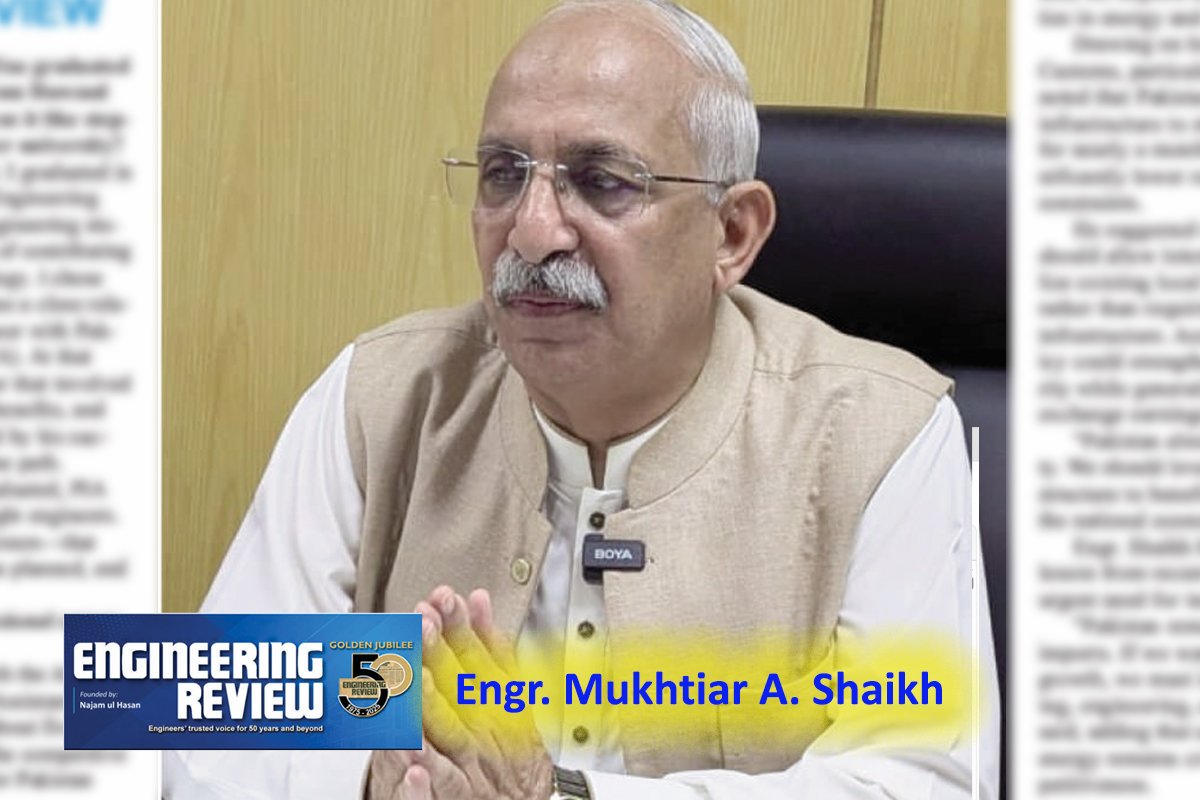
THE INTERVIEW
Engineering Review: You graduated in Electronics Engineering from Dawood Engineering College. What was it like stepping into professional life after university?
Engr. Mukhtiar Ahmed Shaikh: I graduated in 1983, having joined Dawood Engineering College in 1978. Like most engineering students, I had ambitious dreams of contributing to the country through technology. I chose Electronics Engineering because a close relative had become a flight engineer with Pakistan International Airlines (PIA). At that time, it was a prestigious career that involved international travel, excellent benefits, and exciting opportunities. Inspired by his success, I hoped to follow the same path.
However, by the time I graduated, PIA had discontinued recruiting flight engineers. That taught me an important lesson—that careers do not always unfold as planned, and adaptability is essential.
ER: How did your professional career begin?
MAS: My first job was with the Airport Development Authority as an Assistant Director, where I worked for about five months. Soon after, I cleared the competitive examinations and interviews for Pakistan Customs and joined as a Technical Appraising Officer.
This was the first time Customs had recruited engineers for technical assessments. Since Pakistan imports a wide range of machinery, industrial equipment, and software, engineers were needed to accurately classify, evaluate, and determine the value of these products. Our technical knowledge helped ensure proper customs valuation and prevent misclassification.
ER: How different was engineering during those years compared to today?
MAS: The difference is remarkable. During university, we studied from classic engineering textbooks that had been in use for decades. Once I entered Customs, I encountered advanced imported machinery and rapidly evolving industrial technologies, particularly in the textile sector.
Our engineering knowledge became invaluable in identifying sophisticated equipment. For example, we had to distinguish between humidifiers and air-conditioning systems, as different duty structures applied. Similarly, engineers could differentiate between industrial materials such as hot-rolled and cold-rolled steel sheets—differences that had significant implications for customs valuation.
Technology was advancing quickly, and engineers had to continuously update their knowledge to keep pace.
ER: Is there any memorable experience from your career that still stands out?
MAS: One incident has stayed with me throughout my career. While posted at the airport, a young doctor arrived carrying a personal computer. At that time, computers imported as engineering tools were exempt from customs duty, but computers brought by other professionals were generally not.
Initially, I questioned why a doctor would need a computer as a professional tool. She patiently explained that all her medical records, prescriptions, and patient information were stored digitally, and that computers had become essential to modern healthcare. After understanding her case, I recommended that she receive the same exemption because the computer was clearly an indispensable professional tool.
Looking back, that experience showed me how rapidly technology was expanding beyond engineering into every profession. Today, computers—and even smartphones—are essential tools for doctors, engineers, teachers, and professionals across every field.
ER: Technology has evolved tremendously since then. How do you view these changes?
MAS: We are now living in the era of artificial intelligence, where a smartphone has more computing power than the computers we once considered extraordinary. Technology has transformed every profession, and we must continue adapting to remain relevant.
Pakistan still has considerable ground to cover in adopting modern technologies. The world is moving forward at an incredible pace, and we must invest more seriously in technological advancement if we want to remain competitive.
ER: Engineering Review has completed 50 years of publication. How do you evaluate its contribution to Pakistan’s engineering community?
MAS: Reaching fifty years of continuous publication is a remarkable achievement in itself. Engineering Review has consistently highlighted engineering developments, professional issues, and the work of institutions such as the Pakistan Engineering Council.
What impresses me most is its consistency—even during the COVID-19 pandemic, when many publications suspended operations, Engineering Review continued publishing. The magazine has provided a valuable platform for discussing industry challenges, recognizing achievements, and encouraging constructive dialogue within the engineering profession.
I regularly read its digital edition and appreciate its balanced approach to covering engineering affairs. It has made a meaningful contribution to the profession, and I sincerely commend the entire team for their dedication over the past five decades.
On Energy Security, Industrialization and Self-Reliance
Reflecting on Pakistan’s experience during the recent Middle East conflict, Engr. Mukhtiar Ahmed Shaikh emphasized that the country must draw important lessons regarding energy security and supply chain resilience.
“The biggest lesson for Pakistan is that engineering capability and industrialization are directly linked to national security,” he said. “The recent crisis exposed our dependence on imports and highlighted vulnerabilities in energy and supply chains.”
Drawing on his experience in Pakistan Customs, particularly in the oil sector, he noted that Pakistan possesses sufficient infrastructure to store petroleum products for nearly a month but often maintains significantly lower reserves due to financial constraints.
He suggested that the government should allow international companies to utilize existing local bonded storage facilities rather than requiring them to build new infrastructure. According to him, such a policy could strengthen Pakistan’s energy security while generating valuable foreign exchange earnings.
“Pakistan already has the storage capacity. We should leverage our existing infrastructure to benefit both local industry and the national economy,” he explained.
Engr. Shaikh believes the second major lesson from recent global events is the urgent need for industrialization.
“Pakistan remains heavily dependent on imports. If we want sustainable economic growth, we must invest in local manufacturing, engineering, and value addition,” he said, adding that affordable and reliable energy remains critical for industrial competitiveness.
Beyond public service, Engr. Shaikh has also ventured into industry. After retirement, he established a fruit and tomato pulp processing facility in Khairpur, Sindh, after observing the country’s dependence on imported processed food products.
Today, the plant supplies major corporations, including Nestlé, Unilever, and Shezan, while creating employment opportunities and supporting local farmers.
“I wanted to create a complete value chain—from farm to industry and eventually to the consumer,” he said.
His experience attending international exhibitions in Saudi Arabia and Dubai further reinforced his belief in Pakistan’s export potential, particularly for agricultural products.
“The demand for Pakistani mangoes is extraordinary. We have world-class products, but we need to invest more in processing, packaging, and exports,” he observed.
To capitalize on these opportunities, Engr. Shaikh is now developing a significantly larger processing facility at Port Qasim, which he says will be among the largest of its kind in Asia.
He also highlighted the importance of agricultural clusters and closer collaboration between government, industry, and farmers. Citing examples from countries such as Nigeria, he noted that targeted support, modern farming practices, and access to financing can dramatically improve productivity.
“The government should identify specific regions for specific crops and provide incentives for industry to establish processing facilities nearby. Stronger integration between agriculture and industry will strengthen our economy and create jobs,” he said.
Having served the engineering community through multiple terms at PEC, Engr. Shaikh remains optimistic about Pakistan’s future.
“Pakistan has immense talent and tremendous potential. If we focus on industrialization, engineering, and self-reliance, we can transform challenges into opportunities,” he concluded.
For Engr. Mukhtiar Ahmed Shaikh, the message is clear: engineering is not merely about building infrastructure—it is about building resilient institutions, stronger industries, and a more prosperous Pakistan. – By Manzoor Shaikh
READ MORE
From Slide Rules to Artificial Intelligence — An Engineer’s 60-Year Journey
Engr. Farooq Mehboob reflects on six decades of engineering, from manual calculations and slide rules…
Engineering, Public Service and Nation Building: The Journey of Engr. Mukhtiar A. Shaikh
From the classrooms of Dawood Engineering College to leadership roles in public service, industry, and…
Building a Stronger Nation: Tahir Sultan on Engineering, Governance, and Economic Revival
Engineering Review: In the aftermath of the Middle East war, Pakistan’s fault lines and weaknesses…

Anthropic Researcher Resigns Over AI Safety Concerns
An Anthropic researcher has resigned from the artificial intelligence (AI) company, warning that leading AI…
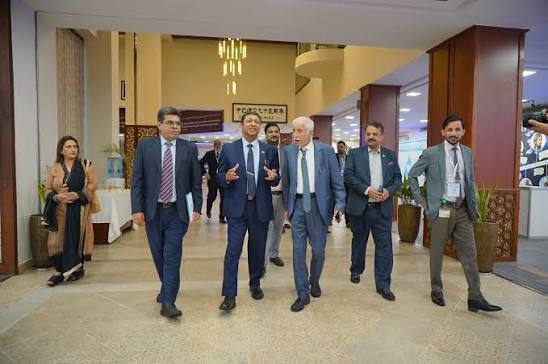
Qaiser Ahmed Sheikh Calls for Turning Economic Knowledge into Practical Solutions
Federal Minister for Board of Investment Qaiser Ahmed Sheikh has called for greater efforts to…

Apple Unveils $1,999 Folding iPhone Duo in Major Flagship Redesign
Apple has unveiled the iPhone Duo, a $1,999 foldable smartphone that marks the company’s biggest…