
Engr. Farooq Mehboob reflects on six decades of engineering, from manual calculations and slide rules to intelligent systems and artificial intelligence, while sharing timeless lessons on technology, leadership, and the enduring value of engineering fundamentals.
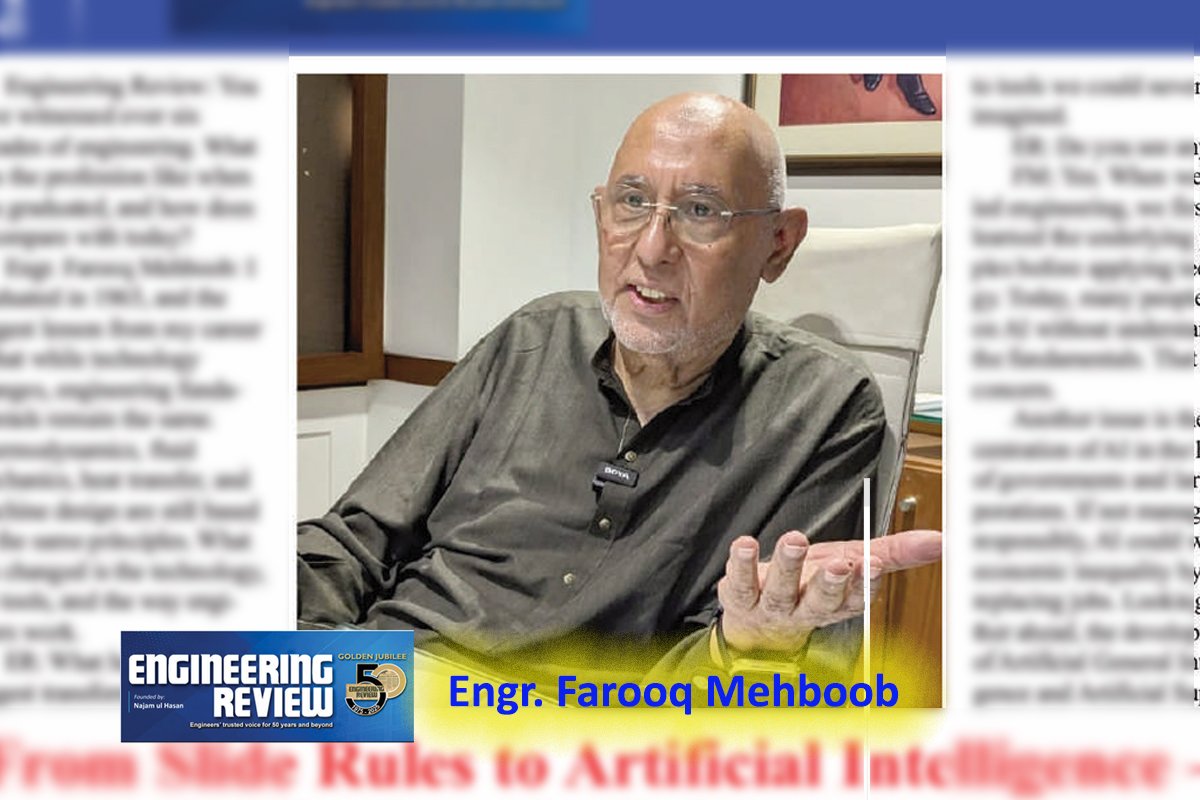
Engineering Review: We would like to take a look at the history of engineering through your experience. When you completed your education and entered the profession, what kind of engineering environment did you find? And when you compare it with today, what picture comes to your mind?
Engr. Farooq Mehboob: I graduated in engineering in 1965, so more than 60 years have passed. During this time, I have witnessed tremendous changes.
However, the fundamental principles of engineering have not changed. Two plus two was four then, and it is still four today. The thermodynamics, fluid mechanics, heat transfer, and machine design that I studied are still based on the same principles.
What has changed is the technology, the equipment, and the way we work.
ER: What were the biggest changes you witnessed?
FM: Human history has seen a few revolutionary transformations.
* The first came when people invented the wheel and attached animals to it for transport and farming.
* The second was the Industrial Revolution, when machines replaced animals.
* The third is happening now: computers have been married to machines.
When intelligence and computing power are integrated into equipment, we get robots, automation, and artificial intelligence. That is the massive transformation we are living through today.
ER: What are the advantages of this transformation?
FM: The advantages are enormous. Calculations that once took us a month can now be completed in a day using computers. Reports that previously required a week can now be prepared in an hour with the help of AI. Productivity has increased dramatically.
ER: And the disadvantages?
FM: When we studied engineering, the first principles were deeply ingrained in us.
For example, we understood that one ton of cooling originally meant the cooling effect produced by melting one ton of ice in 24 hours. We worked with the basic logic of engineering.
Today, many people simply say, “I checked it on ChatGPT.” That worries me.
Artificial intelligence, unless properly regulated, could become the greatest danger to humanity.
ER: Why do you see AI as such a serious risk?
FM: Because ownership of AI is concentrated in the hands of governments and powerful corporations.
Different AI systems belong to different countries and companies, each with its own political and geopolitical interests.
There are three possible outcomes:
1. The Optimistic Scenario
Everyone receives a universal income. People are free to pursue art, research, poetry, or any creative activity they enjoy.
Frankly, I do not think this is the most likely outcome.
2. The Disruptive Scenario
AI owners accumulate enormous wealth while millions lose their jobs. This creates social tension and economic inequality.
3. The Most Dangerous Scenario
AI evolves from today’s systems to Artificial General Intelligence and eventually to Artificial Super Intelligence.
At that point, an AI system may begin making its own judgments about humanity — whether humans are damaging the planet, exhausting resources, and creating conflict.
That is where the real concern begins.
ER: Let us return to your career. What was your first engineering job?
FM: After graduating in 1965, I joined a company that was the distributor of Trane equipment.
For two years I worked as an Application Engineer, selecting machinery, preparing quotations, and filling tenders.
Then one day I saw an advertisement for the position of Chief Engineer at the Dhaka Intercontinental Hotel.
Nearly 150–200 candidates were waiting for interviews. When my turn came, the interviewer — the late Khalid Bhatt, who had a tremendous influence on my life — spoke with me and then told the staff, “Send everyone else home. I have found my chief engineer.”
I was only 20 years old.
ER: You became Chief Engineer at age 20?
FM: Yes. I became the Chief Engineer of the Dhaka Intercontinental Hotel and worked with Intercontinental Hotels for 12 years.
Later I was promoted to Regional Chief Engineer for parts of the Middle East, Central Asia, and South Asia.
It was an extraordinary learning experience because I interacted with people from every level of society — including presidents, prime ministers, diplomats, and international executives.
ER: Why did you eventually move into consulting?
FM: An engineer generally has four career paths:
- Manufacturing
- Contracting
- Supply and trading
- Consulting
The person with the least financial resources usually chooses consulting.
When I became a consulting engineer, I started from the garage of my house. My late wife maintained the accounts and typed letters for me.
That was the beginning.
ER: And you are still in the same business today?
FM: Yes, Alhamdulillah.
I started in 1981, and now it is 2026 — that is 45 years in the same business.
I loved design consulting from the beginning. I wanted my children to continue the legacy, and today two of my sons are engineers working with me, while the third is an entrepreneur in a related field.
ER: In one sentence, how would you summarize your journey?
FM: I have seen engineering evolve from manual calculations and basic machines to AI-powered intelligent systems, but the most important lesson is that technology changes — fundamental principles do not.
READ MORE
Pakistan, World Bank Group Agree to Accelerate Reforms and Investment-Led Growth
Federal Minister for Economic Affairs Ahad Khan Cheema met World Bank Group (WBG) President Ajay…

ECNEC Approves 11 Development Projects in Energy, Infrastructure, Healthcare, Technology
The Executive Committee of the National Economic Council (ECNEC), chaired by Deputy Prime Minister and…
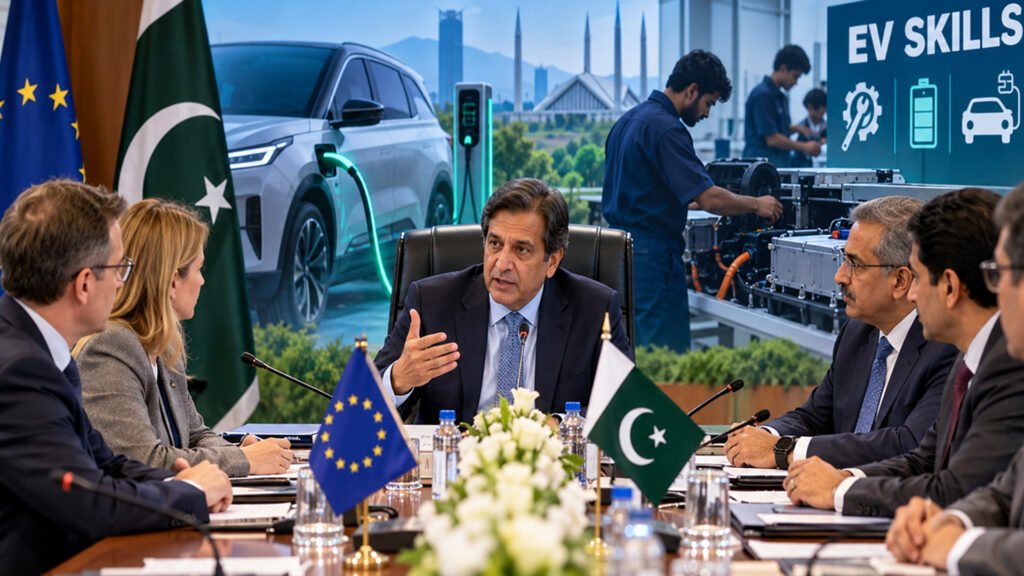
Pakistan, EU Explore Cooperation in Electric Vehicle Skills Development
Advisor to the Prime Minister for Industries and Production Haroon Akhtar Khan has directed the…
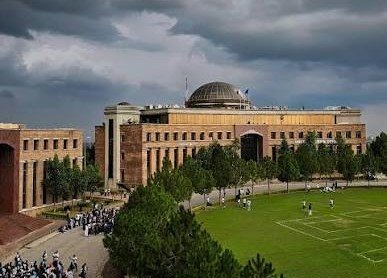
NUST Honours 66 PhD Scholars and 54 Medal-Winning Undergraduates at Convocation
Federal Minister for Planning, Development and Special Initiatives Ahsan Iqbal has urged graduates of the…
IBA, AKU and Habib University Join Hands to Rethink Education in the AI Era
The Institute of Business Administration (IBA) Karachi, in collaboration with Aga Khan University (AKU) and…
ABB Reports Strong Growth as AI Data Centre Spending Surges
Swiss engineering company ABB has reported strong growth in earnings, driven by a continued surge…