
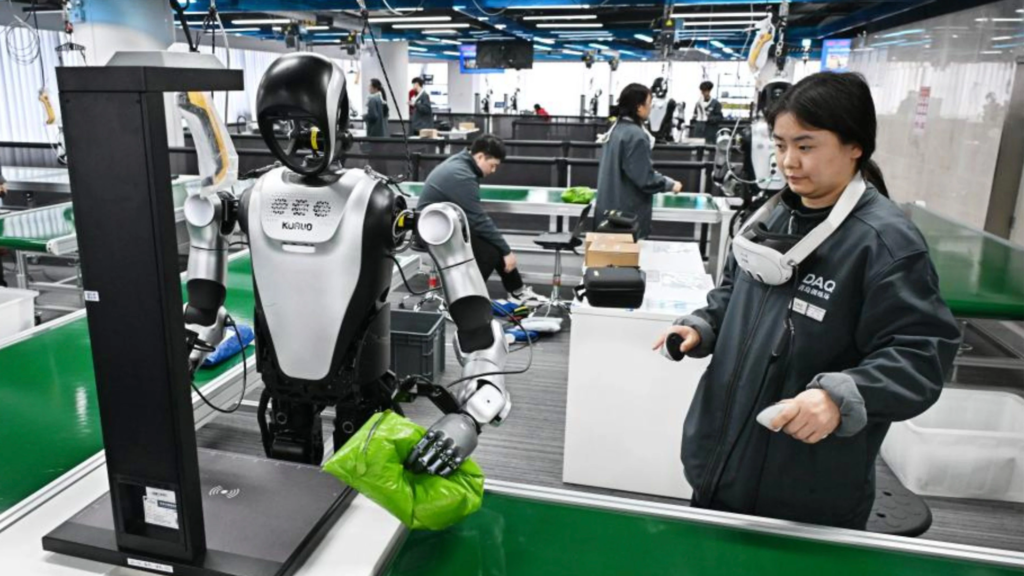
Across China, a growing number of freelance workers are training robots by performing everyday household chores while wearing motion-capture equipment. Their movements, including picking up cups, opening bottle caps, washing dishes and folding clothes, are recorded and converted into datasets to help robots perform tasks in homes, factories and supermarkets.
Such jobs are increasingly appearing on Chinese social media and recruitment platforms, offering monthly salaries of between 4,000 yuan and 6,000 yuan. The positions attract unemployed workers, students and people seeking flexible employment.
Liu Yun, 40, joined the industry after losing her job in the automotive sector and struggling to find new employment. At a Beijing studio, she wore sensors and finger-mounted devices to record repetitive movements under computer-guided instructions. She compared the experience to teaching a young child, saying the work involved demonstrating simple actions repeatedly.
Workers are monitored for speed and accuracy, with daily targets reportedly reaching 160 recorded samples. However, the repetitive nature of the tasks can be physically and mentally exhausting.
Sun, a 22-year-old university student from Shanxi province, took up the job during his summer break while searching for an internship. His duties included sweeping floors, folding clothes and recording standardised movements. Although the work offered daily payments of 120 yuan for day shifts and 135 yuan for night shifts, he found the earnings insufficient to compensate for the workload.
For others, the job provides greater flexibility. Guo Hongjuan, from Jiangsu province, collects data from home for around six hours daily, earning approximately 4,000 yuan a month while caring for her child.
Robot training is also expanding into outdoor environments. In August, Shenzhen-based Physen AI partnered with a sanitation company to equip street cleaners with data-collection devices. Their movements were recorded to help robots understand real-world conditions.
The trend has sparked mixed reactions online, with some describing the work as a digital assembly line. Others have highlighted the irony that workers are helping train machines that could eventually replace them. – TS/ERMD
READ MORE
China’s Robot Trainers Turn Household Chores into AI Training Data
Across China, a growing number of freelance workers are training robots by performing everyday household…

AI Safety Concerns Dominate Dublin Summit as Experts Warn of Emerging Threats
Artificial intelligence safety emerged as a major concern at an industry summit in Dublin on…

40 Major Media Groups Join Coalition to Protect Journalism from AI Copyright Violations
Forty major media organisations, including The New York Times, The Economist and Agence France-Presse (AFP),…

Zong Launches 5G Home Broadband Service in Pakistan
Zong has launched Z HomeFi, a 5G fixed wireless access (FWA) home broadband service, aiming…

BYD Eyes Ultra-Fast EV Charging Technology for Pakistan
Chinese electric vehicle (EV) manufacturer BYD is in discussions with its Pakistani partner, Mega Motor…

Game-Based Digital Therapies Show Mixed Results in Treating Children with ADHD
Stimulant medications are among the most common treatments for children with attention-deficit/hyperactivity disorder (ADHD), helping…