
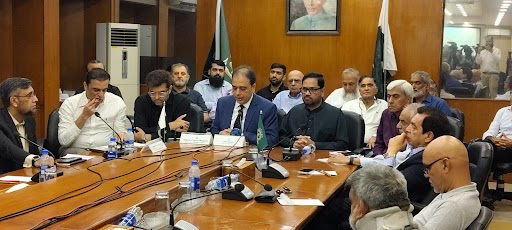
President of the Federation of Pakistan Chambers of Commerce and Industry (FPCCI), Atif Ikram Sheikh, has called on the government to immediately address what he described as discriminatory tax policies against commercial importers of industrial raw materials, warning that the current regime could inflict billions of rupees in losses on the national exchequer and undermine the viability of small and medium-sized enterprises (SMEs).
In a statement, Mr. Sheikh urged the government to ensure equal treatment for commercial importers and industrial manufacturers importing industrial raw materials, arguing that the existing tax structure places an unfair burden on commercial importers and distorts market competition.
He explained that commercial importers currently face an additional tax burden ranging from 6 to 9 percent, while industrial manufacturers are allowed to trade imported raw materials after paying only 3 percent additional Value Added Tax (VAT). According to him, this disparity threatens the survival of legitimate businesses and creates an uneven playing field.
“Industry’s primary function is manufacturing, not trading,” he said.
“This imbalanced system will encourage the use of flying invoices, misuse of industrial licenses, and substantial revenue losses for the government.”
The FPCCI president maintained that adopting a uniform tax policy for industrial raw materials across all sectors would help prevent tax leakages and save billions of rupees for the national treasury.
FPCCI Senior Vice President Saquib Fayyaz Magoon also highlighted several shortcomings in the existing and proposed tax regime.
He noted that commercial importers are being subjected to excessive additional sales tax and withholding tax burdens ranging between 6 and 9 percent, while the Finance Bill effectively allows industrial importers to engage in trading activities with a significantly lower tax incidence of just 3 percent additional VAT.
According to Mr. Magoon, the policy effectively legitimizes a practice that falls outside the traditional scope of industrial activity and places commercial importers at a severe disadvantage.
He further warned that the discriminatory tax framework could encourage undocumented economic activity by forcing commercial importers out of business, thereby creating opportunities for fake refunds, tax adjustments, flying invoices, and misuse of industrial licenses.
The FPCCI leadership emphasized that cottage industries and SMEs, considered the backbone of Pakistan’s economy, depend heavily on commercial importers for access to industrial raw materials.
If commercial importers are pushed out of the market, SMEs may face difficulties in obtaining raw materials at competitive prices, adversely affecting production, employment, and economic growth.
“This discriminatory policy is creating serious market distortions,” Mr. Magoon said. “Without commercial importers, SMEs will struggle to secure raw materials at competitive rates, resulting in reduced industrial output and loss of employment opportunities.”
The business community has urged the government to amend the Finance Bill and ensure that industrial raw materials are treated uniformly across all sectors.
FPCCI maintained that a level playing field and a consistent tax policy are essential for promoting a competitive, documented, and sustainable economy.
The issue was also raised during a major press conference organized by FPCCI in Karachi, attended by the leadership of several trade associations, including the Pakistan Yarn Merchants Association (PYMA), Pakistan Artificial Leather Importers and Merchants Association (PALIMA), Pakistan Chemicals and Dyes Merchants Association (PCDMA), Pakistan Iron and Steel Merchants Association (PISMA), and Pakistan Plastic Manufacturers Association (PPMA).
Representatives of these associations echoed concerns over the proposed tax measures and called for immediate corrective action to safeguard legitimate trade, support SMEs, and prevent further distortions in the market. – PR