
AI ERA
By Prof. Dr. Tariq Rahim Soomro, SMIEEE
We rode the wave of freelancing through Upwork, survived the dot-dot-dot bubbles, and watched the rise of a startup ecosystem centered in Karachi, Lahore, and Islamabad. But nothing—absolutely nothing—has moved the tectonic plates of our career landscape quite like Generative AI. Let’s discuss the realistic scenario for the Pakistani job market over the next 5 to 10 years. This isn’t about whether AI will take our jobs; it is about how the structure of employment in Pakistan is being rewritten in real-time.
For the last 15 years, a massive chunk of Pakistan’s tech employment has been built on arbitrage—specifically, the difference between the US dollar and the PKR, and the willingness of Pakistani engineers to work for $30 to $10 per hour or less doing what US engineers do for $100 per hour. We are already seeing a shift in the export industry. Tasks that used to require a team of five junior front-end developers or content writers are now being handled by one senior developer using AI copilots (Cursor, Copilot, etc.) and one AI editor. The demand for generic coding skills is dropping. The Pakistani freelancer who relies on basic HTML/CSS tweaks, simple WordPress development, or standard content writing is facing a saturated market where AI tools have drastically lowered the barrier to entry. We will likely see a bifurcation. The lower end of the market (routine software development, basic data entry, standard copywriting) will experience a “race to the bottom” in pricing, forcing many professionals to either upskill drastically or exit the tech-adjacent gig economy.
Pakistan’s local enterprise sector—banking, textiles, retail, and telecom—has traditionally been slow to adopt tech. However, the pressure to cut costs is forcing a change. We are entering an era where local companies will no longer hire coders; they will hire AI-augmented teams. Instead of a hierarchy of 1 Project Manager + 5 Developers + 2 QA + 1 DevOps, the structure is shrinking to 1 Product Lead + 2 AI-Augmented Engineers. In the Software Houses, the “body rental” model (where Pakistani companies rent out engineers to foreign clients by the headcount) is facing an existential threat. Clients are now asking: “Why do I need 10 engineers, when AI can handle the boilerplate?”. The value proposition is shifting from manpower to expertise. The Pakistani companies that will thrive are those that sell solutions, not hours. They are hiring Architects—people who understand system design, security, and how to integrate AI models (local or cloud) into legacy systems.
Pakistan produces hundreds of thousands of graduates every year. In the past, if you weren’t a software engineer, your chances in the digital economy were slim. AI is changing that now. We are entering a phase where English proficiency + Domain Expertise + AI Tooling is becoming a viable career path, bypassing traditional coding. A graduate with a degree in Accounting, Business, Economics, Social Sciences, or even a skilled tradesperson, can now leverage AI to become a “Prompt Engineer”, “AI Workflow Specialist”, or “Data Labeling Supervisor”. Pakistan has a young, English-speaking population. Global AI companies (and local ones) need massive amounts of data labeling, model fine-tuning, and local language model (Urdu/Regional) development. This creates a new tier of “AI Operations” jobs that didn’t exist three years ago. These are not traditional STEM jobs, but they are high-value digital jobs.
As a computer professional observing this market, I see three distinct survival strategies for the Pakistani workforce:
1. For Developers: If your stack is purely “MERN” (MongoDB <database>, Express.js <back-end framework>, React.js <front-end library), and Node.js <server-side runtime>) with no specialization, your bargaining power is wearing away. The market is demanding AI Integration Specialists. If you can build RAG (Retrieval-Augmented Generation) – an AI framework, pipelines, fine-tune LLMs on local Urdu data, or secure cloud infrastructure for AI workloads, you are not just safe—you are in the top 1% of earners in the country.
2. For Businesses: The old model of selling developers by the numbers is over. Pakistani IT companies must rebrand themselves as AI transformation partners. Foreign clients will pay premium dollars not for a coder, but for a partner who can reduce their operational costs using AI. This requires sales teams to understand tech deeply—a rare skill in our current market.
3. For Fresh Graduates: Universities in Pakistan are not keeping up. While students learn outdated curricula, imposed by the Higher Education Commission and accreditation Bodies, the industry needs people who understand how to connect OpenAI APIs to local databases. The “Last Mile” gap—knowing how to deploy a model, manage latency, and handle hallucinations—is where the money is. A fresh graduate with a strong portfolio of AI-integrated projects will out-earn a 10-year expert who refuses to adapt.
Pakistan’s AI future is hampered by two things:
1.Brain Drain: The best AI talent is leaving for the UAE, KSA, and the West because of the economic situation, Pak Rupees to Dollar rate, Taxations, local infrastructure (power outages, internet disruptions, visa policies) makes running high-stakes AI operations unstable, along with other obvious reasons.
2.The Internet Wall: AI is an internet-first industry. If we face prolonged internet shutdowns or throttling, the market will simply bypass Pakistan. We saw a preview of this in 2024; foreign clients started shifting their contracts to Vietnam and Latin America when connectivity became unreliable.
The future of careers in Pakistan in the era of AI is not a story of undesirability; it is a story of compression and elevation. The middle tier is being compressed. The low-skill digital jobs are disappearing. But the top tier—the AI engineers, the product architects, the prompt engineers, and the business leaders who understand how to deploy these tools—are seeing opportunities that were unimaginable two years ago. For the Pakistani computer professional, the mantra must change. We can no longer sell hours, rather we must sell intelligence. The era of simply being a coder is over. The era of being an orchestrator—someone who commands machines to build for humans—has just begun.
Prof. Dr. Tariq Rahim Soomro is the Rector at the Institute of Business Management (IoBM), Karachi, and has more than 30 years of experience in academia and industry. He can be reached at tariqsoomr@gmail.com
READ MORE

Industry 5.0 and Green Engineering: Human-Centric Sustainable Production
INDUSTRY 5.O Industry 5.0 redesigns the production architecture in order to place human beings at…

Navigating the Future of Careers in Pakistan in the AI Era
AI ERA By Prof. Dr. Tariq Rahim Soomro, SMIEEE We rode the wave of freelancing…

US–Israel–Iran War: Where Does Pakistan’s Food Security Stand?
FOOD SECURITY By Manzoor Shaikh For now, doomsday scenario such as a full-scale escalation involving…

A Milestone Achievement in 5G Railway Communication Research
INTERBATIONAL COLLABORATION Mehran University of Engineering & Technology (MUET) proudly announces the successful completion of…

Where does Pakistan stand in unprecedented surge of AI, emerging technologies?
TECHNOLOGY CEO Rastek Technologies, Engr. Rafik Ahmed Lakhani, in a conversation with ER, explained how…
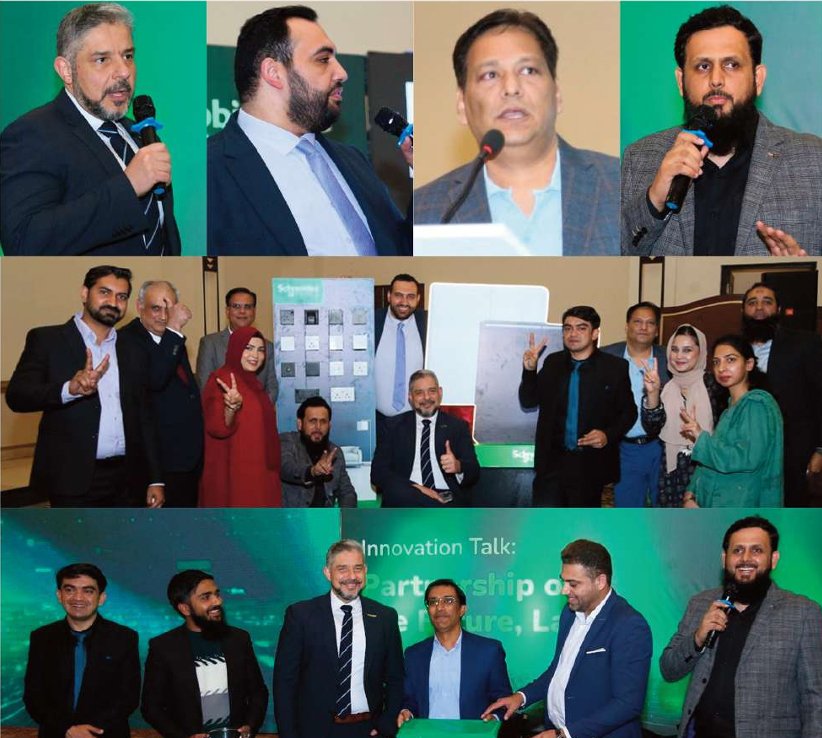
Advancing Energy, Digital Transformation: Schneider Electric Hosts Future Partnership
ENERGY Schneider Electric Pakistan hosted Partnership of the Future – Lahore, bringing together contractors, consultants,…
Leave a Reply