
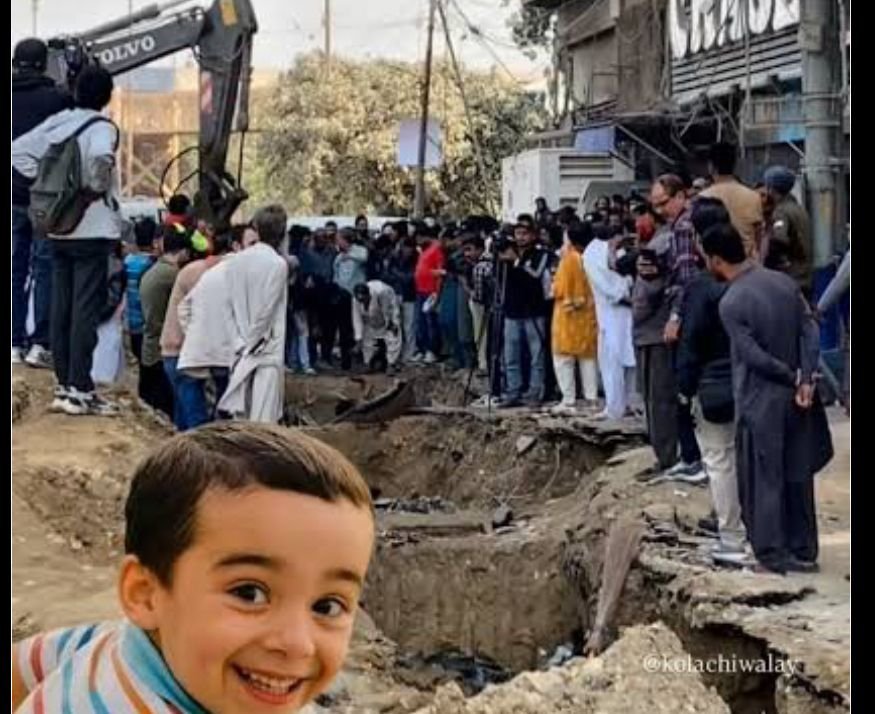
The tragic death of a three-year-old child who fell into an open manhole in Karachi earlier this week is not merely a horrifying accident — it is an indictment of the city’s civic collapse and the collective failure of those entrusted with public safety. A life so young, lost in a manner so cruel and utterly preventable, should shake this city to its core. And yet, if history is any guide, Karachi will mourn briefly before returning to a familiar cycle of apathy, misgovernance, and forgetfulness.
This child’s death should not be allowed to fade into that cycle. It must instead serve as a catalyst for the accountability this city has been denied for decades.
The Banality of Negligence
That an open manhole — a basic municipal hazard that competent cities address within hours, not years — could claim a young life is a measure of how dangerously normalized negligence has become in Karachi. Local reports indicate that more than two dozen people have died in similar incidents this year alone. In any functioning urban system, such a statistic would prompt resignations, emergency audits, and widespread administrative reform. In Karachi, it prompts condolences, promises, and the quiet reinstallation of a manhole cover that may or may not survive the next round of encroachments, theft, or bureaucratic oversight.
When recurring tragedies cease to shock, it is a sign that a city has lost its civic conscience.
A Pattern of Preventable Disasters
The baby’s death does not stand in isolation. It sits atop a long list of avoidable catastrophes that reflect the same administrative failure.
In July, 27 people were killed when a five-storey building collapsed in Lyari — a structure officially declared unsafe three years earlier but never evacuated or demolished. Sindh’s dengue death toll this year reached 27 as well, with public-health experts calling it a “man-made disaster” fuelled by stagnant water, clogged drains, and minimal fumigation. Only three of Karachi’s nine water-filtration plants currently function, and unchlorinated water continues to expose citizens to deadly Naegleria infections. Entire neighbourhoods rely on unregulated tanker water because piped supply has dwindled to a trickle or ceased altogether.
In every case, the underlying cause is the same: a provincial and municipal governance system incapable of performing its most basic responsibilities.
A City Governed by No One
Karachi’s civic dysfunction is rooted in its fragmented, politically contested administrative structure. Responsibility is divided across several overlapping institutions: the Karachi Metropolitan Corporation, district municipal corporations, Karachi Water & Sewerage Corporation, Sindh Building Control Authority, Sindh Solid Waste Management Board, and the provincial government itself. The result is an urban authority where confusion is the rule and accountability the exception.
When a manhole is left open, it is unclear which body should have covered it, who failed to report it, and who must answer for the death that followed. This diffusion of responsibility has become the perfect refuge for incompetence.
The Cost of Looking Away
Too often, Karachi’s tragedies are treated as background noise — unfortunate but inevitable outcomes of a sprawling, overburdened city. But cities do not deteriorate by accident. They deteriorate through deliberate neglect, mismanagement, and the tolerance of poor performance.
A manhole does not open itself. A child does not fall because of fate. These deaths occur because basic inspection, maintenance, and oversight mechanisms have been allowed to collapse or have been corroded through corruption and political interference.
The moral cost of this indifference is catastrophic. The economic cost is not far behind: damaged infrastructure, health crises, and preventable deaths impose billions in losses annually, while eroding public trust in the state’s most fundamental obligations.
What Must Be Done
If Karachi is to prevent more needless deaths, certain steps are non-negotiable:
A citywide audit of all manholes, drains, and sewage points, with immediate repair and covering of hazardous sites. No excuses, no delays.
Clear lines of authority establishing which institution is responsible for sewerage maintenance — and who must be held accountable for negligence.
Strengthening of municipal inspection systems, including routine checks, GPS-mapped reporting, and public disclosure of maintenance data.
Criminal liability where negligence leads to loss of life. A child’s death must not vanish into administrative paperwork.
Long-term investment in Karachi’s sewage, drainage, and water infrastructure, accompanied by independent oversight to ensure funds are used transparently.
Reform of Karachi’s fractured governance structure, ensuring that the city is managed by a single empowered authority rather than a patchwork of competing agencies.
A Chance for Reflection and Action
The death of this young child is a moment of collective reckoning. Karachi has lost many to preventable causes — collapsing buildings, contaminated water, vector-borne diseases, flooding, and civic hazards — but the moral clarity of a tragedy involving a toddler demands more from all of us.
If this incident, too, is allowed to pass without structural reform, Karachi will continue its descent into a city where daily life is a negotiation with danger, and where the most vulnerable pay the highest price.
The child who died in that open manhole deserved better. So do the millions who call this city home. The question now is whether those in power are prepared to confront the truth that Karachi’s citizens already know: this was not an accident — it was a failure. And failures can, and must, be corrected.
Engr. Ramesh Raja is a civil engineer and managerial/ planning professional who also contributes as a freelance writer on technical matters. He may be reached at engineer.raja@gmail.com
READ MORE
Gul Ahmed Textile Mills Limited Appoints Mohammed Zaki Bashir as CEO
PAKISTAN Gul Ahmed Textile Mills Limited (GATM) has appointed Mohammed Zaki Bashir as its Chief…

Lucky Cement Limited Subsidiary Enters Partnership with GAC Group
PAKISTAN Lucky Cement Limited has announced that its subsidiary, Lucky Motor Corporation Limited (LMC), has…
OGDCL Announces Start of Production from Spinwam-1 Discovery
PAKISTAN Oil and Gas Development Company Limited (OGDCL) has announced the commencement of gas and…
Pakistan, Netherlands Explore Expanded Energy Cooperation
PAKISTAN Federal Minister for Petroleum Ali Pervaiz Malik held a meeting with H.E. Robert Jan…
Proposal to Establish Blue Economy Sectoral Council to Boost Exports
PAKISTAN Rana Ihsaan Afzal Khan, Coordinator to the Prime Minister on Commerce, held a meeting…

Pakistan raises climate concerns at Arctic Circle Rome Forum
WORLD Federal Minister for Climate Change Musadik Masood Malik represented Pakistan at the Arctic Circle…
Leave a Reply