
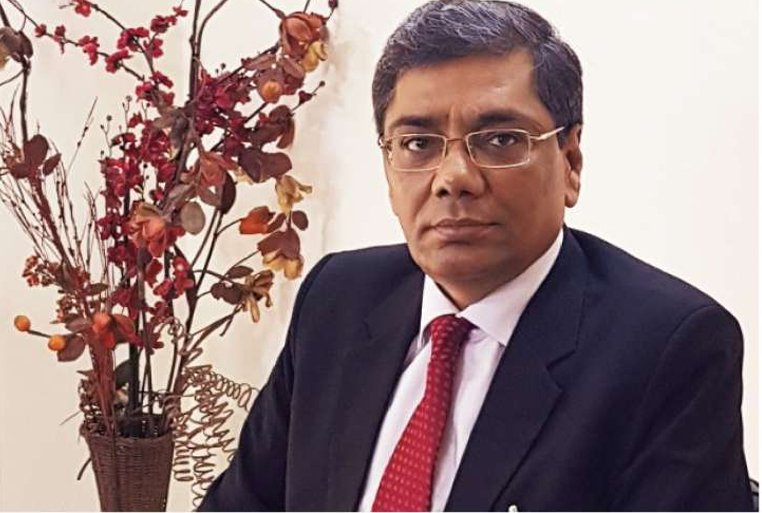

Engr. Saleemullah Saeed
AI Has Limits in Water Engineering, Says Engr. Saleemullah Saeed
Water Engineering & Management Services specializes in the design, engineering, and implementation of water treatment, desalination, and wastewater management systems across key industrial sectors, including textiles, sugar, power, and food & beverages. The company is known for integrating international technologies with local engineering expertise, delivering cost-effective solutions, and providing strong after-sales support. Over the years, it has built a solid reputation for technical reliability, regulatory compliance, and sustainable water management solutions in Pakistan.
Engr. Saleemullah Saeed is a seasoned chemical engineer with more than three decades of professional experience in water and wastewater engineering. After serving Descon Engineering for 11 years, he co-founded Water Engineering & Management Services in 2001 to address Pakistan’s growing need for locally designed and engineered water solutions. He is widely recognized as one of the pioneers who introduced membrane technologies and later industrial wastewater treatment systems in Pakistan. Here is his views.
AI & Water Engineering
Water is a very critical subject around the globe. In Pakistan, it is even more important at present. Here, AI has not significantly affected our field because there is a difference between technology and engineering. Technology does not assess engineering; it provides a general overview, but you cannot design a plant through AI systems. For this, one must rely on experience and synchronize it with the technologies in use.
I feel proud that in 2001 I was the very first person to introduce membrane technologies in Pakistan. After three years, we introduced industrial wastewater treatment technologies. Before that, all such technologies, plants, and equipment were imported, but we started local integration and system manufacturing in Pakistan. Critical equipment is still imported, but we have been doing complete system design locally for the last two decades.
AI provides general information, whereas specific information required for design is not available. We neither get facilitation from AI nor face any threat from it. Maybe in the future, advancements will produce modules that can help; however, at present, there is nothing substantial in water treatment technologies.
Water Institute
To explore any technology, knowledge is essential. It is also important what questions you ask. Unfortunately, there is no dedicated institute for water and wastewater in Pakistan. Pakistani universities also do not offer specialized studies in this area. We have bookish knowledge and old technologies, but membrane technologies, wastewater treatment, and aerobic technologies—newer technologies—are not being focused on by universities. Even the government has not set up any institute to address this need.
This is one of the reasons why projects like Saaf Pani failed, as there was no trained manpower. Most plants failed due to the lack of trained personnel.
Why Universities Stay Away
I think this is due to a drawback in our education system. The main stakeholders are the faculty. It is like a person teaching driving without ever having driven themselves. Faculty members often lack practical experience. Universities remain disconnected from technology due to the absence of industry–academia linkages, resulting in limited awareness of market technologies.
In our universities, students—regardless of discipline—are taught design, yet very little is actually designed in Pakistan. Less than one percent of employment is based on engineers’ design capabilities. Most job opportunities are in operations and maintenance, as these are the real industry challenges. Design is practically sidelined.
We are an agricultural country and have exported agricultural produce for decades, yet the machines we use are imported. We are not even able to reverse-engineer machines. I believe we should initially focus on reverse engineering; this was China’s model many years ago.
Water Awareness and the Textile Industry
There are two categories within the textile industry. Export-oriented industries comply with standards because they supply major international brands. They adhere to requirements related to water conservation, treatment, and sustainability. However, local manufacturers hardly care about water consumption.
Under EPA guidelines, the textile industry was required to install treatment plants by the end of 2025 as the first phase. In the second phase, treated water is supposed to be recycled. In the food and beverage sector, multinational companies have set a target of using 1.2 liters of water per bottle produced. Earlier, it was three liters per bottle. Through various measures, they achieved a target of 1.5 liters per bottle.
Water Quality and Ordinary People
We follow guidelines set by the WHO and the government. Bottled water standards differ from water for general consumption. Total dissolved solids (TDS) are important. The permissible mineral level in drinking water is set at 1,000 ppm, while 500 ppm is considered standard.
In cities, water sources include both underground and surface water. Surface water is generally less contaminated than groundwater.
The issue is that the government relies on only one method for water treatment—RO plants. RO plants are not required for every type of water. Water quality must first be assessed to determine the appropriate treatment. For example, if water has high arsenic levels but is otherwise acceptable, only an arsenic removal plant is required. Gradually, awareness is increasing, but consultants and governments largely still focus only on RO solutions.
About Water Engineering & Management Services
I completed my chemical engineering degree in the 1990s and served Descon Engineering for 11 years. In 2001, I launched this company with my friend Ashfaqur Rehman, who had experience in desalination in Saudi Arabia. There was a significant gap in Pakistan in this field, which we explored by introducing membrane technologies.
In 2004, we expanded into wastewater treatment. Over the past 20 years, we have worked across multiple sectors, particularly textiles, collaborating with Gul Ahmed, Nishat, Interloop, and others, as well as the sugar and power sectors. In the sugar industry, wastewater treatment was a major challenge, but we successfully implemented plants at Alliance Sugar Mills, RYK, and Chashma 1 and 2. Provincial EPAs confirmed our results.
We achieved 30–40 percent cost reduction in projects through local engineering and development of components. While costs are not low, they are significantly lower compared to foreign companies. Local after-sales service is a major advantage. We have built a strong reputation, and even foreign companies now collaborate with us and assess our work.
Initially, there were concerns about us being a local company, but once industries saw international brands integrated through local design and engineering, confidence increased.
Future Plans
Establishing a Water Technology Institute is my dream, and I hope it becomes a reality. Skill institutes should train people in wastewater treatment and related technologies. Business is not my primary concern anymore. After 35 years in engineering, I no longer think only for myself—I think about contributing to the country.
I have tried at multiple levels, but the idea has not yet materialized, perhaps due to a lack of vision. The Engineers Pakistan, led by Engr. Jawed Salim Qureshi, made significant efforts in this regard, including establishing a reverse engineering cell and promoting industry–academia collaboration. This is an ongoing process, and we will continue our endeavors. – By Muhammad Salahuddin
WATCH THE INTERVIEW
READ MORE

Industry 5.0 and Green Engineering: Human-Centric Sustainable Production
INDUSTRY 5.O Industry 5.0 redesigns the production architecture in order to place human beings at…

Navigating the Future of Careers in Pakistan in the AI Era
AI ERA By Prof. Dr. Tariq Rahim Soomro, SMIEEE We rode the wave of freelancing…

US–Israel–Iran War: Where Does Pakistan’s Food Security Stand?
FOOD SECURITY By Manzoor Shaikh For now, doomsday scenario such as a full-scale escalation involving…

A Milestone Achievement in 5G Railway Communication Research
INTERBATIONAL COLLABORATION Mehran University of Engineering & Technology (MUET) proudly announces the successful completion of…

Where does Pakistan stand in unprecedented surge of AI, emerging technologies?
TECHNOLOGY CEO Rastek Technologies, Engr. Rafik Ahmed Lakhani, in a conversation with ER, explained how…
Advancing Energy, Digital Transformation: Schneider Electric Hosts Future Partnership
ENERGY Schneider Electric Pakistan hosted Partnership of the Future – Lahore, bringing together contractors, consultants,…
Leave a Reply