
By Ramesh Raja
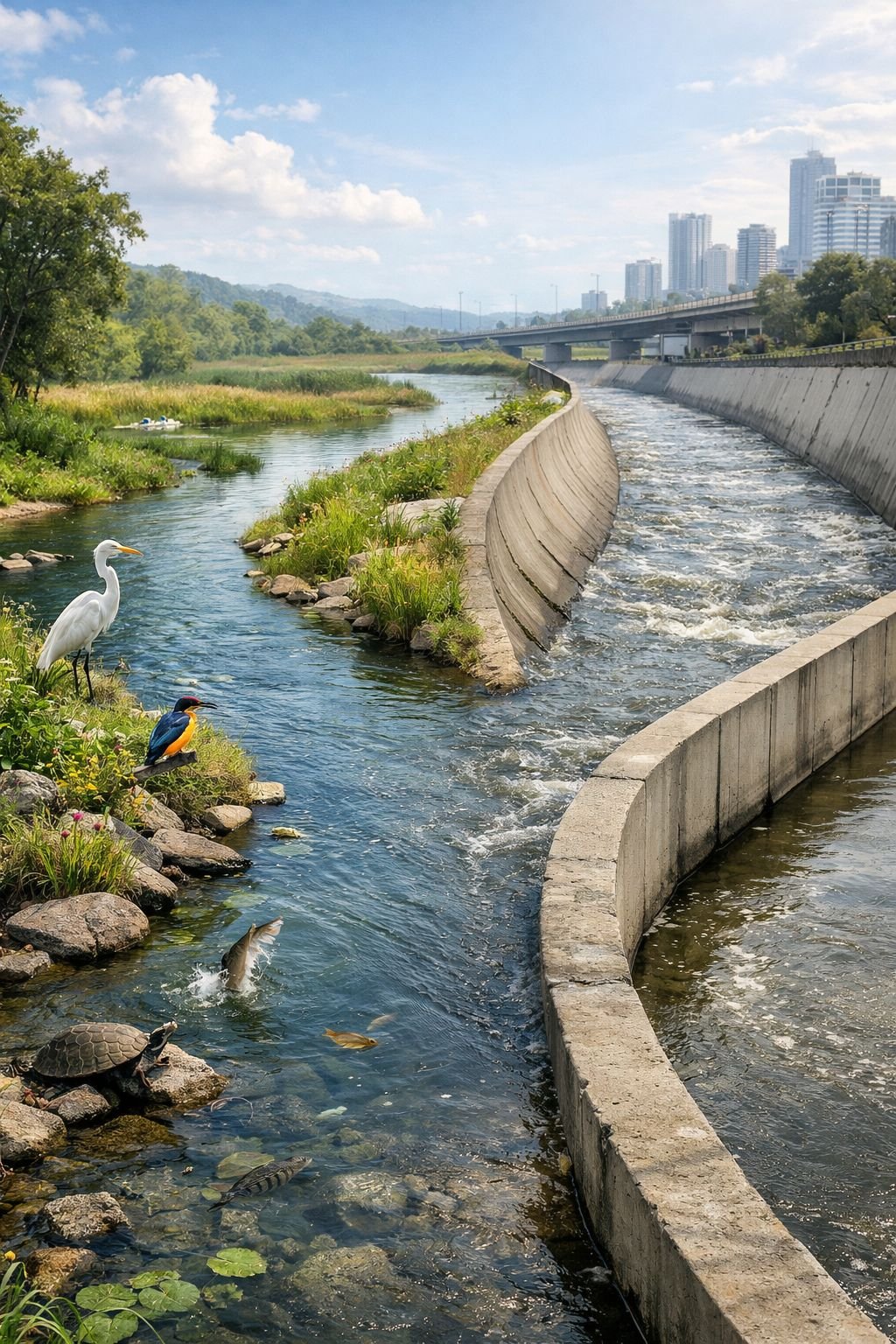
I was educated and trained to straighten rivers, confine them between concrete walls, and force water to behave. For decades, this was considered good engineering. Concrete meant control. Control meant safety. And safety, we believed, meant progress.
But after a lifetime spent designing, building, inspecting, and repairing water infrastructure, I have reached a humbling conclusion: rivers were never the problem — our approach was.
Across the world, and particularly in water-stressed countries like Pakistan, we poured concrete over rivers believing we could outsmart nature. Channels were narrowed to accelerate flows, floodplains disconnected in the name of development, and riverbanks hardened to look modern and efficient. For a while, it seemed to work. Until floods became more destructive, groundwater declined, ecosystems collapsed, and maintenance costs spiraled.
The Hidden Cost of Concrete Control
Concrete does not tame rivers; it imprisons them. By squeezing water into narrow corridors, we increase velocity rather than stability. During intense rainfall, fast-moving water has nowhere to spread, leading to higher flood peaks, sudden urban inundation, infrastructure failure, and loss of life. Ironically, many of the disasters we label as “natural” today are the outcome of rigid engineering decisions.
Concrete riverbanks silently destroy aquatic habitats, cut off groundwater recharge, and transfer flood risk downstream. They also demand perpetual repair. What looks permanent on paper often becomes a long-term financial liability for taxpayers.
As engineers, we were taught to calculate discharge, velocity, and freeboard. What we were not taught enough was restraint.
Nature: The Original Engineer
Natural rivers function differently — and far more intelligently. They slow themselves through meanders, spread safely across floodplains, recharge aquifers through permeable soils, and purify water through wetlands and vegetation. Floodplains are not wasted land; they are natural safety systems. Wetlands are not obstacles; they are living infrastructure.
When rivers are allowed to reconnect with vegetation, wetlands, stones, and floodplains, flood peaks naturally reduce, groundwater replenishes, pollution is filtered, biodiversity returns, and even urban temperatures decline. No mechanical system delivers so many benefits simultaneously — and at such low long-term cost.
Engineering Meets Ecology
This is not a call to abandon engineering. It is a call to evolve it.
Nature-based solutions — river restoration, wetland rehabilitation, riparian planting, and green urban drainage — are not sentimental ideas. They are high-performance systems, backed by science and economics. Global research consistently shows that restoring natural hydrology can reduce flood risk by up to 40 percent while costing less over a project’s life cycle than concrete infrastructure.
In an era of climate uncertainty, ecosystems scale better than concrete.
Knowing Where Control Is Necessary — and Where It Is Not
Sound engineering is not about doing more; it is about doing what is appropriate. In irrigation systems, water is distributed through three main components: rivers, canals, and watercourses. Treating all three with the same engineering philosophy is a fundamental mistake.
Rivers and major canals should, as far as possible, remain natural or near-natural systems. They are the arteries of the hydrological cycle and must retain their ability to recharge groundwater, support biodiversity, dissipate flood energy, and adapt to climatic variability. Over-confinement only amplifies risk.
Watercourses, however, serve a different role. They are last-mile distribution channels. Where water losses are excessive, selective lining of watercourses can be justified to improve efficiency and equity — provided it is carefully designed and does not eliminate beneficial recharge where communities depend on shallow aquifers.
Precision matters. Let rivers live. Let canals balance flow and ecology. Engineer watercourses where efficiency gains are real.
Pakistan’s Irrigation System: Scale and Sensitivity
Pakistan operates one of the world’s largest contiguous irrigation networks, anchored in the Indus River system. The Indus and its tributaries, Jhelum, Chenab, Ravi, Beas, and Sutlej, sustain nearly 90 percent of the country’s agriculture and millions of livelihoods.
Historically, these rivers carried seasonal floods that nourished floodplains, wetlands, and delta ecosystems. Over time, embankments, barrages, and rigid flow regulation have increasingly disconnected rivers from their natural systems. While regulation is essential for allocation, over-engineering has reduced resilience.
From these rivers branches an extensive canal network — including major systems such as the Upper Chenab Canal, Lower Bari Doab Canal, and the canal systems of Sukkur, Guddu, and Kotri barrages. Canals represent a middle ground: they require management, but excessive lining eliminates seepage that once sustained groundwater reserves in arid regions.
At the final level lie over 100,000 watercourses, where the greatest conveyance losses occur. From both engineering and ecological perspectives, this is where lining delivers the highest benefit with the least environmental cost.
Pakistan’s challenge is not a lack of infrastructure, but misplaced uniformity. Rivers, canals, and watercourses require differentiated thinking.
Climate Change and the Limits of Rigidity
Climate change has rewritten the rules of design. Rainfall is more intense, storms are more erratic, and historical data is increasingly unreliable. Rigid systems fail abruptly due to such uncertainty. Ecosystems, by contrast, absorb shock gradually.
Concrete assumes stability.
Nature assumes change.
Vegetated floodplains adapt. Wetlands expand and contract. Natural channels self-repair. This adaptability is resilience, and resilience is now the most valuable design parameter.
An Ethical Responsibility
Rivers are not drainage lines. They are living systems that sustain food security, groundwater, culture, and identity. When we degrade them, we do not merely damage ecology; we destabilize societies.
As an engineer who has spent a lifetime building infrastructure, I believe our greatest legacy will not be the concrete we poured, but the systems we had the wisdom to restore.
The Way Forward
The future of water engineering lies in partnership with nature. This means:
- Designing with floodplains, not against them
- Restoring riverbanks with vegetation instead of concrete
- Integrating green infrastructure into urban planning
- Valuing ecosystem services in economic analysis
- Training engineers to think ecologically, not just hydraulically
Healthy rivers mean safer cities, resilient agriculture, stronger economies, and a livable future.
Final Reflection
Concrete may look permanent, but ecosystems endure longer.
If engineering is the art of solving problems, then the most intelligent solution before us is clear: Let rivers flow like rivers again.
Engr. Ramesh Raja is a civil engineer and managerial/ planning professional who also contributes as a freelance writer on technical matters. He may be reached at engineer.raja@gmail.com
READ MORE

Pakistan, Netherlands Explore Expanded Energy Cooperation
PAKISTAN Federal Minister for Petroleum Ali Pervaiz Malik held a meeting with H.E. Robert Jan…
Proposal to Establish Blue Economy Sectoral Council to Boost Exports
PAKISTAN Rana Ihsaan Afzal Khan, Coordinator to the Prime Minister on Commerce, held a meeting…
Pakistan raises climate concerns at Arctic Circle Rome Forum
WORLD Federal Minister for Climate Change Musadik Masood Malik represented Pakistan at the Arctic Circle…
OGDCL, PPL Announce Oil and Gas Discovery at Baragzai X-01 Well
PAKISTAN Oil and Gas Development Company Limited (OGDCL) and Pakistan Petroleum Limited (PPL) have announced…

Supernet Announces CEO Change, Jamal Nasir Khan Appointed as New Chief Executive
PAKISTAN Supernet Limited has announced a change in its top management, informing the Pakistan Stock…

Building Future with Tech-Skilled Youth
By Ramesh Raja Sindh, with its rich cultural heritage and industrious population, is home to…
Leave a Reply