
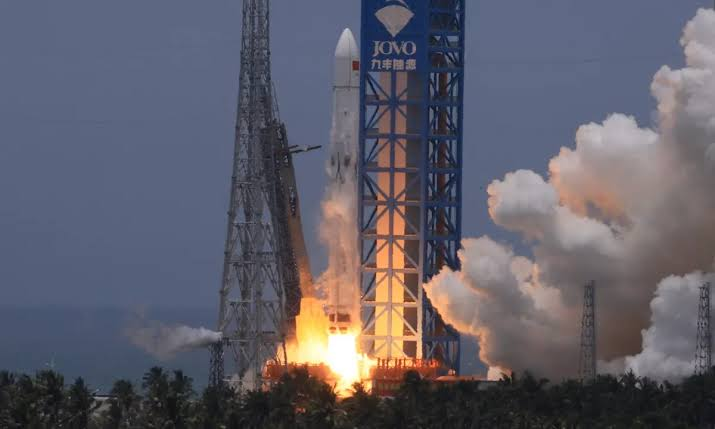
China on Friday successfully tested an experimental sea-based rocket recovery system, marking the country’s first successful retrieval of an orbital-class booster and moving it closer to developing reusable launch vehicles.
The Long March 10B lifted off from the Hainan Commercial Space Launch Site at 12:15 p.m. local time. About six minutes after separating from the upper stage, the booster returned vertically and was captured by a net mounted on an offshore platform, according to state broadcaster CCTV.
State media said the rocket successfully placed a satellite into its preset orbit before the booster recovery was completed.
The achievement is seen as a significant step in China’s efforts to develop reusable rockets and reduce launch costs for its expanding commercial satellite industry. Following the announcement, shares of several Chinese aerospace companies, including China Spacesat and China Satellite Communications, rose sharply and hit their daily trading limits.
The Long March 10B, developed by the China Academy of Launch Vehicle Technology, has often been compared with Falcon 9. It can carry at least 16 metric tons to low-Earth orbit. Unlike Falcon 9, which lands on deployable legs, the Chinese rocket uses four landing hooks to catch a recovery net suspended above a sea platform.
Chen Muye, an expert at CALT, told state news agency Xinhua that the net-based system simplifies the rocket’s onboard structure, reduces weight and increases payload capacity while providing greater tolerance for landing-point deviations.
SpaceX first landed a Falcon 9 booster from an orbital flight in 2015, and reusable rockets have since become a cornerstone of the global launch industry. China has been working on similar technology for nearly a decade, progressing from low-altitude hover tests to orbital-class recovery attempts.
Private Chinese firms have also intensified efforts to develop reusable rockets, aided by relaxed initial public offering rules designed to help companies raise funding. Attempts by LandSpace and the China Aerospace Science and Technology Corporation last year failed during the final landing and recovery phase.
The Long March 10B is part of the broader Long March 10 family being developed for China’s planned crewed lunar missions before 2030. State media said the recovered booster is expected to be used again for another launch before the end of this year.-ERMD
READ MORE

Zong Launches 5G Home Broadband Service in Pakistan
Zong has launched Z HomeFi, a 5G fixed wireless access (FWA) home broadband service, aiming…
BYD Eyes Ultra-Fast EV Charging Technology for Pakistan
Chinese electric vehicle (EV) manufacturer BYD is in discussions with its Pakistani partner, Mega Motor…

Game-Based Digital Therapies Show Mixed Results in Treating Children with ADHD
Stimulant medications are among the most common treatments for children with attention-deficit/hyperactivity disorder (ADHD), helping…

Henri Kagan and Kenso Soai Awarded 2026 Nobel Prize in Chemistry
Scientists Henri Kagan and Kenso Soai have been awarded the 2026 Nobel Prize in Chemistry…

In Memory of Mohammad Akram Sheikh Chairman United Wire Industries
Mohammad Akram Sheikh Chairman United Wire Industries With profound sorrow, we remember Mr. Mohammad Akram…

IEEE Education Society Karachi Section Hosts Dr. Chi-Un Lei Webinar
Rethinking Graduate Education in Age of AI Chair IEEE Education Society, Karachi Section, Prof Dr…