
Britain has called for urgent international action to establish safeguards for artificial intelligence (AI), warning that the technology could become one of the world’s biggest security challenges over the next decade if left unchecked.
In a policy article to be published by think tank Chatham House, UK Home Secretary Yvette Cooper is expected to urge governments to work together on global AI governance, saying the world cannot afford to wait for a major AI-related disaster before introducing effective regulation.
Cooper will compare the rapid rise of AI with the development of nuclear technology after the Second World War, arguing that international cooperation on nuclear safety only emerged after the devastating atomic bombings of Hiroshima and Nagasaki.
“On nuclear, international agreement came only after the world saw the terrifying power of the new technology at Hiroshima and asked what would happen if it fell into the wrong hands,” she will say. “We cannot afford to wait for an AI equivalent of Hiroshima before we act.”
Her warning comes amid growing international concern over the misuse of AI in cybercrime, fraud, disinformation and other security threats.
A recent United Nations report cautioned that AI could lead to “catastrophic outcomes” if governments fail to keep pace with the technology’s rapid development.
Concerns have also been raised within the technology industry.
AI company Anthropic recently restricted the release of its Mythos model over fears it could be exploited to identify cybersecurity vulnerabilities.
Cooper is expected to argue that Britain is well positioned to lead international efforts on AI safety, citing its hosting of the world’s first AI Safety Summit in 2023, which brought together political leaders, technology executives and researchers to discuss the responsible development of AI.
She will emphasise that the benefits of frontier technologies can only be fully realised if countries reach a broad international consensus on safety standards, governance and regulatory guardrails. Bloomberg-ERMD
READ MORE
Engr. Waseem Asghar re-elected ACEP Chairman
Engr. Waseem Asghar has been re-elected Chairman of the Association of Consulting Engineers Pakistan (ACEP)…
Adoption of Industry 5.0 Technologies in Sustainable Engineering
In the field of engineering for sustainability, the switch to Industry 5.0 technologies signifies a…

Pakistan Cables recognized at 3rd International Solar Technology Excellence Awards 2026
Pakistan Cables Ltd. has been recognized as the exclusive category winner for Solar DC Cables…
PEC Deadlock: How Did the Two-Year Crisis Develop?
The Pakistan Engineering Council (PEC) is facing a serious institutional deadlock, raising questions about how…
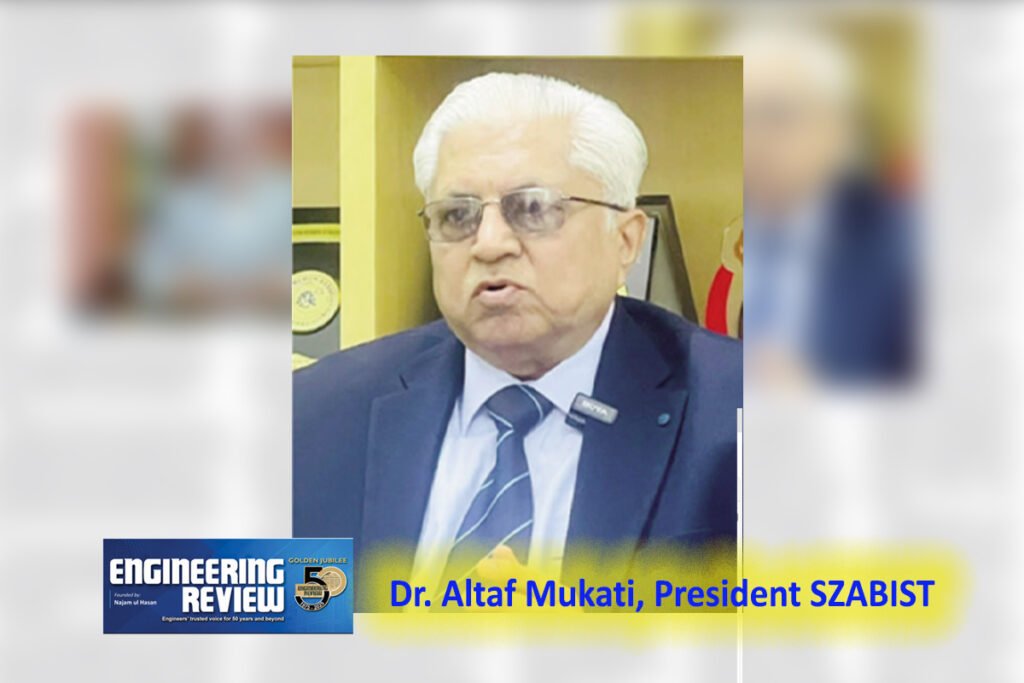
Prof. Dr. Altaf Mukati appointed SZABIST President
Prof. Dr. Muhammad Altaf Mukati has been appointed President of Shaheed Zulfikar Ali Bhutto Institute…
Sheikh Tariq Nazir elected CAP chairman unopposed
Sheikh Tariq Nazir has been elected unopposed as Chairman of the Constructors Association of Pakistan…