
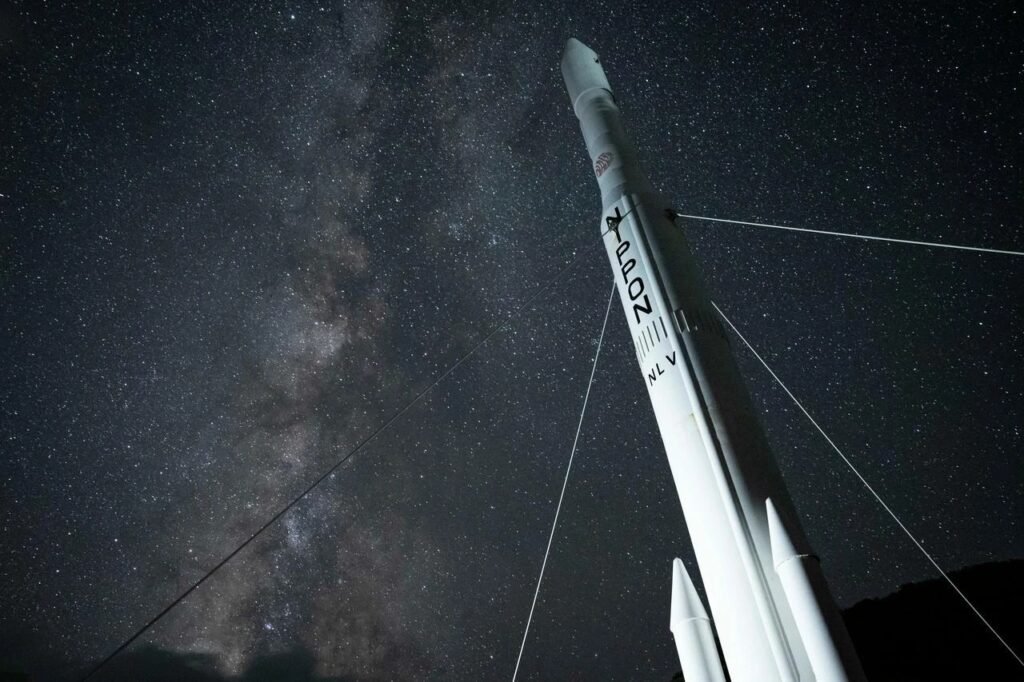
Japanese scientists are preparing to launch a mission to Mars’ moons that could provide new clues about the formation of the Solar System and the origins of life on Earth, while China is pursuing a competing mission that could return Martian samples first.
The Japan Aerospace Exploration Agency’s (JAXA) Martian Moons eXploration (MMX) spacecraft is scheduled to launch from the Tanegashima Space Centre in the coming months. It will spend about three years around Mars and attempt to land on Phobos, the larger of the planet’s two moons.
MMX will collect at least 10 grams of material from Phobos, while the Idefix rover, named after the dog in the French comic series Asterix, will conduct surface observations. The spacecraft will also study Deimos before sending a return capsule to Earth, with the landing expected in Australia around 2031.
Scientists hope the samples will help resolve how Mars’ moons formed. One theory suggests Phobos and Deimos were created from debris after a large object collided with Mars. Another proposes that they are asteroids from the outer Solar System captured by Mars’ gravity.
Determining which theory is correct could improve understanding of how water, organic compounds and other materials reached the inner Solar System and helped create habitable conditions on rocky planets.
French astrophysicist Patrick Michel, involved with the Idefix rover, said the moons could preserve clues about materials that contributed to the emergence of life.
JAXA also hopes MMX will develop technologies needed for future crewed missions to Mars. The agency is exploring whether Phobos could eventually serve as a “natural space station”.
The mission involves France’s CNES, Germany’s DLR, NASA, the European Space Agency and several universities and companies. Engineers have faced challenges designing landing legs because Phobos has extremely weak gravity.
Japan previously demonstrated its sample-return expertise when Hayabusa-2 brought 5.4 grams of asteroid material back to Earth in 2020.
China’s Tianwen-3 mission is expected to launch around 2028 and return Martian samples around 2031, potentially beating MMX to Earth. – ERMD
READ MORE

Kaspersky Raises Alarm Over Cyber Threats to Young Pakistani Users
Cybersecurity company Kaspersky has warned that children in Pakistan may face a range of online…

Pakistani Robotics Firm Hosts Hackathon at UC Berkeley
Pakistani robotics data company World Context has held its first robotics hackathon at the University…

Pakistan Nears Selection of First Astronaut for China’s Tiangong Mission
Pakistan is preparing to select its first astronaut for a mission to China’s Tiangong space…

SoftBank Raises $11.1bn Through Bond Sale to Fund OpenAI Investment
Japanese technology investor SoftBank Group has raised $11.1 billion through dollar- and euro-denominated bond offerings,…

Fauji Cement Approves 50 MWh Battery Energy Storage and 10 MW Solar Project
The Board of Directors of Fauji Cement Company Limited (FCCL) has approved the installation of…

First-Year QUEST Nawab Shah Student Found Dead; Students Allege Brutal Torture
The body of a first-year student of the Quaid-e-Awam University of Engineering, Science and Technology…