
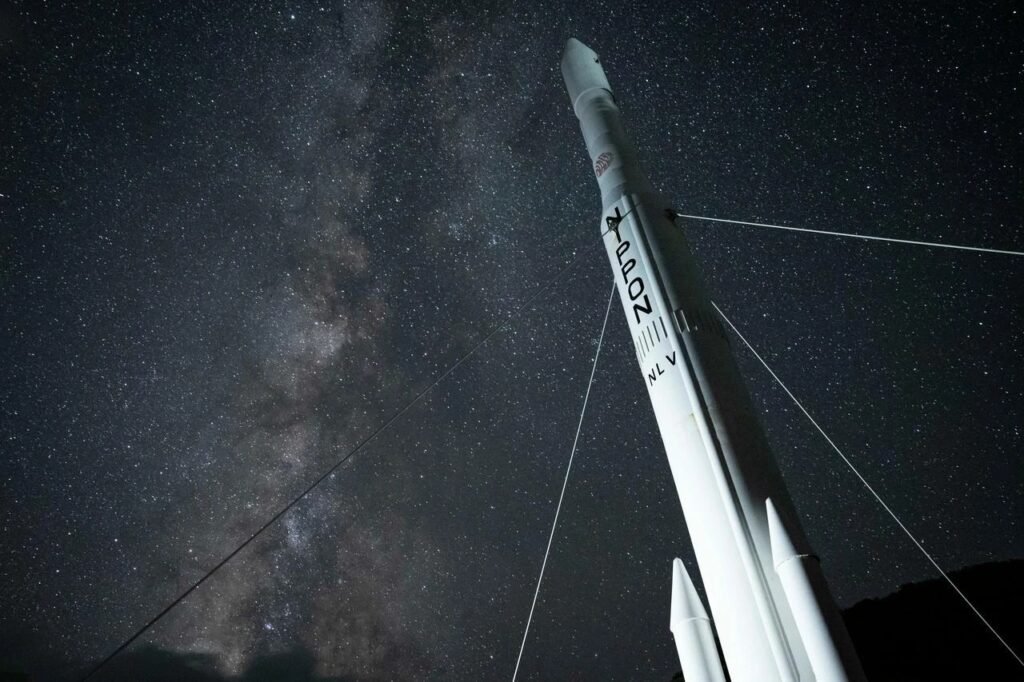
Japanese scientists are preparing to launch a mission to Mars’ moons that could provide new clues about the formation of the Solar System and the origins of life on Earth, while China is pursuing a competing mission that could return Martian samples first.
The Japan Aerospace Exploration Agency’s (JAXA) Martian Moons eXploration (MMX) spacecraft is scheduled to launch from the Tanegashima Space Centre in the coming months. It will spend about three years around Mars and attempt to land on Phobos, the larger of the planet’s two moons.
MMX will collect at least 10 grams of material from Phobos, while the Idefix rover, named after the dog in the French comic series Asterix, will conduct surface observations. The spacecraft will also study Deimos before sending a return capsule to Earth, with the landing expected in Australia around 2031.
Scientists hope the samples will help resolve how Mars’ moons formed. One theory suggests Phobos and Deimos were created from debris after a large object collided with Mars. Another proposes that they are asteroids from the outer Solar System captured by Mars’ gravity.
Determining which theory is correct could improve understanding of how water, organic compounds and other materials reached the inner Solar System and helped create habitable conditions on rocky planets.
French astrophysicist Patrick Michel, involved with the Idefix rover, said the moons could preserve clues about materials that contributed to the emergence of life.
JAXA also hopes MMX will develop technologies needed for future crewed missions to Mars. The agency is exploring whether Phobos could eventually serve as a “natural space station”.
The mission involves France’s CNES, Germany’s DLR, NASA, the European Space Agency and several universities and companies. Engineers have faced challenges designing landing legs because Phobos has extremely weak gravity.
Japan previously demonstrated its sample-return expertise when Hayabusa-2 brought 5.4 grams of asteroid material back to Earth in 2020.
China’s Tianwen-3 mission is expected to launch around 2028 and return Martian samples around 2031, potentially beating MMX to Earth. – ERMD
READ MORE

Pakistan, World Bank Group Agree to Accelerate Reforms and Investment-Led Growth
Federal Minister for Economic Affairs Ahad Khan Cheema met World Bank Group (WBG) President Ajay…

ECNEC Approves 11 Development Projects in Energy, Infrastructure, Healthcare, Technology
The Executive Committee of the National Economic Council (ECNEC), chaired by Deputy Prime Minister and…

Pakistan, EU Explore Cooperation in Electric Vehicle Skills Development
Advisor to the Prime Minister for Industries and Production Haroon Akhtar Khan has directed the…

NUST Honours 66 PhD Scholars and 54 Medal-Winning Undergraduates at Convocation
Federal Minister for Planning, Development and Special Initiatives Ahsan Iqbal has urged graduates of the…

IBA, AKU and Habib University Join Hands to Rethink Education in the AI Era
The Institute of Business Administration (IBA) Karachi, in collaboration with Aga Khan University (AKU) and…

ABB Reports Strong Growth as AI Data Centre Spending Surges
Swiss engineering company ABB has reported strong growth in earnings, driven by a continued surge…