
By Raja Ramesh
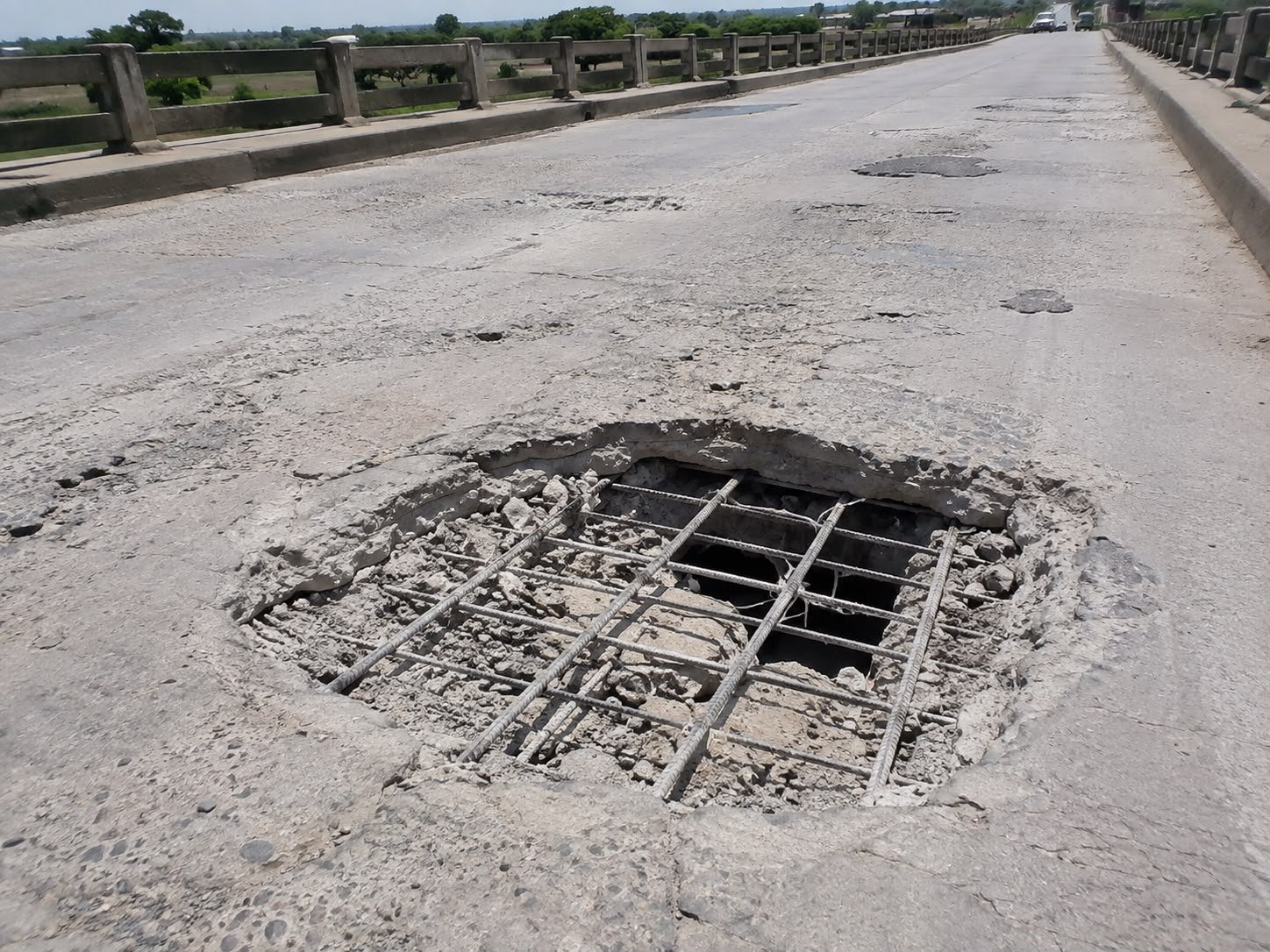
Why are cracks, spalling and holes appearing on Pakistan’s newly constructed bridge decks?We cross them every day, but are we ignoring the growing threat beneath our wheels?
Across Pakistan, people cross hundreds of bridges every day on NHA and provincial road networks. Yet an increasingly disturbing sight is becoming common: new bridge deck slabs developing cracks, spalling, exposed reinforcement and even holes within one or two years of construction. What should be durable structural infrastructure is, in some cases, beginning to resemble a deteriorating road pavement soon after opening.
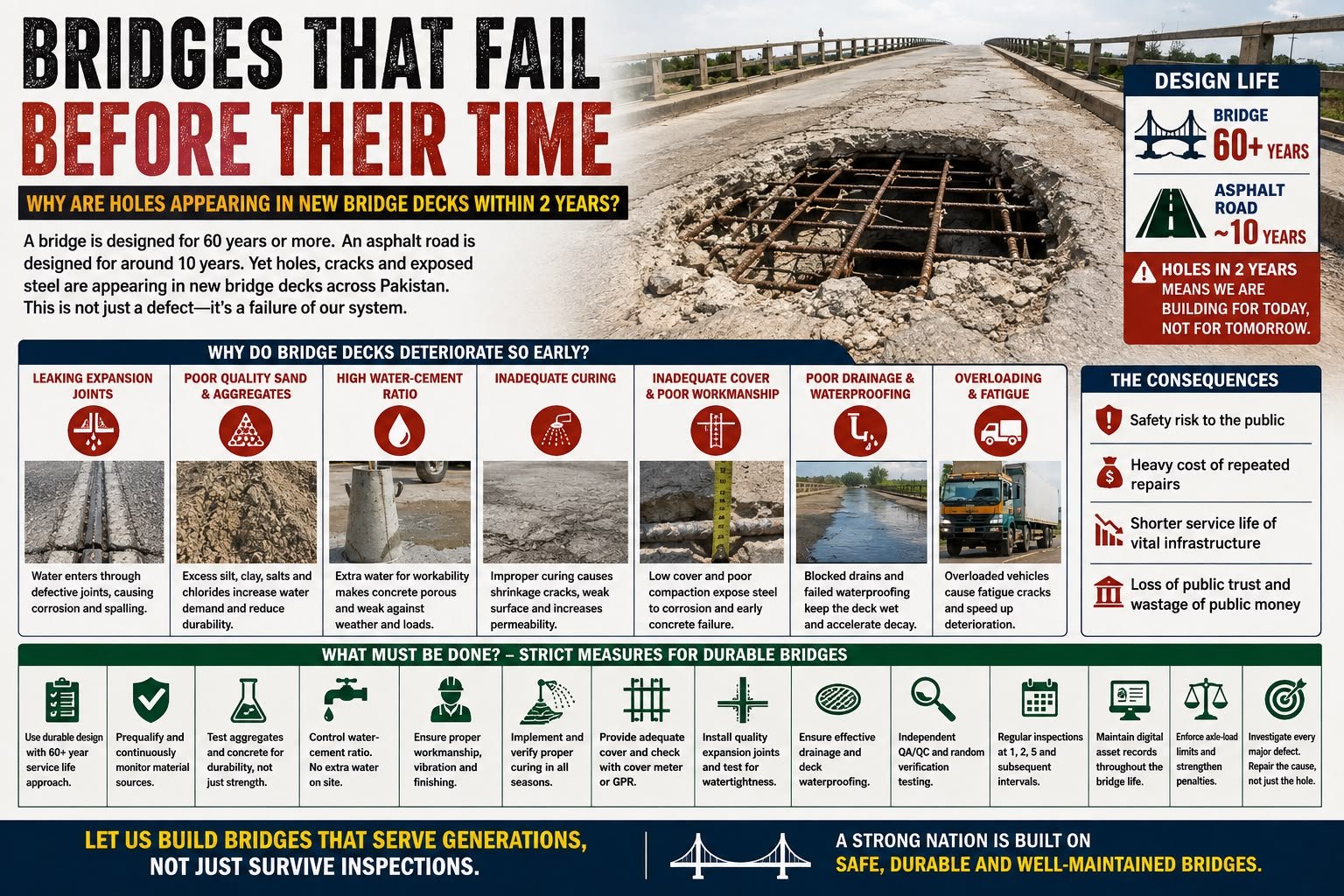
This deserves serious national attention. An asphalt pavement may commonly have a design period of around 10 years before major rehabilitation, depending on traffic, climate and specifications. A bridge is fundamentally different. Major bridge structures are generally designed for a service life of 60 years or more. Their decks, girders, piers and foundations represent long-term public investment and are expected to remain safe and functional for generations.
Therefore, when holes appear in a bridge deck within two years, it is not simply a maintenance issue. It is a warning that something in the chain of design, materials, construction, supervision, durability, traffic loading or maintenance requires investigation.
We Have Standards, Plants, Laboratories and Consultants. So What Is Going Wrong?
Pakistan cannot be accused of having no technical standards. Modern projects use automatic concrete batching plants, sophisticated laboratories, independent consultants and quality-control systems. ASTM, AASHTO, BS, EN and project-specific specifications are routinely incorporated into highway and bridge contracts. Concrete cubes are tested, aggregates are approved, reinforcement is inspected and volumes of documentation are generated.
Yet premature deterioration continues.
This suggests that the problem is not necessarily a lack of standards, but a gap between documented compliance and actual field performance. An automatic batching plant can accurately measure and mix materials, but it cannot turn poor-quality sand into good sand. A laboratory can certify a cube, but a few specimens cannot represent every cubic metre of concrete placed under variable site conditions. A consultant can certify compliance with drawings, but certification alone cannot guarantee decades of durability.
The engineering question should therefore change from “Did the paperwork comply?” to “What physical mechanism is causing the bridge to fail?”
Expansion Joints, Drainage and Water Ingress
Expansion joints should be among the first elements investigated in prematurely deteriorating decks. They must accommodate repeated thermal and traffic-induced movement while preventing water and contaminants from entering the structure.
A defective or leaking joint can initiate a destructive sequence: water ingress, reinforcement corrosion, cracking, delamination, spalling and ultimately loss of deck concrete.
Poor joint installation, incorrect movement gaps, inadequate anchorage, defective seals, insufficient concrete compaction around anchors and ineffective drainage can all contribute. Waterproofing must also be properly connected with the joint system.
For a bridge designed for 60 years or more, an expansion joint cannot be treated as a minor finishing item. It is a critical life-cycle component requiring proper selection, installation, inspection, maintenance and planned replacement.
Sand, Aggregates and Concrete Durability
The quality of sand and aggregates is another critical but often underestimated factor. Fine aggregate containing excessive silt, clay, chlorides, sulphates, organic impurities or harmful reactive constituents can adversely affect concrete performance.
Poorly graded or contaminated sand can increase water demand. If additional water is introduced to obtain workability, the effective water-cement ratio increases, producing more permeable concrete. The sequence can become:
poor aggregate → increased water demand → higher water-cement ratio → porous concrete → water and chloride ingress → corrosion → cracking and spalling.
An approved source does not guarantee uniform quality forever. Actual materials delivered during each major concrete operation should remain traceable and subject to appropriate testing.
For bridge decks, compressive strength alone is not a sufficient measure of durability. Low permeability, resistance to chloride ingress, shrinkage, cracking and other exposure-related characteristics must also be considered.
Curing and Field Construction: The Hidden Gap
Pakistan’s climate makes curing particularly important. High temperature and rapid evaporation can cause plastic and drying shrinkage, surface weakness and increased permeability if concrete is not adequately protected and cured.
Similarly, poor vibration can cause honeycombing and voids. Inadequate reinforcement cover exposes steel to environmental attack. Poor construction joints can become pathways for water. Excessive surface finishing or improper finishing over bleed water can weaken the surface.
These defects may not appear in laboratory reports. They are field-performance issues.
This is why bridge-deck construction requires intensive inspection during reinforcement fixing, concreting, vibration, finishing and curing, rather than relying primarily on the final test certificates.
Overloading Must Be Measured, Not Assumed
Heavy-vehicle overloading is undoubtedly a serious issue on Pakistan’s roads. Excessive axle loads increase fatigue stresses, dynamic effects and repeated wheel-load damage. However, overloading should not become a universal explanation for every premature bridge defect.
Where overloading is suspected, actual axle-load surveys, traffic counts, fatigue assessment and damage-pattern analysis should be undertaken and compared with design assumptions.
Engineering conclusions must be based on evidence.
From Test Passing to Performance Proving
The fundamental reform required is a shift from quality-control paperwork to life-cycle performance.
For major bridges, material sources should be strictly prequalified and continuously monitored. Fine and coarse aggregates should be tested for grading, silt, clay, chlorides, sulphates and relevant durability characteristics. Concrete should be controlled for actual water-cement ratio and, where appropriate, permeability, chloride resistance, electrical resistivity, sorptivity and shrinkage in addition to compressive strength.
Actual reinforcement cover should be verified using cover meters or other non-destructive techniques. Expansion joints, waterproofing and drainage should have dedicated inspection and acceptance procedures. Curing should be treated as a critical construction operation, particularly during extreme temperatures.
Independent verification testing should genuinely be independent and include random checks of critical materials and completed works.
Strict Measures for Durable Bridges
Pakistan should establish a stronger life-cycle durability framework for major NHA and provincial bridges.
Every major bridge should have a documented service-life assessment covering environmental exposure, corrosion, fatigue, traffic growth, flooding, climate effects, drainage and replacement of vulnerable components. Durability requirements should become contractual obligations, not merely recommendations.
Material sources and individual concrete pours should be traceable. Unauthorized addition of water should be prohibited. Aggregate moisture corrections should be verified. Reinforcement cover should be checked in the completed work, not merely accepted from drawings.
Expansion joints should undergo independent checks for movement capacity, installation, anchorage, sealing and water-tightness. Deck drainage and waterproofing should be treated as essential durability systems.
Major bridges should receive systematic condition surveys at one, two, five and subsequently defined intervals, with detailed inspections according to condition and risk. Each bridge should have a permanent digital asset record containing drawings, mix designs, material sources, test results, construction records, inspection findings and repair history.
Most importantly, a significant premature defect should trigger a forensic root-cause investigation. A hole should not simply be patched without determining why it developed.
Accountability Must Extend Beyond Inauguration
A bridge should not be considered successful merely because it is completed on schedule, passes laboratory tests and is opened to traffic. The real test begins after inauguration.
If serious deterioration occurs within two years, the investigation should establish whether the cause was design, materials, construction, curing, inadequate cover, expansion-joint leakage, drainage, waterproofing, environmental exposure, overloading or inadequate maintenance.
Where negligence or non-compliance is established, responsibility should follow the evidence.
Repairing symptoms without eliminating causes merely creates recurring expenditure. If the joint is leaking, repair the joint. If water is penetrating through defective waterproofing, rectify the waterproofing. If corrosion is occurring, address its source and mechanism. If concrete durability is inadequate, determine why. If overloading is accelerating fatigue, enforce axle-load regulations.
Building for Generations, Not Inauguration Day
Pakistan already possesses the engineers, consultants, laboratories, technology and international standards necessary to build durable bridges. The challenge is to connect these resources with strict field enforcement, independent verification and long-term accountability.
A major bridge designed for 60 years or more should not develop holes within two years. For strategically important structures, Pakistan should aspire to a 100-year durability vision, supported by appropriate design, inspection, maintenance and planned replacement of vulnerable components.
Every hole in a young bridge deck should therefore be treated as more than a pothole. It is a visible symptom of a potentially deeper engineering failure.
We must stop asking only whether a bridge passed its tests on the day it was completed. We must ask whether it will continue to perform safely decades later. The objective should not merely be to build bridges that pass inspection. It should be to build bridges that pass the test of time.
READ MORE

China’s Robot Trainers Turn Household Chores into AI Training Data
Across China, a growing number of freelance workers are training robots by performing everyday household…

AI Safety Concerns Dominate Dublin Summit as Experts Warn of Emerging Threats
Artificial intelligence safety emerged as a major concern at an industry summit in Dublin on…
40 Major Media Groups Join Coalition to Protect Journalism from AI Copyright Violations
Forty major media organisations, including The New York Times, The Economist and Agence France-Presse (AFP),…

Zong Launches 5G Home Broadband Service in Pakistan
Zong has launched Z HomeFi, a 5G fixed wireless access (FWA) home broadband service, aiming…

BYD Eyes Ultra-Fast EV Charging Technology for Pakistan
Chinese electric vehicle (EV) manufacturer BYD is in discussions with its Pakistani partner, Mega Motor…

Game-Based Digital Therapies Show Mixed Results in Treating Children with ADHD
Stimulant medications are among the most common treatments for children with attention-deficit/hyperactivity disorder (ADHD), helping…