

The federal government has enforced the Telecommunication Equipment Standards Regulations, 2024, making compliance with internationally recognized technical, safety and electromagnetic standards mandatory for all telecommunication equipment manufactured, imported, sold or used in Pakistan.
The regulations were notified by the Ministry of Information Technology and Telecommunication through SRO 1110(I)/2026 and have been framed by the Pakistan Telecommunication Authority (PTA) under the Pakistan Telecommunication (Re-organization) Act, 1996, with the approval of the federal government. The rules took effect immediately upon their publication in the official Gazette.
Under the new framework, all telecom licensees, manufacturers and importers must ensure that equipment complies with prescribed technical standards and testing procedures before it can be deployed in Pakistan. The regulations aim to improve network security, consumer safety, service quality and interoperability by ensuring telecom devices meet globally accepted performance and safety benchmarks.
The regulations define key technical concepts, including electromagnetic compatibility (EMC), radio frequency (RF), fixed wireless access, satellite communication devices and telecommunication equipment standards. They also authorize designated PTA officials to monitor compliance and enforce the new requirements.
To align Pakistan’s telecom sector with international best practices, the PTA has adopted standards developed by leading global organizations, including the International Telecommunication Union (ITU-T), the European Union’s Radio Equipment Directive (RED), the Federal Communications Commission (FCC), the International Organization for Standardization (ISO), the European Telecommunications Standards Institute (ETSI), the International Electrotechnical Commission (IEC), CISPR, CENELEC and OHSAS.
The mandatory standards cover a wide range of areas, including electromagnetic compatibility, health and electrical safety, optical and laser safety, radio frequency communications, mobile and satellite communications, and terrestrial telecommunications equipment. The PTA will also periodically review and update these standards in consultation with stakeholders to keep pace with technological developments and evolving international best practices. – ERMD
Engr. Waseem Asghar re-elected ACEP Chairman
Engr. Waseem Asghar has been re-elected Chairman of the Association of Consulting Engineers Pakistan (ACEP)…

Adoption of Industry 5.0 Technologies in Sustainable Engineering
In the field of engineering for sustainability, the switch to Industry 5.0 technologies signifies a…

Pakistan Cables recognized at 3rd International Solar Technology Excellence Awards 2026
Pakistan Cables Ltd. has been recognized as the exclusive category winner for Solar DC Cables…

PEC Deadlock: How Did the Two-Year Crisis Develop?
The Pakistan Engineering Council (PEC) is facing a serious institutional deadlock, raising questions about how…
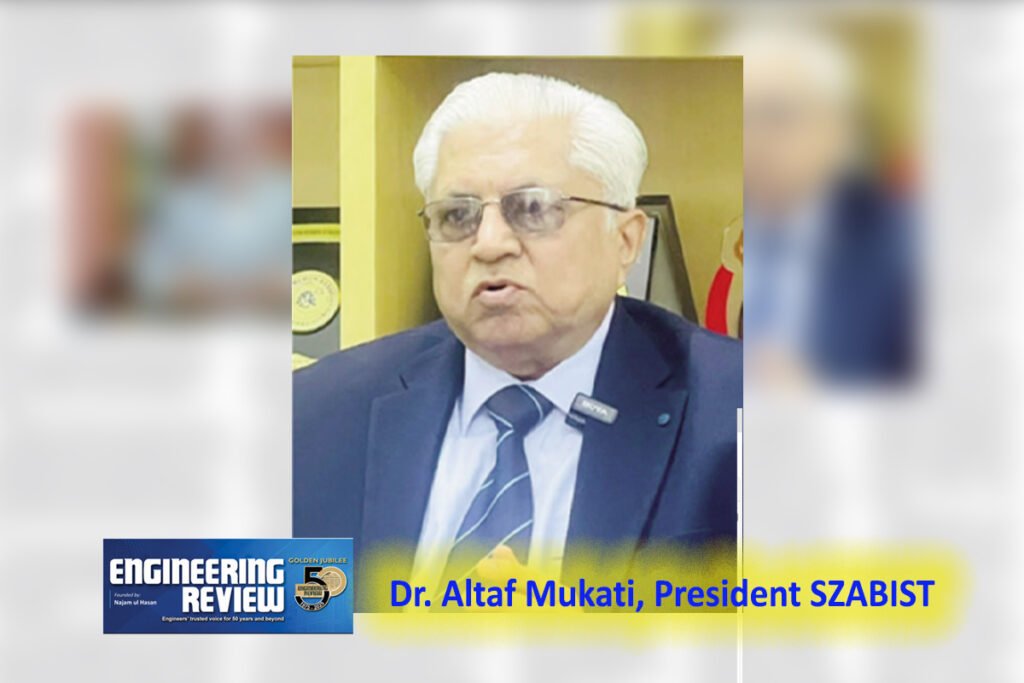
Prof. Dr. Altaf Mukati appointed SZABIST President
Prof. Dr. Muhammad Altaf Mukati has been appointed President of Shaheed Zulfikar Ali Bhutto Institute…

Sheikh Tariq Nazir elected CAP chairman unopposed
Sheikh Tariq Nazir has been elected unopposed as Chairman of the Constructors Association of Pakistan…