

The Ministry of Law and Justice has stated that the Committee constituted by the Prime Minister of the Islamic Republic of Pakistan to review the Right of Way provisions incorporated in the Pakistan Telecommunication Reorganization (Amendment) Bill, 2026, has submitted its interim report.
According to the Ministry, the Committee conducted a detailed review of the proposed amendments contained in the Bill as well as the existing legal framework relating to Right of Way.
The Committee held multiple meetings and, after extensive deliberations, concluded that the primary objective of the Bill is to enhance digital connectivity across the country while safeguarding the rights of citizens. However, the Committee observed that certain provisions require further clarification in their drafting to eliminate any ambiguity.
The Report states that, in matters relating to private property, the consent of the owner and mutual agreement shall remain fundamental requirements.
No action concerning access to or use of the land, building, property, or assets of any private individual or private legal entity shall be undertaken without the owner’s consent and a mutually agreed arrangement.
The Committee has recommended that the scope of the law be expressly clarified to apply to land, buildings, properties, and assets owned or administered by public bodies, the Federal Government, Provincial Governments, and Local Governments, as well as regulated private residential schemes, cooperative housing societies, and other entities of a similar nature.
The Committee has further recommended that the definitions of private land, private property, private persons, companies, cooperative societies, and other forms of joint ownership arrangements be expressly and clearly incorporated into the law so as to avoid any misunderstanding at any level.
According to the Report, a clear distinction shall be maintained between above-ground and underground telecommunications infrastructure, Right of Way, and related equipment, and separate procedures shall be prescribed for each category.
In the event of a dispute between a licensee and a public authority, residential scheme, cooperative housing society, or any other entity of a similar nature, the matter shall be referred to the Appropriate Government. The Appropriate Government shall decide the matter within forty-five (45) days in accordance with law.
The Committee has recommended that clear guiding principles be prescribed for the Appropriate Government to enable it to assess the necessity, appropriateness, public interest considerations, and payable compensation relating to any proposal.
The Committee has further recommended that any person aggrieved by the decision of the Appropriate Government shall have the right to seek recourse before the Telecommunication Appellate Tribunal established under Section 7A of the Pakistan Telecommunication (Reorganization) Act, 1996. The decision of the Tribunal in such matters shall be final.
The Report has recommended a reconsideration of the overriding clause to ensure consistency between the language and objectives of the law and to remove any ambiguity concerning the rights of citizens.
The Committee has also recommended a review of the amount of the penalty proposed under Section 27B(1) and its alignment with the overall objectives, structure, and provisions of the law.
According to the Ministry of Law and Justice, the Committee has reached consensus on the broad principles, policy objectives, and necessary amendments.
In light of the Committee’s recommendations, a draft of the proposed amendments to the Pakistan Telecommunication Reorganization (Amendment) Bill, 2026, will be finalized within one week and submitted for further consideration and directions.
The Ministry clarified that the Government is committed to the development of the telecommunications and information technology sectors; however, such development shall proceed with full protection of the constitutional and legal rights of citizens.
The Ministry of Law and Justice further stated that there shall be no compromise on the principles of protection of private property, owner consent, the right to object, legal safeguards, and compensation.
The objective of the Right of Way reforms is to provide the public with improved, reliable, and high-speed internet services, and not to adversely affect any citizen’s proprietary rights.-ERMD
READ MORE

Sindh Expands Mobile Healthcare Services Across 17 Districts
The Sindh government is working to improve the efficiency of its mobile health unit system…

Pakistan, World Bank Group Agree to Accelerate Reforms and Investment-Led Growth
Federal Minister for Economic Affairs Ahad Khan Cheema met World Bank Group (WBG) President Ajay…

ECNEC Approves 11 Development Projects in Energy, Infrastructure, Healthcare, Technology
The Executive Committee of the National Economic Council (ECNEC), chaired by Deputy Prime Minister and…

Pakistan, EU Explore Cooperation in Electric Vehicle Skills Development
Advisor to the Prime Minister for Industries and Production Haroon Akhtar Khan has directed the…

NUST Honours 66 PhD Scholars and 54 Medal-Winning Undergraduates at Convocation
Federal Minister for Planning, Development and Special Initiatives Ahsan Iqbal has urged graduates of the…
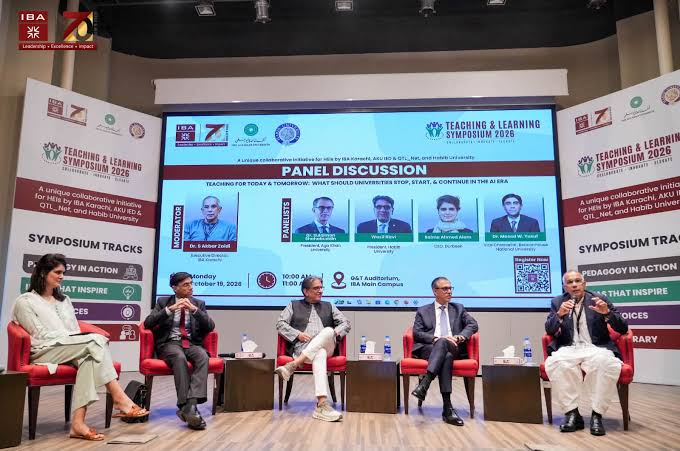
IBA, AKU and Habib University Join Hands to Rethink Education in the AI Era
The Institute of Business Administration (IBA) Karachi, in collaboration with Aga Khan University (AKU) and…