
WORLD
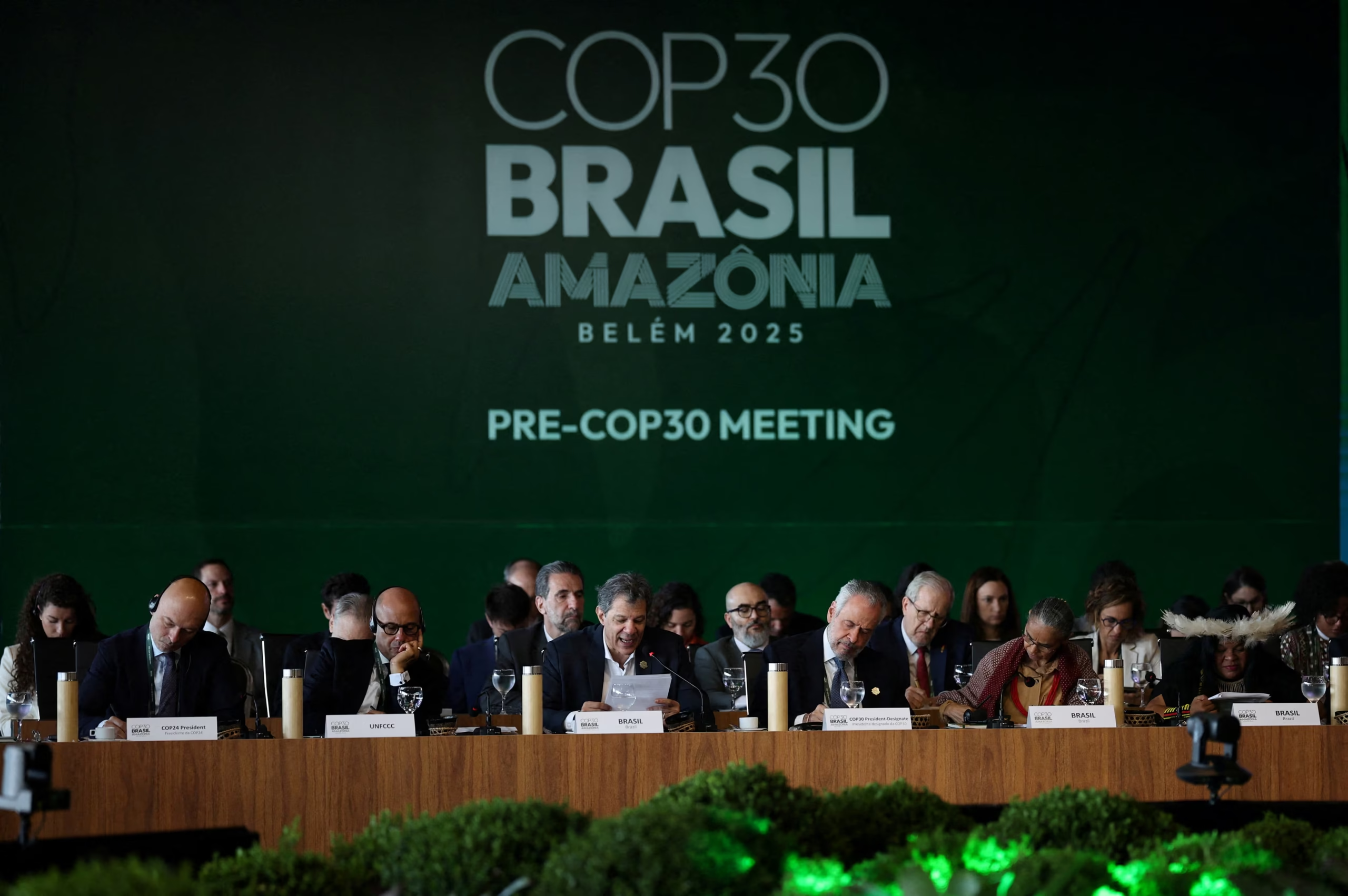
The 30th UN Climate Change Conference (COP30) opened Monday in Belem, Brazil, on the edge of the Amazon rainforest, against the backdrop of a recent climate tragedy and notably low global attendance.
The summit follows yet another climate disaster in southern Brazil, where a tornado struck the state of Parana on Friday, destroying the city of Rio Bonito do Iguaçu, killing six people, and injuring more than 700. The incident came just months after devastating floods overwhelmed the neighboring state of Rio Grande do Sul, underscoring the urgency of climate action as delegates gather.
Despite the high stakes, this year’s conference has seen a notably smaller turnout, with representatives from about 160 countries — down from 195 at COP29 in Azerbaijan. Prominent leaders from major economies, including the United States, China, and India, are absent. Only three Latin American heads of state — from Honduras, Colombia, and Chile — joined Brazilian President Luiz Inácio Lula da Silva at the opening session.
Still, around 50,000 participants, including diplomats, experts, and civil society members, are expected over the 11-day summit, which will focus on strategies to keep global warming within the 1.5°C target, update national emission reduction plans, and track delivery of climate finance commitments made at COP29.
Hosting the event in the Amazon rainforest gives Brazil a symbolic platform to emphasize deforestation, biodiversity protection, and climate justice — issues central to the global South.
South Asia Seeks Unity and Urgent Action
As the world’s attention turns to Belem, South Asia arrives at COP30 not as a spectator, but as a region already living the climate crisis.
The region has faced recurring cyclones, floods, droughts, and heat waves, pushing millions into poverty and displacement. Despite contributing less than 9% of global emissions, South Asia accounts for nearly one-third of global climate-related losses, according to the World Bank.
The World Meteorological Organization’s “State of the Climate in Asia 2024” report warned that the continent is warming nearly twice as fast as the global average, intensifying disasters that have already claimed tens of thousands of lives.
“South Asia is entering COP30 with glaciers retreating, deltas drowning, and heat extremes threatening 1.8 billion people,” said Zakir Hossain Khan, CEO of the Change Initiative think tank. “Our priorities are clear — fully grant-based adaptation and loss-and-damage funding, transparent and accessible finance windows for least-developed countries, and mechanisms like Debt-for-Nature and Climate Swaps to ease vulnerable economies out of debt.”
Khan emphasized that India, as a G20 economy, must expand renewable energy capacity and push technology transfer, while Bangladesh, Nepal, Bhutan, and the Maldives — among the region’s most vulnerable nations — need predictable, grant-based funding to survive worsening climate shocks.
Call for Regional Unity
Experts and observers say COP30 could be decisive for South Asia’s collective climate future.
“South Asian countries need to show up as a political bloc with a shared minimum agenda,” Khan said. “If South Asia negotiates as fragmented individual emitters, it will lose; if it negotiates as a single climate-vulnerable system, it has leverage.”
He cited shared ecosystems — the Ganges-Brahmaputra-Meghna basin, the Sundarbans, and the Himalayas — as natural opportunities for cooperative governance rather than geopolitical division.
Khan added that the region’s priorities extend beyond finance to technology access, energy transition, and ecosystem protection: “South Asia needs renewables, energy storage, grid modernization, and climate-smart agriculture — plus data-driven early-warning systems to protect deltas, rivers, mangroves, and forests as first lines of defense.”
He urged a mindset shift in policymaking: “South Asia must move from treating ecosystems as assets to exploit, to living systems with rights — where river health, delta protection, and groundwater security are constitutional priorities.”
High Stakes for a Vulnerable Region
At COP29, developed nations pledged to mobilize $300 billion annually by 2035, with a longer-term goal of $1.3 trillion for developing nations. Khan said the challenge now is to turn those promises into “real architecture” — transparent, accessible, and accountable finance structures.
Failure to deliver, he warned, could lock South Asia into a warming trajectory of 2.3°C or higher, leading to catastrophic consequences: collapsing infrastructure, food and water crises, and mass displacement.
A World Bank report estimates up to 40 million South Asians could be forced to migrate by 2050 due to climate-induced disasters.
“For South Asia,” Khan said, “climate ambition is not a diplomatic preference — it’s a survival requirement.” – ERMD/Inputs from Intl repots
MORE NEWS

Fauji Cement Approves 50 MWh Battery Energy Storage and 10 MW Solar Project
The Board of Directors of Fauji Cement Company Limited (FCCL) has approved the installation of…
First-Year QUEST Nawab Shah Student Found Dead; Students Allege Brutal Torture
The body of a first-year student of the Quaid-e-Awam University of Engineering, Science and Technology…

AI Voices May Increase Scam Risks for Some Dialect Speakers
The growing use of artificial intelligence (AI)-generated voices is raising concerns that increasingly realistic synthetic…

China Reassesses AI Risks as Cybersecurity Threats Grow
China is reassessing the risks posed by artificial intelligence as increasingly capable AI models demonstrate…
Pakistan Moves Towards Competitive Electricity Market with First Wheeling Auction
Pakistan has taken a major step towards shifting its power sector from the traditional single-buyer…

Sindh CM Orders Enrolment Drive to Fill New Schools
Sindh Chief Minister Syed Murad Ali Shah has directed the School Education Department, district administrations…