
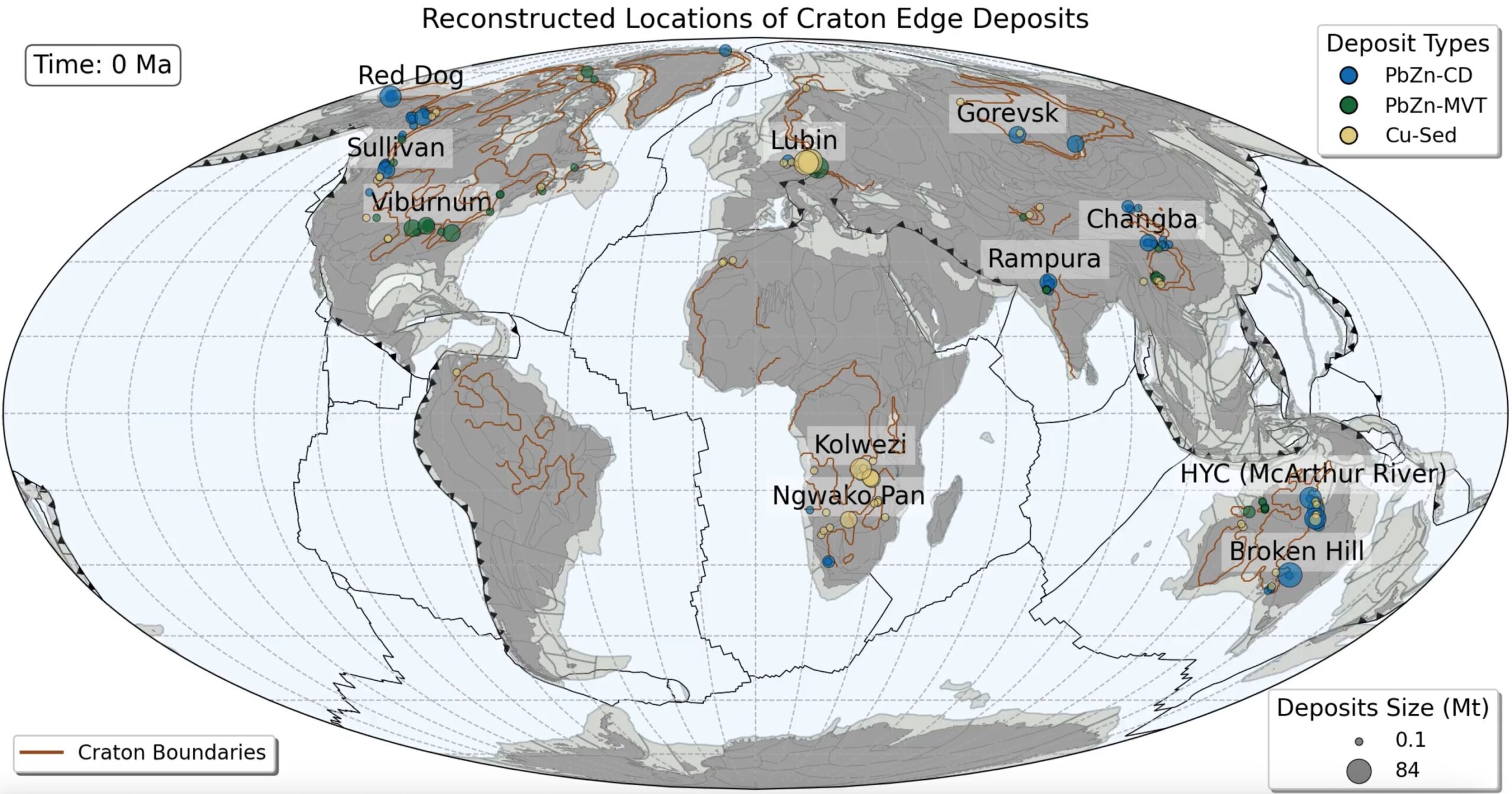
Ancient subduction zones played a crucial role in the formation of some of the world’s largest copper, zinc and lead deposits, according to a new study led by the University of Sydney.
Published in Nature Communications, the research offers a new framework for mineral exploration by explaining why some ancient continental margins are rich in mineral resources while others with similar geology are not.
The researchers reconstructed 1.8 billion years of plate tectonic activity and found that major sediment-hosted mineral deposits are typically located 800 to 1,800 kilometres from ancient subduction zones, with a median distance of about 1,200 kilometres.
Using geodynamic modelling, seismic data and a global database of more than 2,000 mineral deposits, the team concluded that deep mantle flow can transmit stress far into continents, weakening the edges of ancient landmasses and creating favourable conditions for mineral formation.
The findings could improve the accuracy of mineral exploration and strengthen long-term supplies of critical metals needed for infrastructure, manufacturing and clean energy technologies, the researchers said.-ERMD/TS
READ MORE

Sindh Expands Mobile Healthcare Services Across 17 Districts
The Sindh government is working to improve the efficiency of its mobile health unit system…

Pakistan, World Bank Group Agree to Accelerate Reforms and Investment-Led Growth
Federal Minister for Economic Affairs Ahad Khan Cheema met World Bank Group (WBG) President Ajay…

ECNEC Approves 11 Development Projects in Energy, Infrastructure, Healthcare, Technology
The Executive Committee of the National Economic Council (ECNEC), chaired by Deputy Prime Minister and…

Pakistan, EU Explore Cooperation in Electric Vehicle Skills Development
Advisor to the Prime Minister for Industries and Production Haroon Akhtar Khan has directed the…
NUST Honours 66 PhD Scholars and 54 Medal-Winning Undergraduates at Convocation
Federal Minister for Planning, Development and Special Initiatives Ahsan Iqbal has urged graduates of the…

IBA, AKU and Habib University Join Hands to Rethink Education in the AI Era
The Institute of Business Administration (IBA) Karachi, in collaboration with Aga Khan University (AKU) and…